Zero Padding: Why Those Extra Zeros Cost Your Neural Networks Too Much
For decades, we have added zero-valued pixels around the edges of images so convolutional layers don't "eat away" at the picture. It's called zero padding. But recent research suggests this "free lunch" has a price. The extra zeros distort the statistical distribution of data at the borders, forcing the network to spend resources processing emptiness. This isn't just a matter of tidiness. It affects accuracy and computational efficiency. In a world where every percentage point of performance counts, it is time to rethink our habitual data preparation methods and decide what should replace this convenient but harmful hack.
AI-processed from MarkTechPost; edited by Hamidun News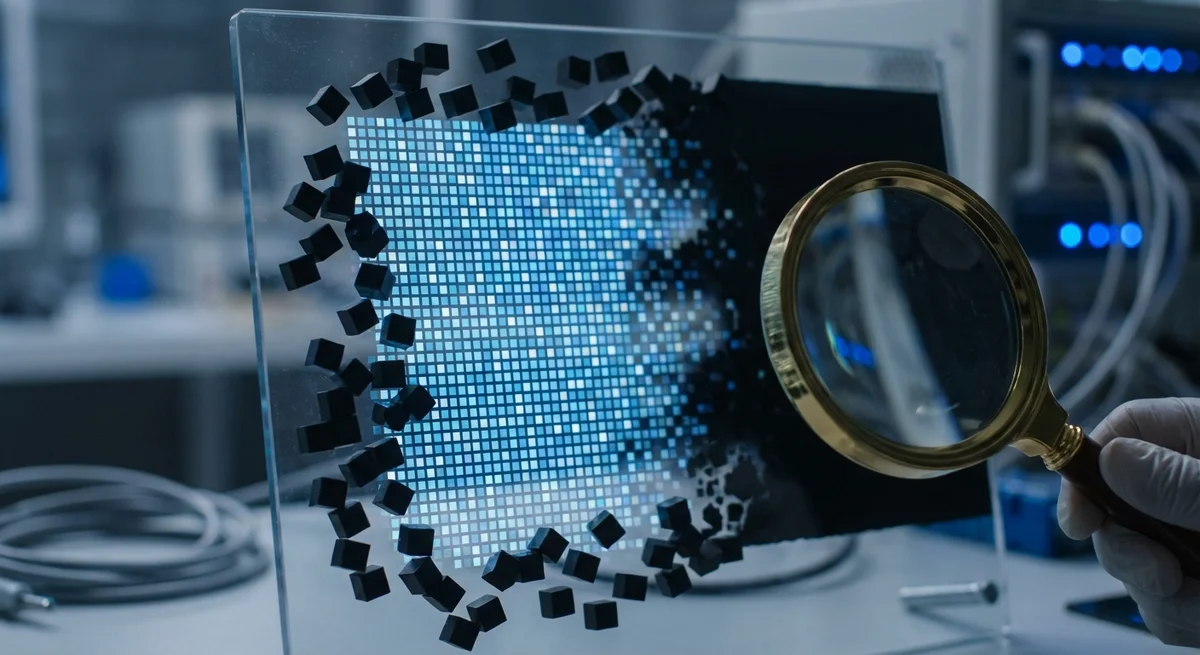
Imagine building a house and, every time you reach the edge of the lot, pouring concrete just for symmetry. In computer vision, we have been doing the same thing for about ten years. Convolutional neural networks (CNNs) love order, but their math makes the image shrink with every layer. To prevent that and avoid losing important details at the edges, we surround the image with a frame of zeros. This is zero padding: a technical hack that became an industry standard, and one that almost nobody thought about seriously until recently. We got used to treating those zeros as "transparent" to the model, but the math says otherwise.
The problem is that these zeros are not simply an absence of information. Statistically, they are a very strong signal that does not exist in reality. When a convolution kernel passes over the edge of an image, it mixes real pixel values with our artificial zeros. This instantly and radically distorts the mean and variance of activations at the borders of the frame. Instead of looking for meaningful patterns such as cats or road signs, the network has to adapt to a strange "black hole" that we created ourselves. This produces what is known as the edge effect, which confuses the model's weights.
Researchers have long suspected this affects accuracy, but the scale of the "statistical tax" has only become clear now. These edge effects spread deeper into the network like ripples from a thrown stone. In deep architectures, padding can distort features even at the center of the image, because errors at the borders accumulate from layer to layer. In effect, we force the model to spend its limited computational weights on ignoring or compensating for noise that we added to the system ourselves. This is not just inelegant; it is highly inefficient in terms of GPU resource use.
Why do we keep doing it if the harm is obvious? The answer is prosaic: it is cheap, fast and convenient. Implementing zero padding in code is an order of magnitude simpler than adopting more complex schemes such as reflection padding or cyclic repetition of pixels. Most popular frameworks, such as PyTorch or TensorFlow, offer zero filling by default, and developers rarely dig into the settings to change it. Yet in tasks where maximum accuracy matters, such as medical diagnosis from MRI scans or control systems for self-driving vehicles, ignoring this factor is becoming increasingly risky.
The industry is now searching for adequate alternatives to this "zero tax." Some research groups propose adaptive methods in which padding values are computed dynamically from the content of the image itself. Others are looking at architectures that are inherently robust to changes in feature size and do not need artificial frames. It is important to understand that in an era when we fight for every teraflop and every percentage point of accuracy, such architectural "details" stop being details. This is a fundamental bug in the foundation of computer vision, one we have for too long considered a useful feature.
The future of deep learning will most likely push us to abandon simple solutions in favor of more statistically correct methods. We already see modern models starting to account for context in places where we used to simply stuff the void with zeros. The only question is how fast library developers will make these advanced methods the standard, so that we no longer have to pay for zeros with our accuracy.
Bottom line: Zero padding is a convenient lie, and we pay for it with a hidden drop in model quality. Will new architectures be able to get rid of "zero frames" completely within the next couple of years?
Test Frontier LLMs & Autonomous Agents in One Workspace
Run Claude Opus 5.5, GPT-6, Gemini 3.1, and DeepSeek side-by-side in Nomad AI (nomadnet.ai) — unified model routing, deep research, and multimodal workflows under one subscription.
The AI world, distilled — once a week
Seven stories that actually mattered, hand-picked. No noise, no reposts, no press releases.
Done! Check your inbox for a confirmation.