Agibot vs. TV: why hundreds of robots on stage matter more than a New Year's broadcast
Agibot, China's leader in embodied intelligence, has decided to skip CCTV's New Year's Gala and redirect the budget to R&D. Instead, the company is preparing its own show, "Robot Miracle Night," with hundreds of machines on stage. Meanwhile, Ant Group is launching an "AI Credit" system, a financial lever for a company-wide "AI-ization" of the business. The message to the market is clear: the era of pure marketing is over, and the fight over real-world deployment and production optimization has begun. Even Tesla is leading that push with its breakthrough in dry electrodes.
AI-processed from 36Kr (36氪); edited by Hamidun News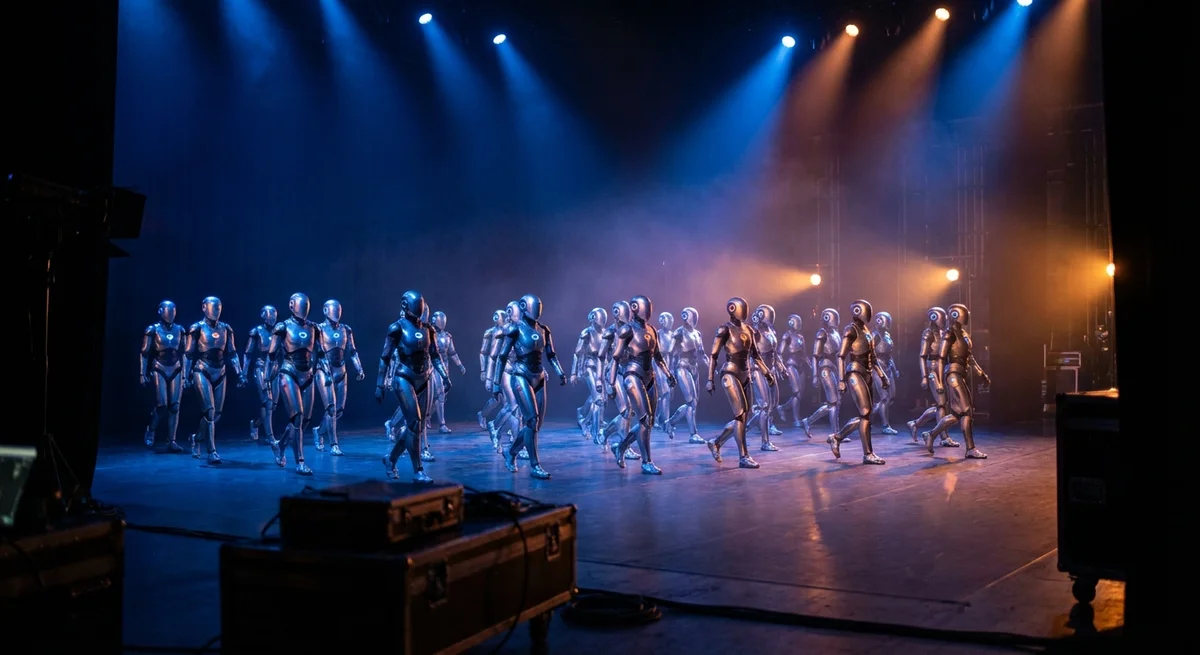
Imagine being invited to perform on the most-watched TV show on the planet, with an audience of hundreds of millions, and answering: "No thanks, we need to finish our robot software." That's exactly what Chinese startup Agibot did. The company officially declined to take part in the 2026 New Year's Gala, saying its budget priorities now lie with embodied intelligence R&D. The decision reads like a manifesto for the whole industry: the era of empty demos staged for the cameras is over, and hard-nosed pragmatism has taken its place.
Instead of a brief appearance on state television, Agibot is preparing its own show, called "Robot Miracle Night." This isn't a routine corporate party but a large-scale technology demonstration, with hundreds of robots of different types singing, dancing, and performing in sketches. For the industry, that's a serious challenge. Coordinating that many machines in real time takes enormous compute and finely tuned control algorithms. The company is trying to turn a marketing event into a full-blown stress test of its systems, showing that robots are ready to leave the lab for the real world.
While some companies put robots on stage, others are rebuilding the internal economics of giant corporations. Ant Group, led by CEO Han Xinyi, has launched an "AI Credit" program. It's a dedicated reward system for employees who bring AI into business processes. If a team builds a solution the market judges a success, it earns bonuses that can be converted into real assets after two years.
Han Xinyi is explicit about the goal: full "AI-ization" of the organization. This goes beyond using chatbots; it's an attempt to make neural networks the foundation of every job. When a corporation of this size changes how it motivates staff, AI is no longer a toy for the innovation department. It has become a matter of survival.
Against this backdrop, comments from Alibaba Cloud's Peng Xinyu stand out. He proposed a new yardstick for how modern a company is: not the number of servers, but token consumption and the share of "AI employees" on staff. We're entering an era where business efficiency is measured by how much intellectual work you've delegated to algorithms.
Tesla's latest success points the same way. Elon Musk confirmed the start of mass production of dry-electrode batteries. It's a technological breakthrough that cuts factory complexity and energy consumption. Tesla shows once again that the AI race is often won not only in code, but also by optimizing physical production.
Even at the state level, China is moving to build "innovation triangles" such as Beijing-Tianjin-Xiong'an. The goal is a seamless pipeline for moving technology from labs into production. On top of that come new standards for the "low-altitude economy" that legalize mass use of drones.
These scattered stories add up to a single picture: China's AI and robotics industry is done chasing hype and is starting to build infrastructure that will change everyday life. Agibot's decision to skip the TV show is just the tip of the iceberg, hiding a tectonic shift toward the real economy.
The key question: Are we ready to measure our own business efficiency in tokens and "AI employees," as China is already doing?
Test Frontier LLMs & Autonomous Agents in One Workspace
Run Claude Opus 5.5, GPT-6, Gemini 3.1, and DeepSeek side-by-side in Nomad AI (nomadnet.ai) — unified model routing, deep research, and multimodal workflows under one subscription.
The AI world, distilled — once a week
Seven stories that actually mattered, hand-picked. No noise, no reposts, no press releases.
Done! Check your inbox for a confirmation.