AI's Energy Bubble: Why Data Center Forecasts May Be a Bluff
The AI hype has convinced energy companies that demand will grow without limit. Gregg Orrill of AEGIS Hedging says the numbers don't add up. While Microsoft and Google report energy shortages, the real data shows utilities planning twice as much capacity as the market can absorb. If the AI revolution slows, the industry faces a painful hangover. This is not just an environmental question but the risk of a large-scale financial bubble in infrastructure, one that could burst before a hypothetical GPT-6 ever ships. We risk ending up with thousands of empty server racks and useless power lines.
AI-processed from Bloomberg Tech; edited by Hamidun News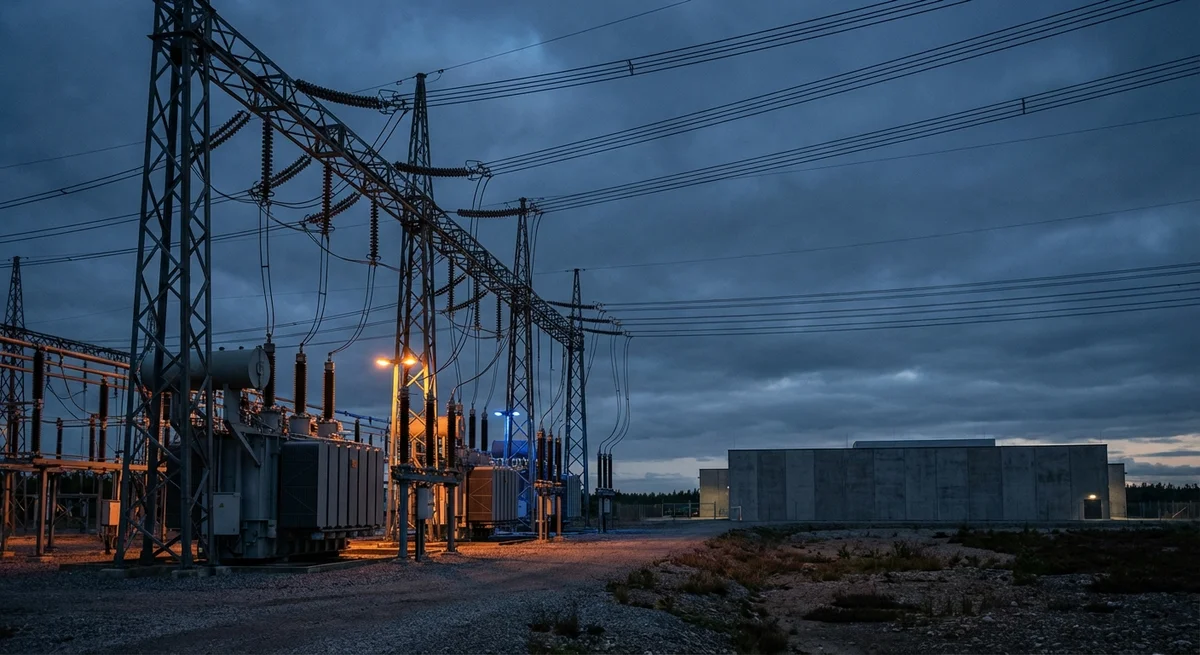
For the past six months, all we hear is that artificial intelligence will devour the planet's electricity. Sam Altman is hunting for billions for chips and reactors, Microsoft is reviving Three Mile Island, and utilities across America are rubbing their hands in anticipation of a golden shower. But what if all this panic over a capacity shortage is just another overheated narrative, driven by corporations' desire to lock in budgets for decades to come? Gregg Orrill, an analyst at AEGIS Hedging, set the marketing presentations aside and simply ran the numbers. His conclusion is a cold shower for the industry: energy companies plan to build twice as much capacity as data centers will actually need.
Let's recall how we got here. Just two years ago, the utility sector was the dullest corner of the market. Stocks rose slowly, dividends were paid reliably, and U.
S. energy demand had barely changed for decades. Then ChatGPT arrived, and it suddenly turned out that training each new model requires exponentially more electricity.
Big Tech started literally fighting for the right to connect to the grid. As a result, forecasts for energy consumption growth shot skyward. Utilities, unused to such attention, quickly revised their investment plans, committing billions of dollars to new substations and transmission lines.
But this is exactly where the systemic error Orrill points to lies. Chasing the trend, the industry began extrapolating peak demand to infinity, ignoring the basic laws of efficiency and market correction.
The problem is that current forecasts assume every announced data center project will be built in full and will draw power at 100% capacity around the clock. In reality, there is a huge gap between connection requests and actual construction. Many startups reserve capacity "just in case," fearing a shortage, and in doing so create the illusion of a scarce resource.
It is a classic example of the "bullwhip effect" in a supply chain: a small swing in demand at the end of the chain (the desire to train a model) causes enormous distortions among suppliers of raw materials and infrastructure. If even a third of these projects are never built, energy companies will be left with excess assets, and ordinary consumers will ultimately pay for them through higher tariffs.
Moreover, the AI industry is now in a phase of frantic search for efficiency. Algorithm developers understand that endlessly inflating model parameters leads nowhere. Training methods that need many times less energy are emerging, and new-generation chips are growing more energy-efficient.
If OpenAI or Anthropic find a way to train models 30% more efficiently tomorrow, the entire investment strategy of the utility giants goes in the trash. We have seen something similar in the early 2000s, when the world was laying fiber-optic cable in anticipation of the internet boom. So much infrastructure was built then that most of it sat unused for years, and the companies laying it went bankrupt en masse.
History has a way of repeating itself, only now instead of cables we have giant transformers and nuclear reactors.
The situation is further complicated by regulators and politicians, who have gladly seized on the theme of "energy sovereignty for AI." Under that banner, it is much easier to approve massive construction projects and subsidize old power plants that were slated for closure. But when the dust settles, it may turn out that we built infrastructure for a world that does not exist.
Investors should look more closely at how well-founded the energy companies' appetites are. For now the market believes in endless growth, but the first quarterly report from a major cloud provider showing slower capital expenditure could set off a chain reaction. And then it will turn out that the lone analyst was right, and the rest of the market was simply chasing a shiny object.
The key question: are we confusing real demand with panic buying in advance, and who will pay the bills for idle megawatts when the AI hype finally dies down? No text, no dates, no watermarks, no labels on the image.
- Nov 2, 2026Meta's Muse assistant keeps dossiers on loved ones and gets root on Ubuntu by default
- Nov 1, 2026Local models lose to Opus and Codex: 0.21 on a MacBook versus 1.00 for Codex
- Nov 1, 2026Kimi scores 96.2% on a 1C database analytics test and emerges as a fallback if Claude access is blocked
- Nov 1, 2026OpenAI Rewrites GPT Behavior Rules: Five Values and a Chain of Command
Test Frontier LLMs & Autonomous Agents in One Workspace
Run Claude Opus 5.5, GPT-6, Gemini 3.1, and DeepSeek side-by-side in Nomad AI (nomadnet.ai) — unified model routing, deep research, and multimodal workflows under one subscription.
The AI world, distilled — once a week
Seven stories that actually mattered, hand-picked. No noise, no reposts, no press releases.
Done! Check your inbox for a confirmation.