Senators Warren and Hawley demand disclosure of US data center energy use
Pressure on the US data center market is growing: Elizabeth Warren and Josh Hawley want the EIA to make annual energy-use reporting mandatory. The senators are interested not only in megawatts, but also in electricity rates, peak loads, grid upgrade costs, and the difference between AI servers and standard cloud workloads. The reason is simple: the AI boom is increasingly affecting electricity bills and power system development plans.
AI-processed from Wired; edited by Hamidun News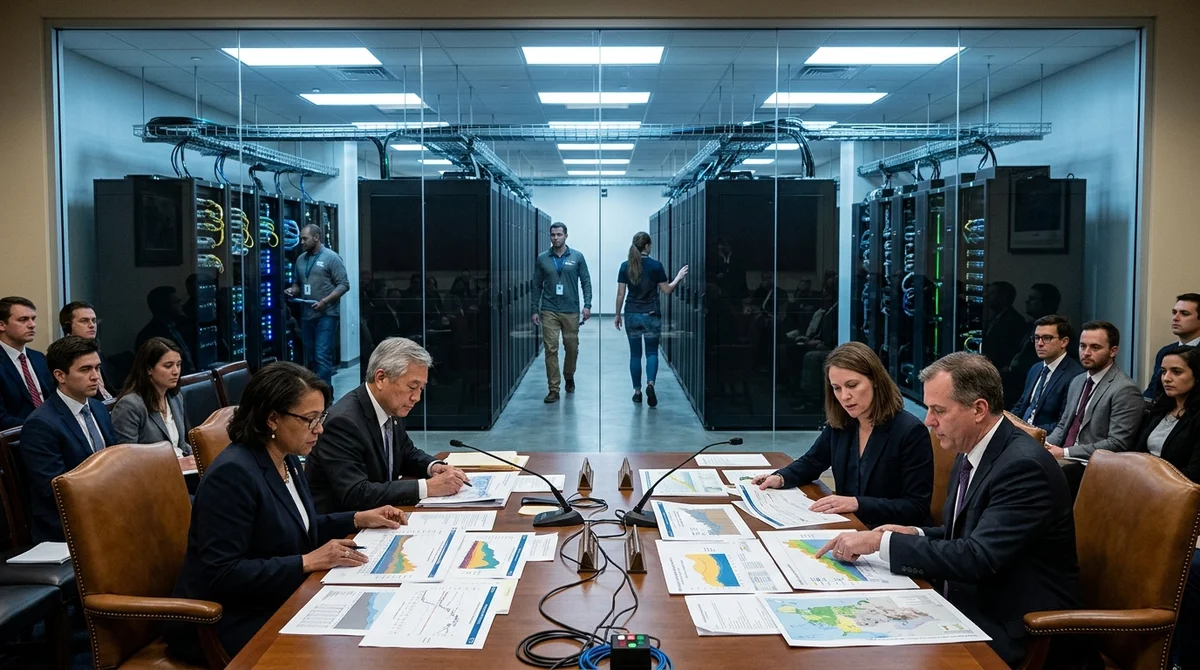
A federal-level dispute over AI infrastructure energy consumption has emerged in the United States. Senators Elizabeth Warren and Josh Hawley have demanded that the U.S. Energy Information Administration require data centers to annually disclose how much electricity they consume and who pays for the associated network infrastructure costs.
What the Senators Are Demanding
On March 26, 2026, Warren and Hawley sent a joint letter to the EIA. They ask the agency to introduce public and mandatory reporting not only for data centers, but also for other major energy consumers. The logic is straightforward: without precise figures, authorities, regulators, and utility companies cannot understand how quickly the network load is growing, who should pay for new lines and substations, and whether major tech companies are actually keeping their promises not to shift costs to ordinary consumers.
The issue became more acute after March 4, when seven tech companies signed a voluntary commitment at the White House to provide new power capacity themselves and not pass the costs to households.
The senators specifically emphasize that the EIA already collects mandatory data from other energy-intensive industries — from oil and gas to manufacturing — which means the agency has both the tools and legal grounds to act the same way regarding data centers. They cite a 1974 law that allows them to demand data from facilities with large energy consumption. The key point for them is to make this information public, rather than leaving it within the agency or with energy companies.
Why the Issue Has Become More Acute
The reason is that the data center market, especially under AI loads, is growing faster than public statistics reflect. According to the International Energy Agency's estimate, data centers will account for about half of the increase in electricity demand in the United States in 2025–2030. And the EIA forecast in January the strongest four-year growth in electricity consumption since 2000 — largely due to major computing facilities.
For the power system, this is no longer a niche story about clouds and GPUs, but a factor that affects rates, infrastructure construction, and grid reliability. In practice, consumption data is often hidden. Contracts between data centers and energy companies are frequently confidential, and local authorities and landowners are sometimes asked to sign NDAs.
An additional problem is on-site power generation outside the main grid, known as behind-the-meter power. If a company builds a separate energy source next to a facility, understanding its full energy footprint becomes even harder. Moreover, energy companies themselves rely on demand forecasts from data center operators, and experts have long warned of the risk of "phantom growth," where capacity is built for future projects that ultimately never materialize.
What Metrics Are Needed
In their letter, the senators did not limit themselves to demanding "show us the total megawatts." They listed the data without which one cannot understand how exactly data centers affect the electricity market and who actually pays for infrastructure expansion. This is not only about annual consumption, but also about load profile, rates, consumption flexibility, and the difference between AI clusters and regular cloud services. In essence, they want to see the economics of the load, not just the final figure in an annual report.
- Hourly, annual, and peak consumption
- Rates and charges for purchased electricity
- Advance payments and security deposits
- Participation in demand response and other ways to flexibly reduce load
- Costs for grid modernization and distribution of these expenses among customers
A separate point is a comparison of energy consumption of AI servers with traditional cloud workloads. This is an important detail: the dispute around data centers in 2026 is no longer simply about "server farms," but about how much generative AI is changing the profile of electricity consumption.
The day before the letter, on March 25, the EIA launched a voluntary pilot survey of 196 companies in Texas, Washington State, and the Northern Virginia/Washington region. The senators welcomed this step, but directly asked whether the next stage would be mandatory, annual, and whether it would cover facilities with on-site power generation.
"Without this data, policymakers, utility companies, and local
communities are operating blind."
What This Means
The story is quickly moving away from the realm of environmental discussions into the realm of regulating AI infrastructure as foundational economics. If U.S. authorities force the market to disclose the energy profile of data centers, the next step could be new rules on rates, grid connection, and on-site power generation. For major tech companies, this is a risk of greater transparency, and for regions, a chance to understand who is actually paying for the AI boom.
Need AI working inside your business — not just in your newsfeed?
I build production AI for companies — custom CRM, internal tools, autonomous agents, workflow automation. Owned by you, shaped to your process, no per-seat tax. Built by Zhemal Khamidun, CPO of AlpinaGPT (AI platform, 6,000+ users).
The AI world, distilled — once a week
Seven stories that actually mattered, hand-picked. No noise, no reposts, no press releases.
Done! Check your inbox for a confirmation.