Your Own Neural Network Server: Stop Torturing Laptops and Listening to Coaches
Remember the feeling when you first ran Llama on your laptop? At first — delight that it's alive, and five minutes later — mute irritation because the model outputs two words per second, and your computer's fans are trying to flee into the stratosphere. The internet today is flooded with guides from self-proclaimed experts promising full-fledged artificial intelligence on five-year-old hardware. Let's be honest: this is self-deception. Serious work with local language models requires a serious approach to infrastructure. If you want a neural network to actually help with coding or document analysis, not just entertain you with crooked jokes, it's time to build your own server. Why build your own hardware when you have APIs from OpenAI or Anthropic at hand? The answer lies in two words: privacy and control.
AI-processed from Habr AI; edited by Hamidun News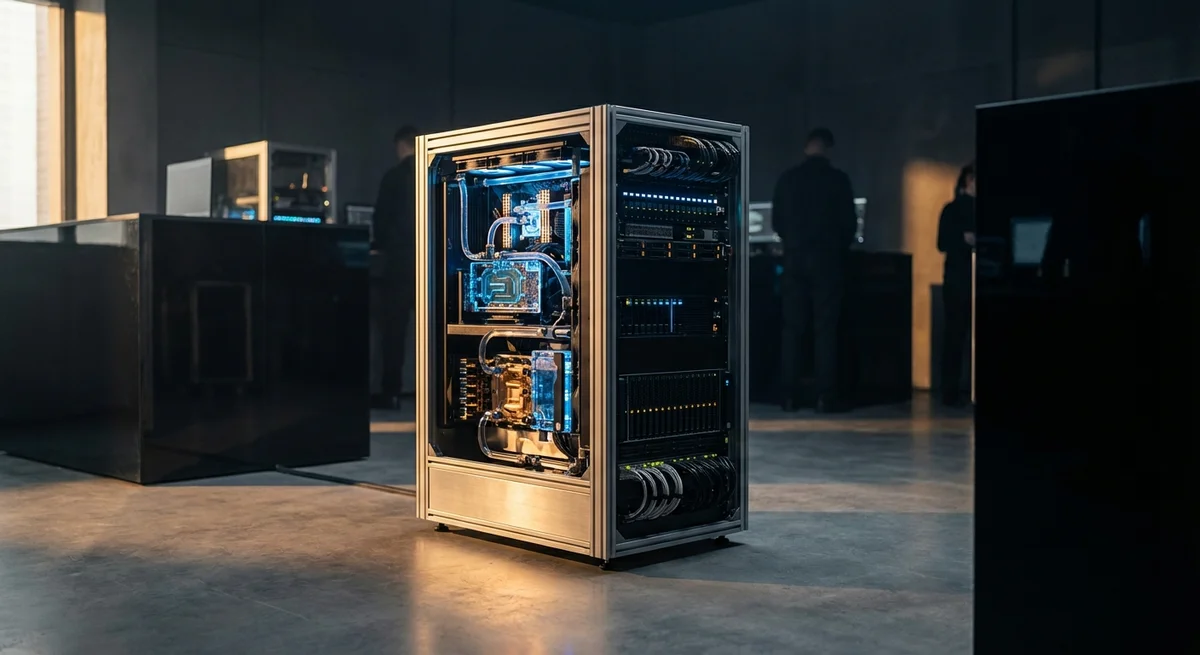
Remember the feeling when you first ran Llama on your laptop? At first — delight that it's alive, and five minutes later — mute irritation because the model outputs two words per second, and your computer's fans are trying to flee into the stratosphere. The internet today is flooded with guides from self-proclaimed experts promising full-fledged artificial intelligence on five-year-old hardware. Let's be honest: this is self-deception. Serious work with local language models requires a serious approach to infrastructure. If you want a neural network to actually help with coding or document analysis, not just entertain you with crooked jokes, it's time to build your own server.
Why build your own hardware when you have APIs from OpenAI or Anthropic at hand? The answer lies in two words: privacy and control. In a world where corporations change the rules on the fly, introduce strict censorship, and can block your account without explanation, having your own digital brain becomes a matter of security. You don't share your trade secrets with servers in California and don't depend on whether Sam Altman decides to triple prices tomorrow. Besides, with intensive use, cloud bills start looking like phone numbers, and buying your own GPUs pays for itself faster than it seems at first glance.
The main problem when assembling such a server is video memory. It's precisely this, not processor frequency, that determines what model you can run and how smart it will be. If for tiny models with 7 billion parameters a mid-range gaming GPU will suffice, then for something truly powerful, like Mixtral or large versions of Llama 3, you need tens and hundreds of gigabytes of VRAM.
Here we enter a zone of complex compromises. You either spend a fortune on professional cards like NVIDIA A100 or H100, or you learn the art of quantization. Quantization allows you to compress model weights with almost no loss of quality, and this is a critically important tuning stage that separates amateurs from professionals.
But memory is only half the problem. The second issue, often forgotten by newcomers, is bandwidth. You can buy lots of cheap memory, but if the data bus is narrow, your model will think painfully slowly. That's why server solutions based on high-bandwidth architectures are worth their money. We're transitioning from the era of ordinary AI users to the era of local systems operators. The ability to deploy, optimize, and maintain your own capabilities today is valued much higher than simply knowing how to write prompts in a chatbot.
The software part of the process is no less fascinating than choosing hardware. Simply running a model from the console is only the beginning. To turn a server into a useful tool, you need to set up an inference environment using modern tools like vLLM or Ollama. You need to learn to manage request queues, configure context windows, and integrate the model into your habitual workflows. This turns a pile of expensive hardware into a well-tuned mechanism that works for you 24 hours a day without weekends or holidays.
Ultimately, your own server is about the freedom to experiment. When you have a powerful machine at hand, you start testing hypotheses that before you simply couldn't afford to spend paid tokens on. You can fine-tune models on your specific data, create autonomous agents, and not fear that tomorrow your access to technology will be limited due to another privacy policy change. This is the entrance ticket to the major league of technological independence, where you set the rules of the game and control every byte of information.
The bottom line: a local server is the only way to get truly private and performant AI without looking over your shoulder at corporations. Are you ready to invest in your digital independence or will you continue to rent brains from Silicon Valley giants?
Want to stop reading about AI and start using it?
AI News is a curated feed of AI/tech news. Hamidun Academy teaches you to use AI systematically in your work.
The AI world, distilled — once a week
Seven stories that actually mattered, hand-picked. No noise, no reposts, no press releases.
Done! Check your inbox for a confirmation.