Nvidia and OpenAI: Jensen Huang Is Preparing the Biggest Check in Company History
Nvidia is officially taking a stake in OpenAI. In Taipei, Jensen Huang called the investment "probably the largest in the company's history." After earning trillions selling the "shovels" of the AI gold rush, Nvidia has decided to grab the mine itself. It is a strategic maneuver. OpenAI is the main consumer of H100 and Blackwell chips, and it is vital for Nvidia that Sam Altman keeps building his models on its architecture. While rivals such as AMD try to catch up on hardware, Nvidia is simply buying the loyalty of the market's biggest player, cementing the dominance of its CUDA ecosystem.
AI-processed from Bloomberg Tech; edited by Hamidun News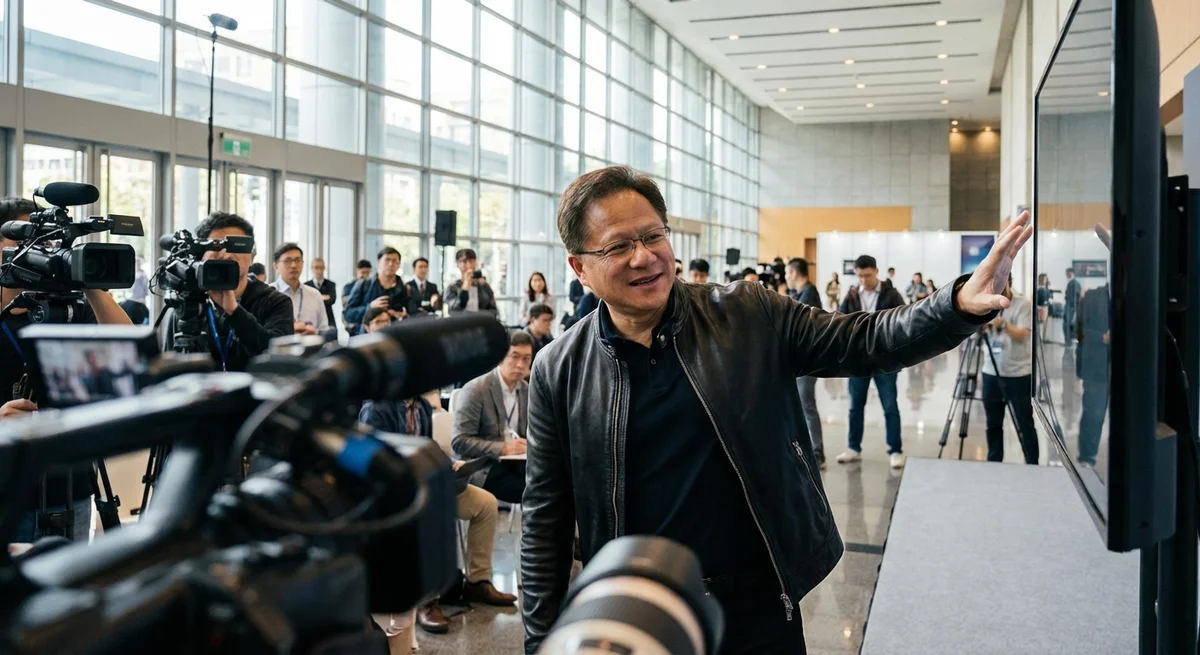
In tech, it is rare for a circle to close this neatly. Standing in front of reporters in Taipei, Jensen Huang said something that made the market flinch: Nvidia's investment in OpenAI will most likely be the largest in the company's history. The statement sounds especially ironic given that it was OpenAI, buying Nvidia's chips by the tens of thousands, that helped make Nvidia the most valuable corporation in the world. Now the "king of GPUs" is returning part of that money to its main customer, to make sure the customer keeps playing by its rules. The context of the deal runs much deeper than a simple wish to profit from the rise of Sam Altman's shares.
The relationship between the two giants began back in 2016, when Jensen personally delivered the first DGX-1 supercomputer to the office of OpenAI, then still a nonprofit. Since then, Nvidia has gone from making gaming cards to being the de facto monopolist of AI infrastructure. Today, however, the situation is changing.
OpenAI is no longer just a startup; it is a huge machine that consumes computing power on a scale comparable to small countries. More importantly, OpenAI has started thinking about developing its own chips to reduce its dependence on Nvidia. Huang's investment is a direct response to those ambitions, an attempt to make Nvidia not merely a supplier but an integral part of the DNA of the future creator of AGI.
Why would Nvidia spend billions on a company that is already queuing up for its products? The answer lies in the ecosystem. Huang's main weapon is not transistors but the CUDA software platform, on which almost all modern neural networks are written.
If OpenAI suddenly decides to move to another manufacturer's architecture, or builds something of its own, Nvidia's monopoly will collapse. As the largest investor, Nvidia gets a voice and access to OpenAI's internal development plans. That lets it synchronize the release of new generations of Blackwell and Rubin chips with the needs of the most advanced models, such as GPT-5 or the future Orion.
In effect, Huang is buying insurance against his main customer one day looking toward competitors.
The competitive landscape also matters. Microsoft has already put more than 13 billion dollars into OpenAI; Apple held talks but ultimately walked away from the deal. Nvidia is jumping onto this departing train at the very peak of the valuation of a company now approaching 150 billion dollars. For Huang this is not a risk but a logical continuation of a vertical integration strategy. If you control both the hardware on which models are trained and the company that creates those models, you control the whole industry. It is a chess game in which Nvidia checkmates rivals AMD and Intel before they have even set their pieces on the board.
In the long run, this alliance may reshape the entire silicon industry. We are watching the formation of a closed club of superpowers, where capital and computing power are so tightly intertwined that entry for new players will be practically closed. Jensen Huang understands perfectly well that the era of simply selling hardware is coming to an end. The future belongs to those who own the intelligence that the hardware gives rise to. And if that requires writing the biggest check in history, he will do it without hesitation, keeping his trademark smile and his unchanging leather jacket.
The bottom line: Nvidia is ceasing to be merely the arms dealer in the AI war and is officially joining the ranks of the army. Will OpenAI be able to keep its independence with its main supplier and its main cloud provider as shareholders at the same time?
- Nov 2, 2026Meta's Muse assistant keeps dossiers on loved ones and gets root on Ubuntu by default
- Nov 1, 2026Local models lose to Opus and Codex: 0.21 on a MacBook versus 1.00 for Codex
- Nov 1, 2026Kimi scores 96.2% on a 1C database analytics test and emerges as a fallback if Claude access is blocked
- Nov 1, 2026OpenAI Rewrites GPT Behavior Rules: Five Values and a Chain of Command
Test Frontier LLMs & Autonomous Agents in One Workspace
Run Claude Opus 5.5, GPT-6, Gemini 3.1, and DeepSeek side-by-side in Nomad AI (nomadnet.ai) — unified model routing, deep research, and multimodal workflows under one subscription.
The AI world, distilled — once a week
Seven stories that actually mattered, hand-picked. No noise, no reposts, no press releases.
Done! Check your inbox for a confirmation.