Kingsemi raises nearly 1 billion yuan to keep Chinese chips from failing
China's Kingsemi is scaling up, raising 970 million yuan to expand capacity. While the industry chases nanometers, the company is focusing on the back end: integrated circuit testing and advanced packaging. Its plans include laser wafer dicing and developing heterogeneous stacking technology. The money targets critical gaps in China's supply chain, not merely new equipment. Without high-quality testing and packaging, even the most powerful processor stays a lump of silicon. Kingsemi is betting that demand for local manufacturing in China will keep growing regardless of sanctions.
AI-processed from 36Kr (36氪); edited by Hamidun News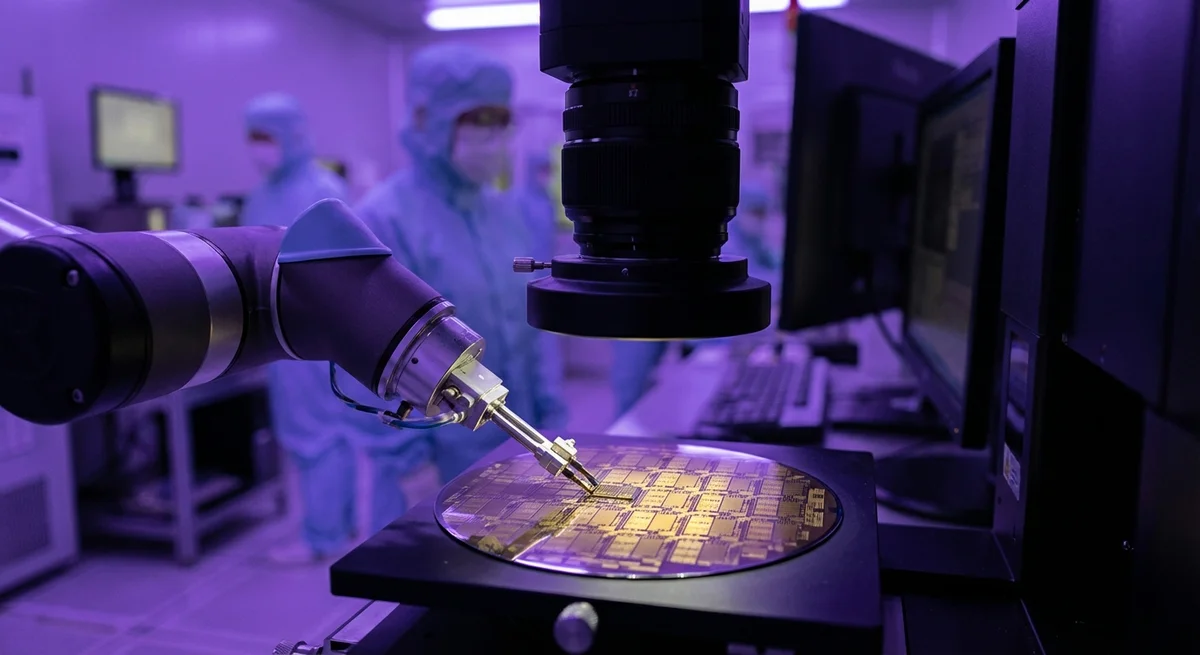
While the general public watches how many teraflops the latest Nvidia release will deliver, industry professionals are looking at something else entirely. The semiconductor world has an "unsexy" side: testing and packaging. These are the stages that determine whether an expensive silicon wafer becomes the brain of a supercomputer or high-tech scrap.
China's Kingsemi has decided that this is where the most promising money lies right now, and it has announced plans to raise 970 million yuan through a private share placement. Why does it need that much? The answer lies in Beijing's ambition to achieve full technological independence.
Most of the funds will go to an integrated circuit testing project in Dongcheng and to the first phase of a laser stealth dicing project for wafers. If you thought chips are simply cut apart with a jigsaw, I hate to disappoint you: it is an extremely complex process in which the slightest error wipes out thousands of dollars in profit. The most interesting part, though, is the R&D into advanced heterogeneous stacking processes.
With Moore's law starting to stumble, packaging multiple dies into a single package (chiplets) is becoming the only way to keep scaling compute for AI workloads. The context matters more than the numbers. China is under enormous pressure from Western sanctions that restrict access to advanced lithography equipment.
In that situation the logic is simple: if we cannot keep making transistors infinitely smaller, we have to learn to package the ones we have as efficiently as possible and test them so rigorously that die yield approaches the ideal. Kingsemi is effectively taking on the role of one of the chief quality controllers for China's entire chip industry. How the company is allocating its resources is also telling.
Part of the proceeds will replenish working capital and pay down bank loans. It's a classic move: clean up the balance sheet so the company can respond quickly to market shifts. In a trade war, flexibility matters more than simply having full warehouses.
Kingsemi understands that dozens of chip fabs are being built in China right now, and all of them will need testing and product finalization services. What does this mean for the market? The Chinese semiconductor ecosystem is ceasing to be a collection of scattered startups and turning into a monolithic structure.
Companies like Kingsemi are building infrastructure that will let local GPU and CPU developers operate with more confidence. If the Dongcheng project is completed on schedule, it could significantly reduce local customers' dependence on foreign testing hubs in Taiwan or Southeast Asia. The bottom line: Kingsemi is betting on the "rear-echelon logistics" of technological sovereignty.
Packaging and testing are the new front in the battle for AI supremacy. Can China make up for its lag in lithography through brilliant packaging engineering?
- Nov 2, 2026NVIDIA releases Nemotron 3.5 Bolt E4B: 4 GB and 133 tokens per second on an RTX 5070
- Nov 2, 2026Cosmos generated training video for drones: detector mAP@50–95 up 10.3%
- Nov 2, 2026Anthropic needs to grow revenue 32% a year to cover $850 billion in contracts
- Nov 2, 2026TensorFold 1.2.0 boosts Qwen3.8-27B throughput on M3 Ultra by 44.2% at 16 streams
Test Frontier LLMs & Autonomous Agents in One Workspace
Run Claude Opus 5.5, GPT-6, Gemini 3.1, and DeepSeek side-by-side in Nomad AI (nomadnet.ai) — unified model routing, deep research, and multimodal workflows under one subscription.
The AI world, distilled — once a week
Seven stories that actually mattered, hand-picked. No noise, no reposts, no press releases.
Done! Check your inbox for a confirmation.