Project Genie: Google Hands Out Keys to Endless Game Worlds
Google has launched Project Genie, an experimental tool for creating interactive worlds. AI Ultra subscribers in the US get access first. Unlike ordinary video generators, Genie builds an environment you can control: jump, run and interact with objects. It is a "world model" that grasps physics and spatial logic without being explicitly programmed for them. For now it is a prototype, but it shows clearly where game development and virtual simulation are heading: a text description, rather than a staff of programmers, may be enough to make a game.
AI-processed from DeepMind Blog; edited by Hamidun News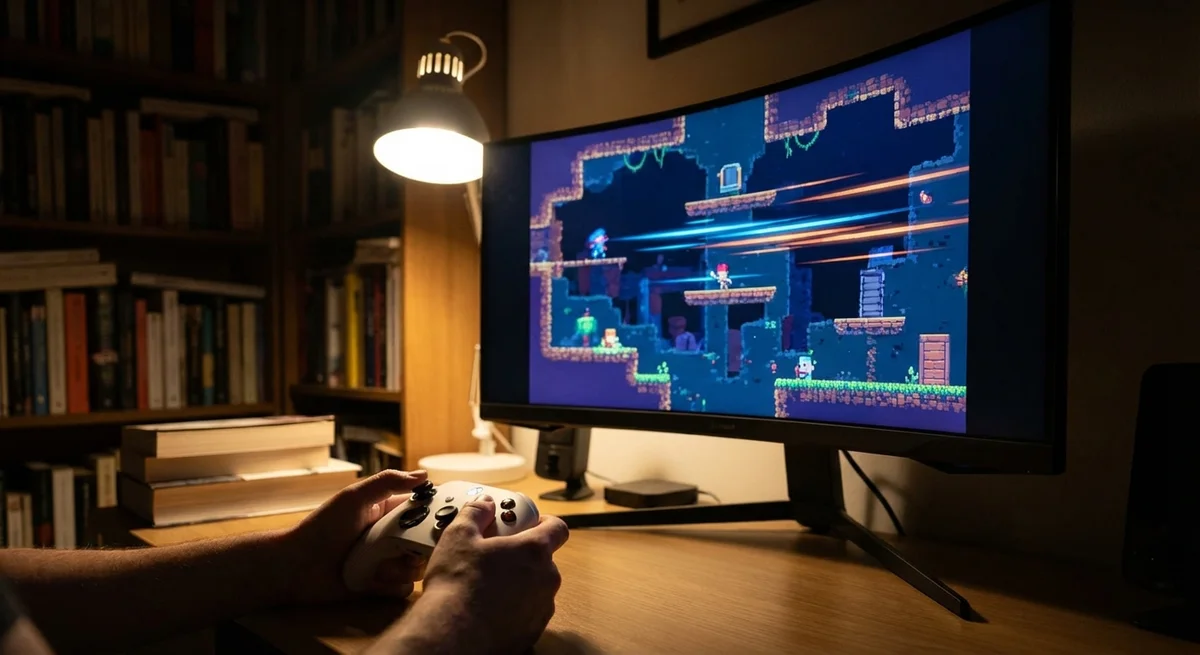
While everyone debates how realistically Sora renders cat fur, Google has played its ace and given users what generative video has been missing: control. Project Genie has finally moved out of closed research papers and into the hands of real people, though for now only AI Ultra subscribers in the US. In short, it is not just a "cartoon generator" but a full world engine that creates an interactive space out of nothing.
Let's recall how this used to work. You wrote a prompt, waited a minute and got a nice clip. Pretty?
Yes. Useful? Well, for social media, perhaps.
But you stayed a spectator. Project Genie changes the rules. Google calls it a "world model" (foundation world model).
The system was trained on hundreds of thousands of hours of video from platformers and other games, with no labeling at all. The AI worked out on its own that when a character presses a button, it should jump, and that when a wall is in front of it, it cannot walk through. This is an intuitive grasp of physics and mechanics that previously had to be spelled out in thousands of lines of code.
Launching this prototype now is not merely an attempt to catch up with OpenAI; it demonstrates a different approach. Google is trying to prove that the future of AI lies not in passive content consumption but in building interactive environments. Imagine describing your dream game, "a cyberpunk platformer in a neo-noir style", and a second later you are controlling a hero in that world. For now Genie works mostly with 2D spaces reminiscent of good old console games, but the potential to scale is enormous. We are seeing the first steps toward what the industry calls "generative games".
Of course, Google wouldn't be Google if it didn't restrict access. US only, paid Ultra subscription only. It looks like an attempt to test the waters and see whether people are ready to pay to play inside a neural network's hallucinations. But the more important point is this: Genie shows that complex interaction logic no longer requires rigid algorithms. The model learns the rules of a world simply by observing it. That matters greatly not only for games but also for robotics, where machines need to understand the consequences of their actions in real space.
What does this mean for the industry as a whole? Game development as it exists today may face a serious identity crisis. If anyone can generate levels and mechanics on the fly, the value of standard assets and templated quests could fall to zero. We are entering an era in which creativity is limited only by imagination, while the technical barriers to making games are collapsing before our eyes. For now Genie is an amusing toy for geeks, but within a couple of iterations it may become a tool that leaves thousands of level designers out of work.
The bottom line: Google is moving generative AI from "watch" mode to "play" mode, and is this the beginning of the end for traditional game development?
- Nov 2, 2026LLM Agent Built a Gearbox in KOMPAS-3D, but Scored Only 50 out of 100 on the Specification
- Nov 2, 2026Karpathy Built HackerTube, a Catalog of 6,454 Videos, in Two Hours with Claude Code
- Nov 2, 2026Я устроил допрос 6 нейросетям про себя и своё ИП глазами заказчика: как ИИ выдумал мне бизнес на Amazon в США и слил смету из закрытого КП
- Nov 2, 2026NVIDIA releases Nemotron 3.5 Bolt E4B: 4 GB and 133 tokens per second on an RTX 5070
Test Frontier LLMs & Autonomous Agents in One Workspace
Run Claude Opus 5.5, GPT-6, Gemini 3.1, and DeepSeek side-by-side in Nomad AI (nomadnet.ai) — unified model routing, deep research, and multimodal workflows under one subscription.
The AI world, distilled — once a week
Seven stories that actually mattered, hand-picked. No noise, no reposts, no press releases.
Done! Check your inbox for a confirmation.