Google's Project Genie lets anyone build their own Mario 64 (badly)
Google DeepMind has unveiled Project Genie, an experimental tool that generates interactive game spaces from text. The technology is still a prototype, and journalists have already had their fun with it, producing wonky knockoffs of classic Nintendo games like Mario 64 and Zelda. Despite the visual artifacts and strange physics, Genie pulls off something remarkable: it "invents" interaction logic and 3D geometry on the fly, with no traditional game engine involved. It goes well beyond image generation, laying the groundwork for a future where games are built in real time for an individual player. For now the results look like digital surrealism, but the game development industry should start getting nervous.
AI-processed from The Verge; edited by Hamidun News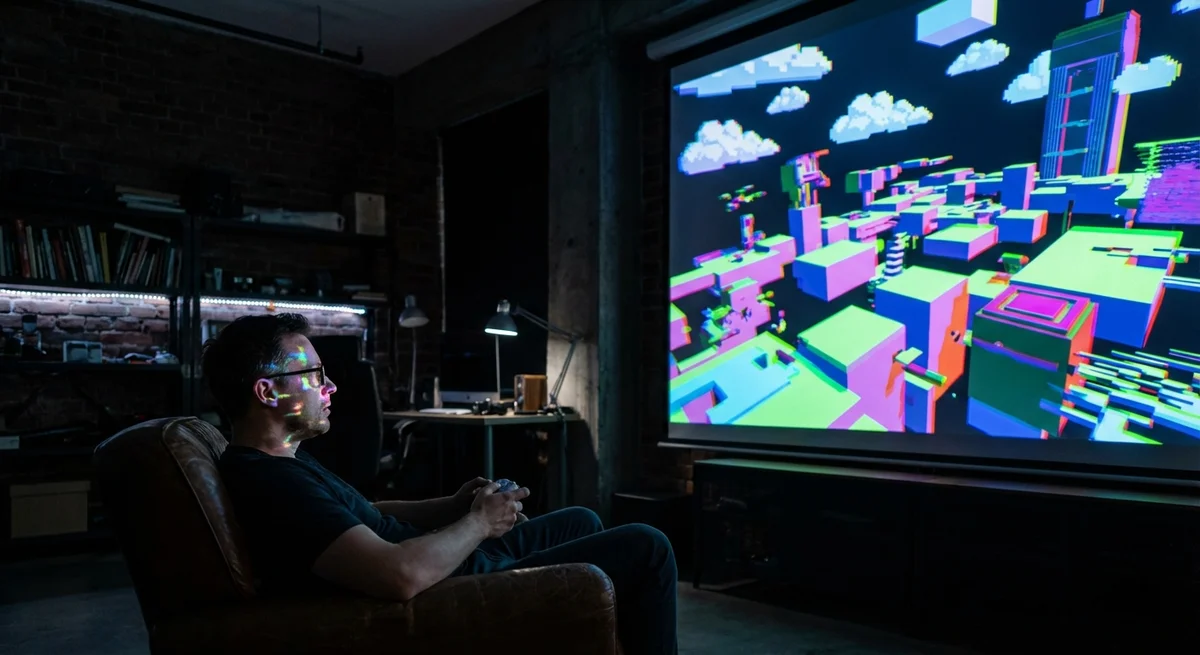
This week, Google DeepMind gave select testers access to Project Genie, an experimental tool that turns a text description into something resembling an interactive 3D world. One tester, a writer for The Verge, used that access to generate their own worlds inspired by Super Mario 64, Metroid Prime, and The Legend of Zelda: Breath of the Wild, complete with a paraglider and, briefly, two Links on screen at once.
What is Project Genie
Genie is an experimental prototype from Google DeepMind, and it works differently from standard video generators. A typical video generator simply predicts the next frame. Genie tries to simulate controls and how the world responds to the user's actions, so the output is a controllable, interactive scene rather than a passive video stream. Instead of being explicitly programmed with the laws of physics, the model was trained on a large volume of gameplay recordings and "picked up" how the rules of virtual worlds work by watching. When a character hits the jump button, the network "knows" the camera should rise and the ground should drop away, simply because "that's what usually happens" in the footage it has seen.
What the generated worlds look like
Ask Genie for something like Super Mario 64 or Metroid Prime, and it draws 3D landscapes that fall apart the moment you try to interact with them. In one example, two Links ran around the screen at the same time, and the jump physics recalled an indie horror game. The image is riddled with artifacts, objects appear out of nowhere, and the controls feel sluggish, like moving through molasses.
What this could mean for game development
Conventional games are built by hand: every object in a virtual world represents a modeler's work, and a jump's physics rests on thousands of lines of physics engine code. Project Genie takes a different route, learning from examples instead of relying on hard-coded rules. If models like this follow the same trajectory as image generators (from recognizable distortions to Midjourney's photorealistic images), a tool like this could eventually produce not just rough sketches but fully playable levels.
That raises questions about copyright over visual style when a neural network generates a "not-Mario" in real time from a single text description. It also raises questions about the role of traditional engines like Unreal or Unity: instead of developers manually tuning lighting and collisions, a model could generate level variations on the fly, up to and including content that adapts to an individual player.
What is Project Genie?
Project Genie is an experimental Google DeepMind tool that turns a text description into something resembling an interactive 3D world. Select testers got access to it this week.
What exactly did the tester generate with Genie?
Their own worlds inspired by Super Mario 64, Metroid Prime, and The Legend of Zelda: Breath of the Wild, including a paraglider and, briefly, two Links on screen at once.
How is Genie different from standard video generators?
A standard video generator predicts the next frame, while Genie tries to simulate controls and how the world responds to the user's actions. It learns from gameplay recordings rather than from programmed laws of physics.
- Nov 1, 2026Google's StreamVibe video agent beats other models by 10.7% on response timing and quality
- Nov 1, 2026OpenAI Rewrites GPT Behavior Rules: Five Values and a Chain of Command
- Nov 1, 2026Voice bots built on LLMs turn to Jev, a fast classifier, for decisions in 200–500 ms
- Nov 1, 2026Google admits AI Mode cuts search revenue, shares fall 15%
Key Questions Answered
What is Project Genie?
Project Genie is an experimental Google DeepMind tool that turns a text description into something resembling an interactive 3D world. Select testers got access to it this week.
What exactly did the tester generate with Genie?
Their own worlds inspired by Super Mario 64, Metroid Prime, and The Legend of Zelda: Breath of the Wild, including a paraglider and, briefly, two Links on screen at once.
How is Genie different from standard video generators?
A standard video generator predicts the next frame, while Genie tries to simulate controls and how the world responds to the user's actions. It learns from gameplay recordings rather than from programmed laws of physics.
Test Frontier LLMs & Autonomous Agents in One Workspace
Run Claude Opus 5.5, GPT-6, Gemini 3.1, and DeepSeek side-by-side in Nomad AI (nomadnet.ai) — unified model routing, deep research, and multimodal workflows under one subscription.
The AI world, distilled — once a week
Seven stories that actually mattered, hand-picked. No noise, no reposts, no press releases.
Done! Check your inbox for a confirmation.