Sora 2: A Chinese Project Breaks the Monopoly of Closed AI Models
Chuangzhi and Mosi, an alliance of Chinese labs, have released Sora 2, a powerful open-source video model. Its headline feature: it generates video and synchronized audio at the same time, reaching cinematic quality. OpenAI's original Sora is still a closed tool for a select few. The Chinese model, by contrast, is available to the community. That deals a serious blow to the monopoly of Western tech giants and marks an important step toward democratizing video production. Creating a clip with sound used to require several neural networks; Sora 2 does it in a single pass, setting a new bar for open-source tools.
AI-processed from Jiqizhixin (机器之心); edited by Hamidun News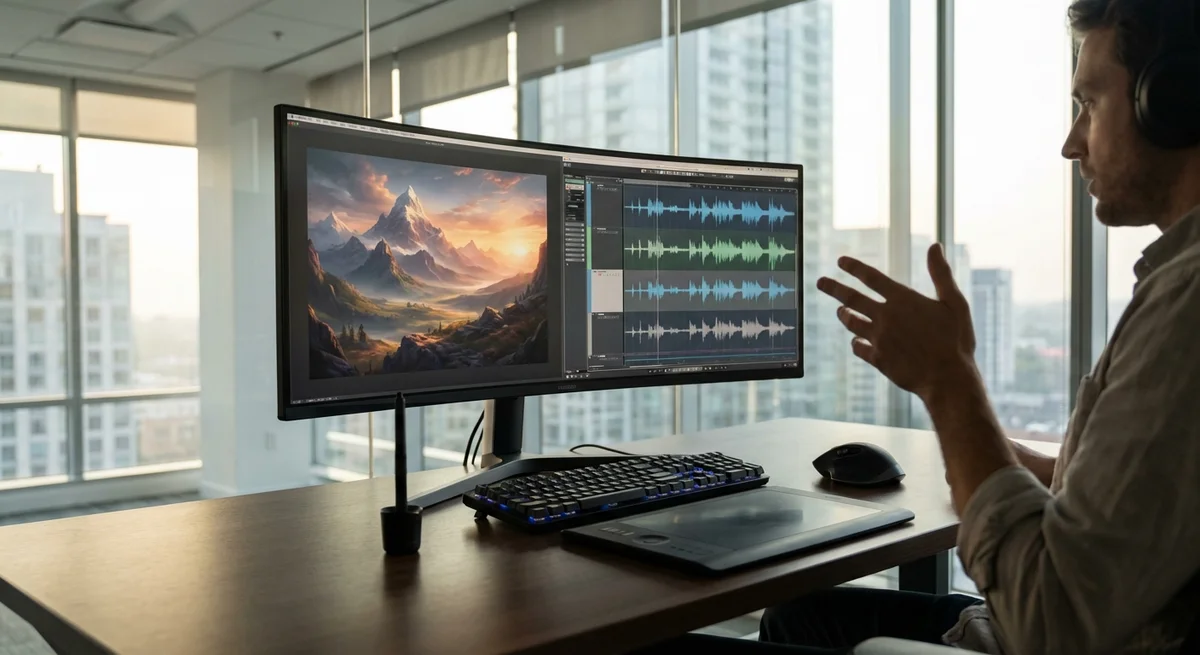
For almost a year, we've lived in a world where OpenAI showed us the future of video generation but never let us touch it. Sam Altman and his team keep feeding the industry flashy teasers on social media, and access to the original Sora remains a privilege for a narrow circle of Hollywood directors. In the East, developers decided to take a different route.
Chuangzhi and Mosi, a coalition of Chinese technology centers, have released a project with the bold name Sora 2. It isn't another attempt to copy Western success. It's a full-fledged manifesto for openness, and it could shake up the established hierarchy in generative art.
For a long time, making quality video with AI felt like assembling a complicated construction kit. You first generated the visuals in one model, then tried to layer sound on top in another, and afterward painstakingly synced lip movements or footsteps with the picture. Sora 2 solves this problem elegantly and radically.
The developers built an architecture that generates audio and video simultaneously, delivering the kind of film-grade sync that creators could previously only dream about. That turns the model from an amusing toy into a real content production tool, where sound is no longer an afterthought. The context of this release is impossible to ignore.
Chinese companies such as Kling or Luma have already proven they can compete with Silicon Valley leaders on image quality. However, most of these services remain closed or run on paid subscriptions. Releasing Sora 2 as open source is a direct challenge to that monopoly.
The moment compares to the release of Stable Diffusion, which in its day wrested the image generation market from the closed DALL-E. Researchers and independent developers around the world now have access to the model weights, which will inevitably trigger an avalanche of new plugins, optimizations, and creative experiments. Under the hood, Sora 2 relies on advanced diffusion transformers (DiT), which became the industry standard after the success of OpenAI's original work.
But the Chinese engineers went further on optimizing compute resources. Despite high resolution and complex scenes, the model shows remarkable frame stability. That matters enormously for professional use, where any texture "drift" or objects suddenly vanishing turns a serious project into a psychedelic nightmare.
Sora 2 holds the frame's structure confidently, making it possible to create long shots that look coherent from the first second to the last. What does this mean for the market in the long run? First, the barrier to entry for video production drops even lower.
Small indie studios now get a tool that used to demand huge budgets for rendering and sound design. Second, OpenAI and Runway are now playing catch-up on openness. They will have to either open up their technology or offer something radically better in quality to justify their closed ecosystems.
The industry no longer wants to wait for favors from corporations; it wants tools it can run on its own servers and fine-tune for its own tasks. Of course, openness also carries certain risks around content safety and copyright. But history shows that progress in AI always accelerates precisely when a technology stops being one company's secret.
Sora 2 is no mere video editor on steroids: it signals to the entire market that the era of closed "black boxes" is coming to an end. While Western giants build walls, the Chinese community builds bridges, and we can already see the results of that strategy today in high-quality clips that are indistinguishable from the work of a professional studio. The bottom line: Sora 2 makes the technology accessible to everyone, and OpenAI will now have to work very hard to convince the world of the value of its closed model.
- Nov 2, 2026Meta's Muse assistant keeps dossiers on loved ones and gets root on Ubuntu by default
- Nov 1, 2026Local models lose to Opus and Codex: 0.21 on a MacBook versus 1.00 for Codex
- Nov 1, 2026Kimi scores 96.2% on a 1C database analytics test and emerges as a fallback if Claude access is blocked
- Nov 1, 2026OpenAI Rewrites GPT Behavior Rules: Five Values and a Chain of Command
Test Frontier LLMs & Autonomous Agents in One Workspace
Run Claude Opus 5.5, GPT-6, Gemini 3.1, and DeepSeek side-by-side in Nomad AI (nomadnet.ai) — unified model routing, deep research, and multimodal workflows under one subscription.
The AI world, distilled — once a week
Seven stories that actually mattered, hand-picked. No noise, no reposts, no press releases.
Done! Check your inbox for a confirmation.