Two Thinking Machines Lab co-founders are heading back to OpenAI
Two co-founders of Thinking Machines Lab are leaving the company and returning to OpenAI. It is a significant loss for the lab. The reasons for the departure are not yet clear, but two main theories have already emerged.
AI-processed from Wired; edited by Hamidun News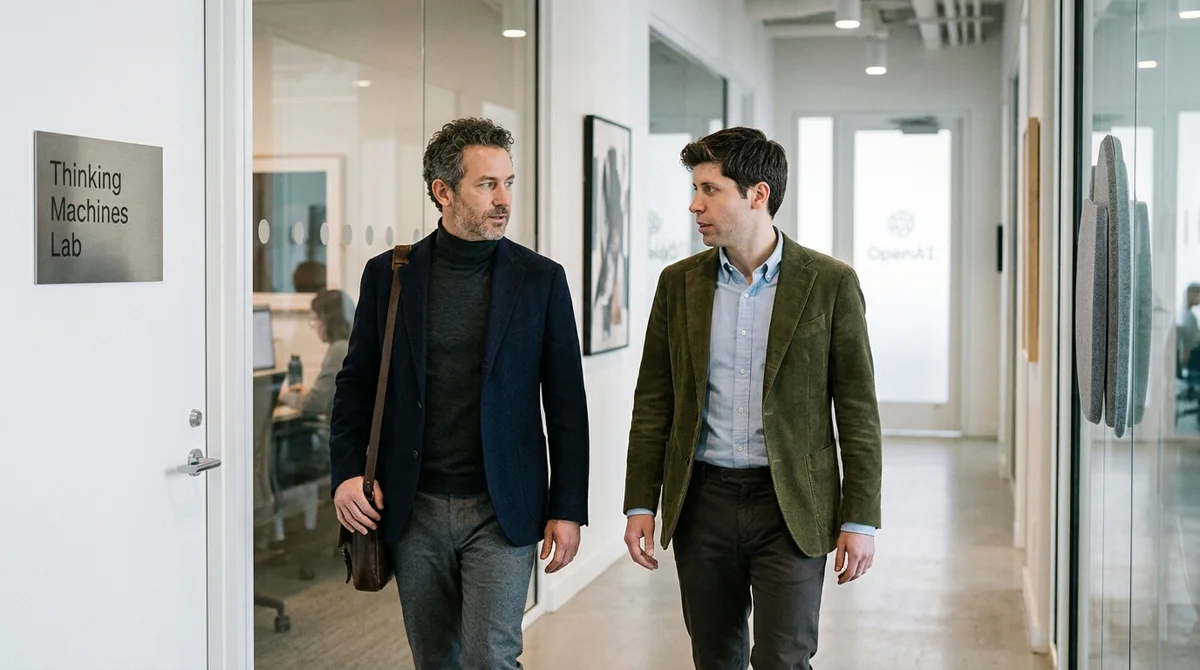
A notable move has shaken the AI world: two co-founders of Thinking Machines Lab, a promising research organization, have decided to step down and return to OpenAI, the company behind the much-discussed GPT. The decision has set off a wave of debate and produced several theories about why they left.
Thinking Machines Lab, founded relatively recently, had managed to establish itself as a promising player in advanced AI development. The exit of key figures is undoubtedly a serious blow to the lab's ambitions and casts doubt on its future plans. The question is what could have driven such experienced, in-demand specialists to leave their own project and go back to an established organization, even one as influential as OpenAI.
Two main theories are currently circulating. The first points to possible internal disagreements at Thinking Machines Lab over strategy and research priorities. It is possible that the co-founders did not reach a consensus with other team members on the company's direction, which led to the decision to return to OpenAI, where their views on AI development may align better with the overall vision.
The second theory holds that OpenAI offered the co-founders more attractive terms, both in funding and in opportunities to pursue their scientific ambitions. With its enormous resources and roster of leading specialists, OpenAI can offer unique prospects for large-scale research and the development of innovative AI solutions. This factor may well have been decisive.
What does this mean for the AI industry? First, it may shift resources and talent toward OpenAI, strengthening its leading position in the market. Second, it may slow the development of Thinking Machines Lab and call into question its ability to compete with larger players. Third, it may signal to other AI startups that retaining key employees amid fierce competition for talent is getting harder.
Ultimately, the co-founders' return to OpenAI is a landmark event that highlights the growing concentration of power and resources in the hands of a few large AI companies. It also serves as a reminder of how important it is to create favorable conditions for talented specialists and give them the chance to pursue their scientific ambitions.
- Nov 2, 2026Arca gives AI agents finance tasks lasting up to 10 days, but leaves the trades to humans
- Nov 2, 2026Meta's Muse assistant keeps dossiers on loved ones and gets root on Ubuntu by default
- Nov 1, 2026Local models lose to Opus and Codex: 0.21 on a MacBook versus 1.00 for Codex
- Nov 1, 2026Kimi scores 96.2% on a 1C database analytics test and emerges as a fallback if Claude access is blocked
Test Frontier LLMs & Autonomous Agents in One Workspace
Run Claude Opus 5.5, GPT-6, Gemini 3.1, and DeepSeek side-by-side in Nomad AI (nomadnet.ai) — unified model routing, deep research, and multimodal workflows under one subscription.
The AI world, distilled — once a week
Seven stories that actually mattered, hand-picked. No noise, no reposts, no press releases.
Done! Check your inbox for a confirmation.