Ma Huateng: Tencent Bets Everything on AI While Others Cut Costs
At Tencent's annual meeting, Pony Ma (Ma Huateng) said plainly that AI is the one area where the company is pouring in huge budgets. While rivals fight over food delivery and group buying, Tencent is rebuilding its team around the Hunyuan model and hunting for "AI-native" talent. Meanwhile, clouds are gathering over Grok in Europe: regulators are launching proceedings under the DSA, which could push Musk's product out of the EU market. With layoffs at Ericsson and price hikes at KFC, the picture is clear: the industry's resources are being redirected toward silicon intelligence.
AI-processed from 36Kr (36氪); edited by Hamidun News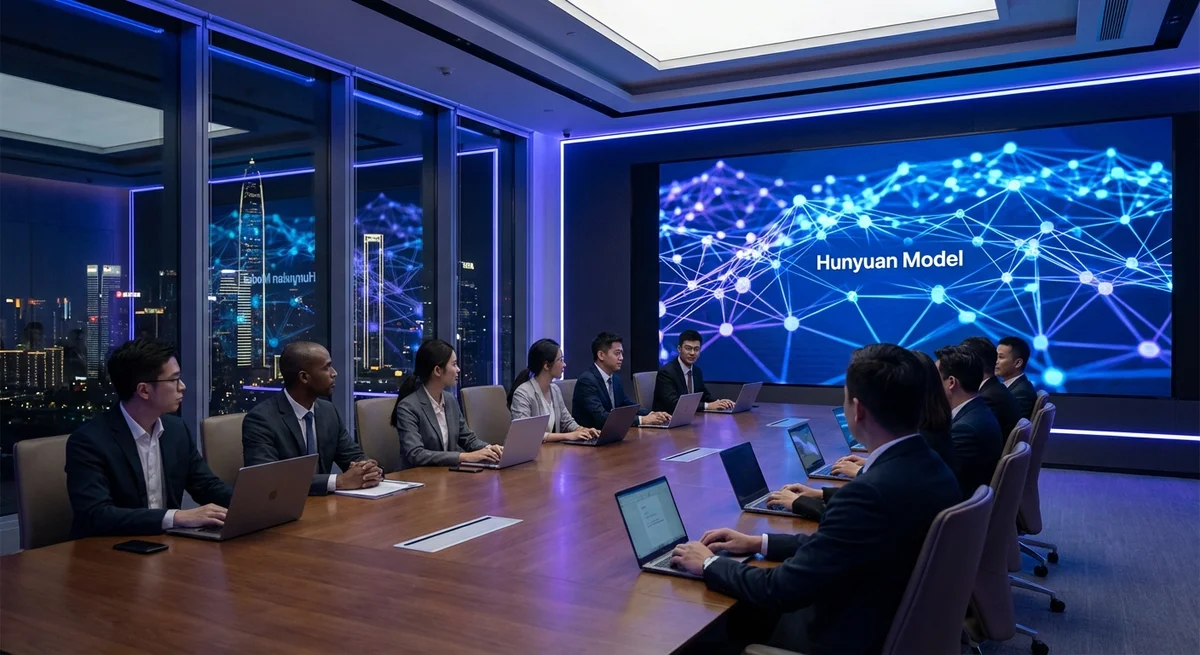
When someone of Pony Ma's stature says his company is spending money on just one thing, it pays to listen. At Tencent's recent annual meeting, the head of the Chinese tech giant set his priorities in the starkest terms: 2025 has been officially declared the "year of AI." While the rest of the business world, in China and beyond, tries to find its footing after prolonged turbulence, Tencent is switching to a mode of directed explosion. The one area where the company is not merely present but literally flooding the market with money is artificial intelligence.
Context matters more than the words themselves. Tencent has always been known for caution and for waiting while competitors take their lumps. This time is different. Ma Huateng noted that while other players burn energy on operational wrangling in food delivery and group buying, his empire is focused on rebuilding its flagship Hunyuan model. Over the past year the project has undergone a serious structural transformation. The goal is no longer simply to "do what OpenAI does" but to recruit so-called AI-native talent: people who did not retrain from classical programming and instead think in terms of neural network architectures from the start.
It is interesting to watch this against the backdrop of the wider industry. While Tencent hires PhDs and reshuffles budgets, other giants are tightening their belts. Ericsson plans to cut another 5000 jobs in 2026, continuing the prolonged decline that began this year. Even the consumer sector is feverish: KFC in China is raising delivery prices to offset operating costs. The contrast is sharp: the old economy and traditional telecom equipment are stagnating, handing their vitality and capital over to generative models.
But the road to AI dominance is blocked not only by technical difficulty but by bureaucracy. While Tencent makes plans for 2025, Elon Musk and his xAI have hit a concrete wall of European regulation. The European Commission is opening formal proceedings against Grok under the Digital Services Act (DSA). The tone from Brussels leaves no illusions: the aim of the process is effectively to push Grok out of the European market if the company does not comply with strict rules on moderation and data transparency. This sets a dangerous precedent, in which an innovative product can be blocked across an entire region simply because regulators cannot keep up with the pace of its development.
For Tencent, the situation in Europe is both a warning and an opportunity. Chinese companies are used to working under strict domestic oversight, so the expansion of their AI products may be better prepared for legal battles in the West than Musk's chaotic forays. Ma Huateng stressed that Tencent will act "steadily and confidently," which in corporate language means a readiness to play the long game without getting distracted by petty scandals.
The transformation of the Hunyuan team and the focus on a new generation of staff show that Tencent has recognized something: AI is not just a feature for the WeChat messenger but the foundation the whole company will stand on for the next decade. If the company once grew on the social connections of its users, it is now betting on the intelligence that will serve those connections. The only question is whether it can grow its own "AI-native" geniuses faster than regulators around the world erect new digital borders.
Bottom line: Tencent is finally turning from a social network into an AI corporation, ignoring the cost. Can Hunyuan become a real competitor to GPT-5 on the global market, or will it stay locked inside the Chinese ecosystem?
- Nov 2, 2026NC State's AICG Framework Cuts MAE by 50.3% on Math Answer Grading
- Nov 2, 2026We Audited 929 Automations at Alpina: What Corporate AI Training Should Look Like in 2026
- Nov 2, 2026I Interrogated 6 AI Models About Myself Through a Procurement Manager's Eyes: Amazon, Esoterica, 'Telo Hudelo' and 5 Holes We Closed in a Day
- Nov 2, 2026TJ Digital: 23% of AI-cited pages open with a direct answer, versus 14% of uncited ones
Test Frontier LLMs & Autonomous Agents in One Workspace
Run Claude Opus 5.5, GPT-6, Gemini 3.1, and DeepSeek side-by-side in Nomad AI (nomadnet.ai) — unified model routing, deep research, and multimodal workflows under one subscription.
The AI world, distilled — once a week
Seven stories that actually mattered, hand-picked. No noise, no reposts, no press releases.
Done! Check your inbox for a confirmation.