AI Meteorologists: How Neural Networks Are Improving Weather Forecasts
Google, Microsoft and Nvidia are building AI models for more accurate, longer-range weather forecasts. Traditional methods are giving ground to neural networks. What does this mean for agriculture and energy?
AI-processed from Bloomberg Tech; edited by Hamidun News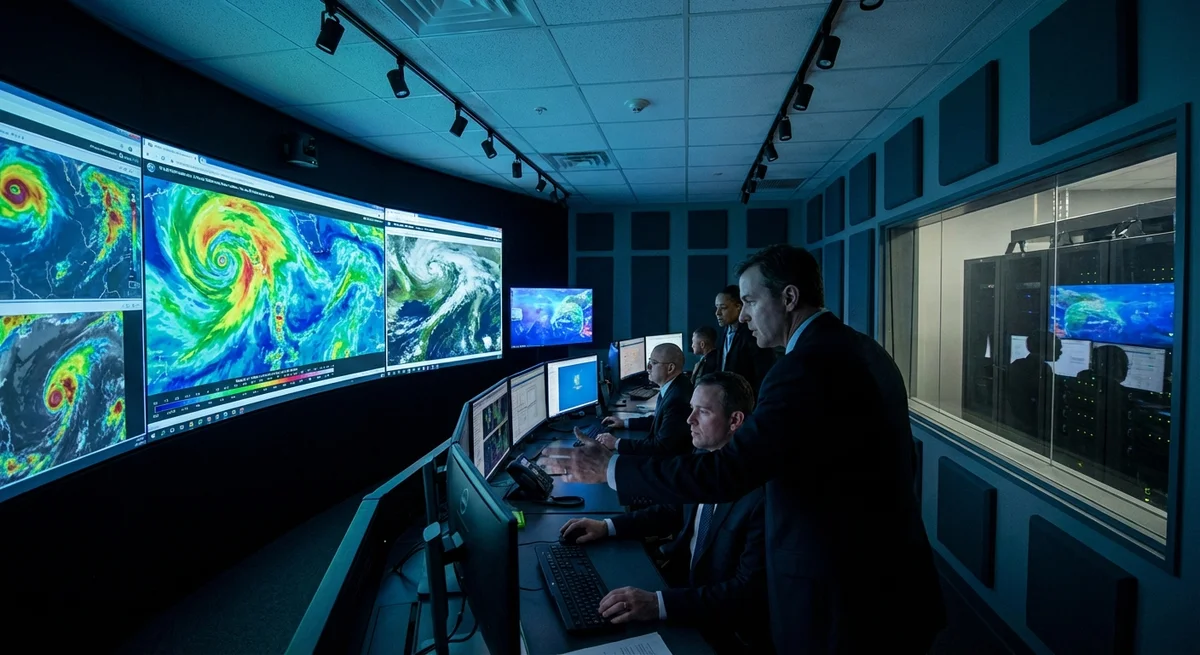
Weather forecast accuracy has always mattered enormously, affecting agriculture, energy, transport and the daily lives of millions of people. Traditional forecasting methods, built on complex physical models and huge volumes of data, often fall short on accuracy, especially over the long term. But with advances in artificial intelligence (AI) and machine learning, that is starting to change. Major technology companies such as Google, Microsoft and Nvidia are actively developing and deploying AI models for weather forecasting, promising significant gains in the accuracy and range of predictions.
The context for this race is a growing need for more reliable forecasts. Climate change is increasing the frequency and intensity of extreme weather events such as droughts, floods and hurricanes. Accurate forecasts allow timely action to protect people and infrastructure and limit economic damage. In addition, the growth of renewable energy, particularly solar and wind, demands more precise weather forecasting to manage power grids efficiently.
The AI models used for weather forecasting are trained on vast archives of historical data, including weather station records, satellite images and the output of numerical models. These models can pick out complex patterns and dependencies that are hard to detect with traditional methods. For example, neural networks can account for the influence of local factors, such as terrain and vegetation, on weather conditions.
Google is developing a model called GraphCast, which it claims outperforms traditional methods at forecasting extreme weather events. Microsoft is also investing heavily in AI meteorology, using cloud computing and machine learning to build more accurate and scalable models. Nvidia, for its part, offers powerful graphics processing units (GPUs) to speed up training and running AI models, and is also developing specialized software tools for meteorologists.
Adopting AI in meteorology has serious consequences for a range of industries. In agriculture, accurate forecasts help optimize sowing, irrigation and the protection of crops from pests and disease. In energy, they help plan the generation and distribution of electricity, taking into account the variability of solar and wind output. In transport, they improve safety and reduce the risk of accidents caused by adverse weather. For ordinary users, more accurate forecasts mean being able to plan their activities more efficiently and make better-informed decisions.
However, the growth of AI meteorology also raises new questions. The reliability and robustness of AI models must be ensured, and the potential risks of using big data and algorithmic bias must be taken into account. It is also important to build cooperation among research institutions, government bodies and private companies to share data and experience. In conclusion, AI meteorology is a promising field that may significantly improve the quality of weather forecasts and benefit society. Competition among Google, Microsoft and Nvidia is spurring innovation and speeding the adoption of new technologies, bringing us closer to a more accurate and reliable understanding of atmospheric processes.
- Nov 2, 2026Karpathy builds a YouTube clone with 6454 videos from Hacker News recommendations in two hours
- Nov 2, 2026Karpathy used Claude to build HackerTube from 6,454 videos recommended on Hacker News
- Nov 2, 2026Anthropic needs to grow revenue 32% a year to cover $850 billion in contracts
- Nov 2, 2026Bun creator uses Claude Code to port 750K lines from Zig to Rust in 11 days
Test Frontier LLMs & Autonomous Agents in One Workspace
Run Claude Opus 5.5, GPT-6, Gemini 3.1, and DeepSeek side-by-side in Nomad AI (nomadnet.ai) — unified model routing, deep research, and multimodal workflows under one subscription.
The AI world, distilled — once a week
Seven stories that actually mattered, hand-picked. No noise, no reposts, no press releases.
Done! Check your inbox for a confirmation.