AI Now Reaches 70% of Business Processes at China's Leading Smart Factories
China's Ministry of Industry and Information Technology says artificial intelligence (AI) now covers more than 70% of business processes at the country's leading smart factories. More than 6000 models have been developed for various industries, driving widespread adoption of smart equipment and software.
AI-processed from 36Kr (36氪); edited by Hamidun News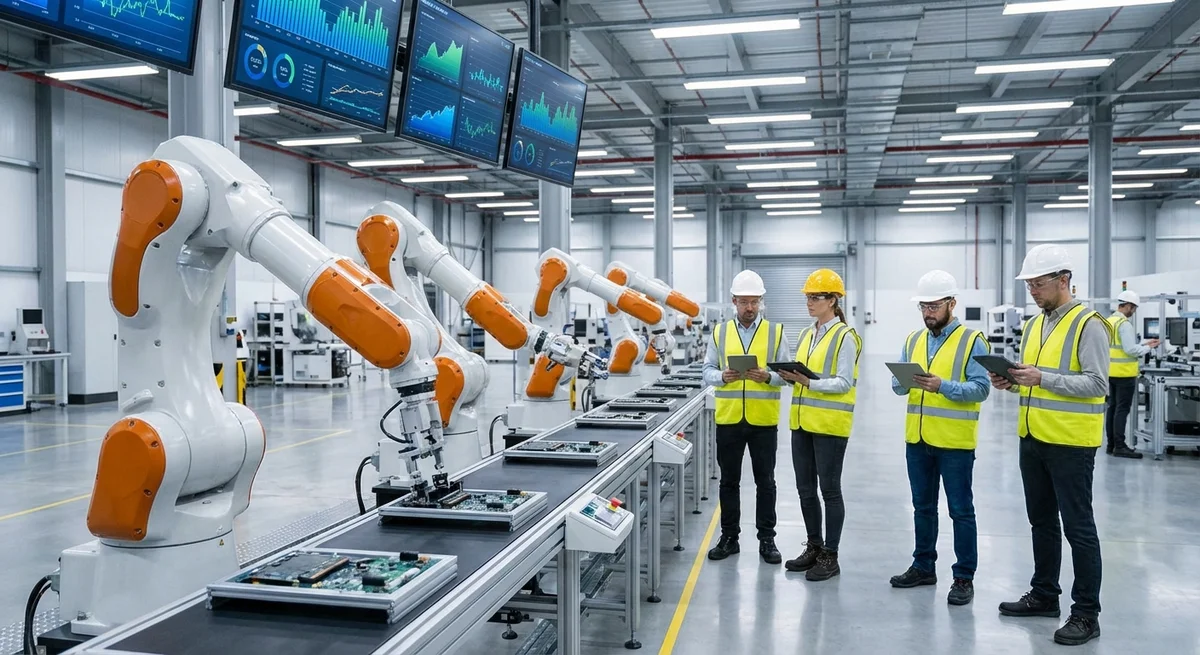
China's Ministry of Industry and Information Technology reports significant progress in bringing artificial intelligence (AI) into manufacturing. According to Xie Cun, head of the ministry's Department of Information and Communication Technology Development, AI already covers more than 70% of business processes at the country's leading smart factories. The figure points to deep integration of advanced technology into industry and opens new opportunities to improve efficiency and automate production.
In recent years, China has invested heavily in developing and deploying AI across sectors of the economy, including industry. Government initiatives aim to build smart manufacturing capacity that can compete on the global market. Integrating AI into smart factories is a key part of this strategy: it lets companies optimize processes, cut costs, and improve product quality.
AI deployment in smart factories has produced more than 6000 models for various industrial sectors. These models handle data analysis, demand forecasting, logistics optimization, and production process management. AI is also driving widespread adoption of smart manufacturing equipment and industrial software, which automates routine tasks and raises labor productivity.
One of the key results of AI adoption is the emergence of industrial intelligent agents that can perceive, make decisions, and carry out tasks. These agents can run production lines on their own, monitor product quality, and adapt to changing conditions. This marks a shift from automated to autonomous manufacturing, where systems can make their own decisions and optimize their own operation.
AI adoption in Chinese industry has far-reaching implications for the global economy. China is becoming a leader in smart manufacturing, which strengthens its position on the global market. It also opens new opportunities for collaboration with other countries on developing and deploying AI technologies.
However, the ethical and social aspects of AI adoption, such as employment and data privacy, need to be taken into account. In conclusion, AI's spread through China's smart factories is an important step toward a modern, competitive industrial base. Developing and deploying AI technologies opens new opportunities to improve efficiency, automate, and optimize production processes.
China is demonstrating its commitment to innovation and its willingness to invest in the future of industry.
- Nov 1, 2026Google's StreamVibe video agent beats other models by 10.7% on response timing and quality
- Nov 1, 2026New test catches hidden AI agent collusion by measuring how a partner reacts to a paraphrase
- Nov 1, 2026Illinois compiled 12 151 open problems and tested whether AI can solve them
- Oct 31, 2026AI engineer writes a single reward function for agent teams: win rate climbs from 51% to 90%
Ship AI Faster with Founders, Engineers & Weekly Architecture Reviews
Inside Vibe Club (hamidun.com/club) — weekly live masterminds with Zhemal Khamidun, Tech Radar, full LMS access, and 370+ production Claude Code skills.
The AI world, distilled — once a week
Seven stories that actually mattered, hand-picked. No noise, no reposts, no press releases.
Done! Check your inbox for a confirmation.