AI in logistics: Nomagic's VLA model halves operator call-outs
Warsaw-based Nomagic has put a vision-language-action (VLA) model into live warehouse operations at commercial customers, and the model halved how often robots "freeze" and need an operator's help. The company's new AI lab is led by a former Google DeepMind researcher. The team is betting on a "mastery before generality" strategy: first get specific warehouse tasks right, such as picking, sorting and moving goods, and only then think about broader applicability.
AI-processed from TNW; edited by Hamidun News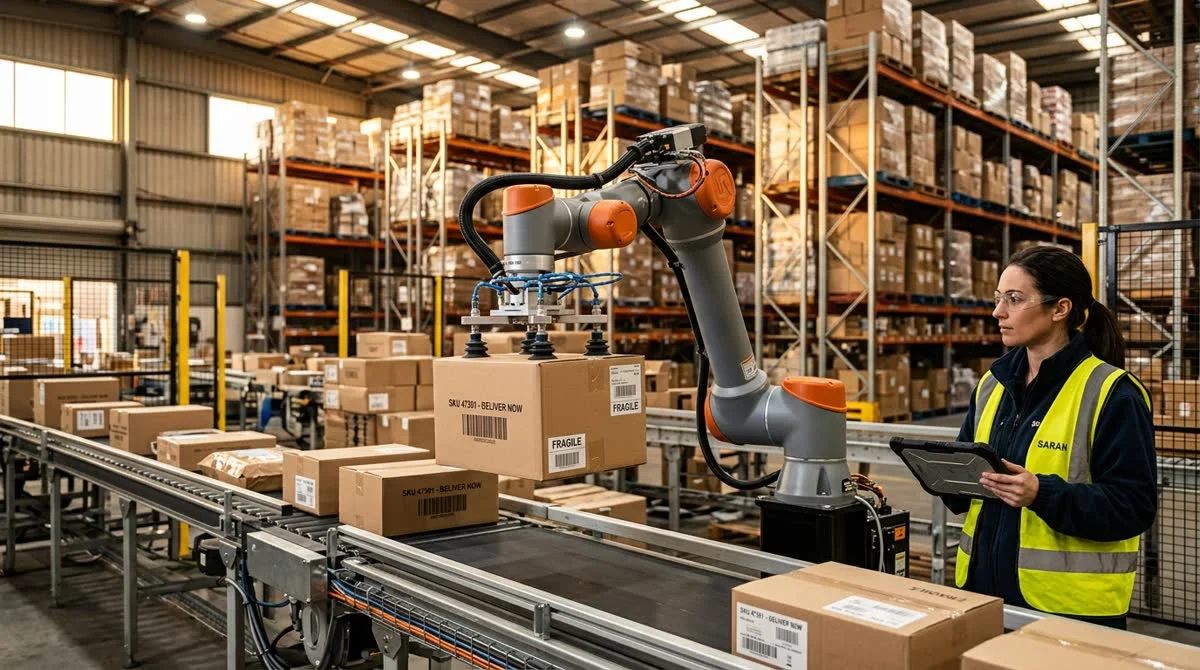
Nomagic has deployed a VLA neural network in warehouse logistics, and the AI halved operator call-outs: the model's rollout began in July 2026 at commercial customers.
What is a VLA model, and why does a warehouse robot need one?
Vision-language-action models are neural networks that combine three components in a single architecture: computer vision (what the robot sees in front of it), contextual understanding (what task needs to be done with that object) and action planning (how exactly to control the manipulator arm). Classical programming requires rules to be written by hand for each product type or unusual scenario. A VLA model instead makes decisions dynamically, much like a person picking up an unfamiliar object without reading the instructions.
Until recently, VLA models lived mostly in the lab, where they were tested on limited sets of objects in controlled environments. Nomagic, a Warsaw company that specializes in robotic arms for warehouse logistics, has moved this technology into real-world conditions.
- Model type: vision-language-action (VLA)
- Company: Nomagic, Warsaw, Poland
- Result: ~50% reduction in the rate of requests for operator intervention
- AI lab: opened in 2026, led by a former Google DeepMind researcher
- Strategy: "mastery before generality": master specific tasks first, then generalize
Why Nomagic is betting on mastery rather than generality
One narrative dominates the robotics race: build a general-purpose agent that can act in any environment and with any object. Physical Intelligence, Google DeepMind and several other large labs are pursuing exactly that. Nomagic has deliberately chosen a different path.
The company's new AI lab is led by a former Google DeepMind researcher, someone who knows the race for generalization well from the inside. Even so, the Nomagic team is deliberately narrowing its focus: deep command of a specific set of warehouse operations (picking, moving and sorting mixed goods at industrial speed) matters more than the ability to handle arbitrary tasks.
The reasoning is pragmatic. A customer building an automated fulfillment center does not need a robot that can open doors or make coffee. They need a system that does not "freeze" and wait for an operator at 3 a.m., when a shipment with non-standard packaging arrives.
What changed in warehouse operations
The key metric in robotic fulfillment is the "human-in-the-loop rate": the share of situations in which the system cannot cope on its own and asks a human for help. Each such call delays the conveyor, adds operating costs and limits scaling without growing headcount.
According to Nomagic, deploying the VLA model cut this figure roughly in half at commercial customer sites. Crucially, the hardware is the same: the robots were not replaced. The twofold gain in autonomy came solely from the new "brain."
For the industry, this is an important signal: VLA models have crossed a threshold where they can be not only shown off at trade-show booths but also deployed in real operations with a measurable commercial result.
What this means
Nomagic has done what the robotics industry has been promising for years: it moved a new-generation AI model from research into production and got a concrete, measurable result. A "mastery first" strategy may turn out to be a shorter route to truly autonomous warehouses than building a general-purpose agent.
What is a VLA model for robots?
A VLA model is a neural network that combines computer vision (what the robot sees), contextual understanding and action skills in a single architecture. In Nomagic's case, this let robots solve warehouse tasks on their own and halve the need for operator help.
What is a VLA neural network?
A VLA model combines computer vision, contextual understanding and action execution in a single neural network architecture for controlling robots.
By how much did the VLA neural network reduce operator call-outs?
By about 50% (by half): Nomagic recorded a twofold drop in the number of cases in which a robot needs operator intervention.
- Nov 1, 202616 models tested on 7 search tools: Exa averaged 10.5 out of 14, SearXNG about 3
- Nov 1, 2026Google's StreamVibe video agent beats other models by 10.7% on response timing and quality
- Nov 1, 2026OpenAI Rewrites GPT Behavior Rules: Five Values and a Chain of Command
- Nov 1, 2026Voice bots built on LLMs turn to Jev, a fast classifier, for decisions in 200–500 ms
Key Questions Answered
What is a VLA model, and why does a warehouse robot need one?
Vision-language-action models are neural networks that combine three components in a single architecture: computer vision (what the robot sees in front of it), contextual understanding (what task needs to be done with that object) and action planning (how exactly to control the manipulator arm). Classical programming requires rules to be written by hand for each product type or unusual scenario. A VLA model instead makes decisions dynamically, much like a person picking up an unfamiliar object without reading the instructions. Until recently, VLA models lived mostly in the
What is a VLA model for robots?
A VLA model is a neural network that combines computer vision (what the robot sees), contextual understanding and action skills in a single architecture. In Nomagic's case, this let robots solve warehouse tasks on their own and halve the need for operator help.
What is a VLA neural network?
A VLA model combines computer vision, contextual understanding and action execution in a single neural network architecture for controlling robots.
By how much did the VLA neural network reduce operator call-outs?
By about 50% (by half): Nomagic recorded a twofold drop in the number of cases in which a robot needs operator intervention.
Test Frontier LLMs & Autonomous Agents in One Workspace
Run Claude Opus 5.5, GPT-6, Gemini 3.1, and DeepSeek side-by-side in Nomad AI (nomadnet.ai) — unified model routing, deep research, and multimodal workflows under one subscription.
The AI world, distilled — once a week
Seven stories that actually mattered, hand-picked. No noise, no reposts, no press releases.
Done! Check your inbox for a confirmation.