From data overload to insight: how Verizon Connect is scaling AI
Verizon Connect has scaled an AI agent to 100,000 daily users. The system turns huge volumes of fleet data into clear insights and recommendations. The company has detailed its architectural decisions, the main challenges it faced and the concrete results.
AI-processed from AWS Machine Learning Blog; edited by Hamidun News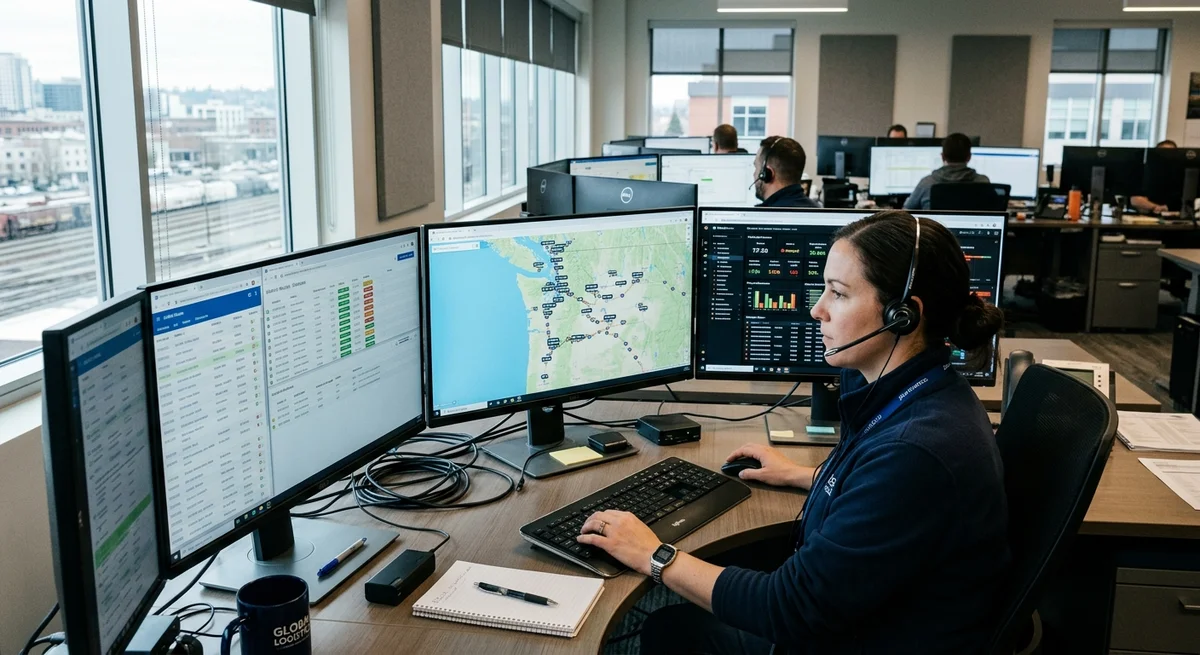
Verizon Connect, a leader in logistics data management and fleet tracking, ran into a classic problem of modern business: how to turn enormous volumes of information about vehicles and routes into useful, timely insights for employees. The answer turned out to be an AI agent that now serves 100,000 daily users and processes data streams in real time.
The data overload problem
When an electronic system collects information on thousands of vehicles — delivery routes, driving speed, fuel consumption, idle time, delivery targets, equipment condition — a paradox appears. There is so much data that people simply cannot extract anything from it at the speed they need. Dispatchers, drivers, foremen and logistics managers drown in numbers and charts instead of focusing on making key decisions in real time.
Verizon Connect grasped one important truth: it needed an AI agent that would analyze these streams on its own and tell people what to pay attention to right now. Not in an hour and not in a day, but at the moment a problem has just appeared and can still be solved.
How the architecture works
The company built its AI system on three key pillars. First, the agent understands the context of each task and the user's role. Second, the system scales without losing response speed. Third, it integrates with the company's existing workflows.
- Analyzes data streams in real time — misses nothing
- Generates custom insights and recommendations for each user depending on their role
- Integrates with the mobile and web interfaces that dispatchers and drivers already use
- Learns from behavior patterns — recommendation accuracy improves automatically over time
- Minimizes the delay between data appearing and a ready action for the person
An important architectural decision: the agent does not just read data and produce reports, it also recommends specific actions. For a dispatcher, that might be rerouting after a delay; for a driver, optimizing stops along the route; for a logistics manager, a report on identified trends and risks.
Scaling challenges
Deploying the system to 100,000 simultaneous users is not simply a matter of adding more cloud resources. It is an architectural challenge. The Verizon Connect team faced several critical problems that had to be solved in parallel.
The first challenge is data consistency. When the agent works with dozens of information sources at once (GPS, fuel, documents, orders), it is crucial that it makes decisions based on synchronized, current data, not stale layers of information from different systems.
The second challenge is processing latency. With 100,000 users, even milliseconds have concrete value. An insight that arrives too late can lose all practical value: the dispatcher has already made a different decision, the route has changed, the delay has already happened.
The third challenge is reliability under peak load. During peak hours (morning, evening, end of month, holidays) the system must withstand several times the normal load without slowing down, without processing errors and without data loss. No timeouts for users.
Results
Despite these serious architectural challenges, the results confirm that the approach is correct and effective. Users get insights at the exact moment they need them, which lets them react faster to logistics problems: delivery delays, unplanned vehicle downtime, route violations and excess fuel consumption. Decision-making speed has increased, and the number of errors and losses has dropped noticeably.
What this means
The Verizon Connect story shows that AI agents can be scaled not only in research labs with hundreds of fundamental-research engineers, but also in real commercial systems with user counts in the hundreds of thousands. If your company has data that people simply cannot process by hand in time, here is a path to a solution. And it already works.
- Nov 1, 2026Local models lose to Opus and Codex: 0.21 on a MacBook versus 1.00 for Codex
- Nov 1, 2026Adobe's EditAgent judge picks a usable edit 81.3% of the time, versus 74.8% for EditScore
- Nov 1, 202616 models tested on 7 search tools: Exa averaged 10.5 out of 14, SearXNG about 3
- Nov 1, 2026Google's StreamVibe video agent beats other models by 10.7% on response timing and quality
Key Questions Answered
What are the key details on The data overload problem?
When an electronic system collects information on thousands of vehicles — delivery routes, driving speed, fuel consumption, idle time, delivery targets, equipment condition — a paradox appears. There is so much data that people simply cannot extract anything from it at the speed they need. Dispatchers, drivers, foremen and logistics managers drown in numbers and charts instead of focusing on making key decisions in real time. Verizon Connect grasped one important truth: it needed an AI agent that would analyze these streams on its own and tell people what to pay attention t
How the architecture works?
The company built its AI system on three key pillars. First, the agent understands the context of each task and the user's role. Second, the system scales without losing response speed. Third, it integrates with the company's existing workflows. Analyzes data streams in real time — misses nothing Generates custom insights and recommendations for each user depending on their role Integrates with the mobile and web interfaces that dispatchers and drivers already use Learns from behavior patterns — recommendation accuracy improves automatically over time Minimizes the delay be
What are the key details on Scaling challenges?
Deploying the system to 100,000 simultaneous users is not simply a matter of adding more cloud resources. It is an architectural challenge. The Verizon Connect team faced several critical problems that had to be solved in parallel. The first challenge is data consistency. When the agent works with dozens of information sources at once (GPS, fuel, documents, orders), it is crucial that it makes decisions based on synchronized, current data, not stale layers of information from different systems. The second challenge is processing latency. With 100,000 users, even millisecond
Test Frontier LLMs & Autonomous Agents in One Workspace
Run Claude Opus 5.5, GPT-6, Gemini 3.1, and DeepSeek side-by-side in Nomad AI (nomadnet.ai) — unified model routing, deep research, and multimodal workflows under one subscription.
The AI world, distilled — once a week
Seven stories that actually mattered, hand-picked. No noise, no reposts, no press releases.
Done! Check your inbox for a confirmation.