Samsung disappoints the market as Amazon borrows $25 billion for AI infrastructure
On July 7, 2026, a selloff in AI chipmaker stocks swept global markets. Samsung reported record quarterly profit growth on memory chips, but investors were not satisfied. Amazon is returning to the debt market: at least $25 billion will go to AI infrastructure. SpaceX will join the Nasdaq 100 index and, for the first time, will receive official analyst coverage from investment banks.
AI-processed from Bloomberg Tech; edited by Hamidun News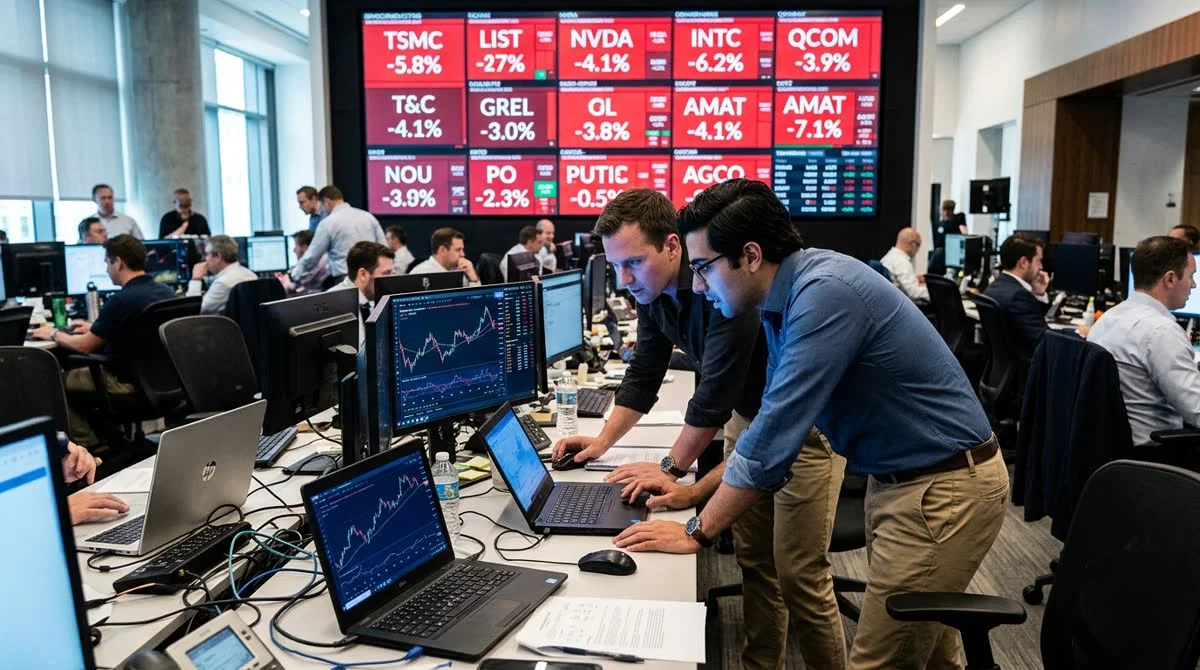
On July 7, 2026, Samsung reported a sharp rise in quarterly profit on frenzied demand for memory chips. It was not enough for investors: a selloff in AI chipmaker stocks spread across every major market, from Asia to Europe and the US.
Why Samsung's profit did not stop the selloff
Samsung's quarterly results beat the consensus forecast for memory revenue, the key segment in the AI era. The market nonetheless reacted with a wave of selling: investors focused on management's cautious outlook and signs of slowing in the HBM and NAND segments.
Bloomberg analysts note that in 2026 the AI market entered a "stress test" phase. The first explosive cycle of demand for GPUs and memory chips for model training is partly saturated, while the next wave, inference and edge AI, has not yet produced stable demand. Investors are pricing that gap into share prices.
- Samsung's quarterly profit rose sharply on demand for memory chips (July 7, 2026)
- The selloff hit exchanges in Asia, Europe and the US at the same time
- The heaviest pressure fell on the HBM segment (memory for AI accelerators)
- Investors reacted to the outlook, not to the actual results
Why Amazon is borrowing $25 billion
Amazon is returning to the debt market: the company plans to raise at least $25 billion through a bond offering. According to Bloomberg, the funds will go toward building and expanding AI infrastructure, primarily data centers and computing capacity for its cloud unit, AWS.
The scale of the deal stands out even against the record AI capital spending of 2025–2026. Over that period Microsoft, Alphabet and Meta announced combined AI infrastructure investments of more than $300 billion. Amazon is betting on debt financing instead of issuing new shares. That is the conservative route, but at current interest rates it is expensive.
Investment bankers say demand for such offerings remains high: institutional investors see bonds from the largest tech companies as a reliable instrument that pays a premium over Treasuries.
SpaceX in the Nasdaq 100: what changes
SpaceX is joining the Nasdaq 100 index, an event the market has awaited since the first tradable instruments on the company's shares appeared. Inclusion automatically triggers purchases by all funds that track the Nasdaq 100, creating mechanical additional demand.
At the same time, leading investment banks are launching official analyst coverage of SpaceX, the first in the company's history. Price targets and ratings from well-known analysts open the door for conservative institutional investors, who until now have steered clear of SpaceX because no official consensus existed.
What this means
The three events of July 7, 2026 add up to a single picture of capital being reallocated within the AI economy. Hardware makers (Samsung) are going through their first reset of expectations after a phase of frenzied growth. The biggest consumers of AI computing (Amazon) are ready to borrow tens of billions so as not to fall behind in the infrastructure race. And unconventional tech companies like SpaceX are entering the mainstream financial arena, gaining access to a new pool of institutional investors.
Frequently asked questions
Why did investors sell Samsung shares despite higher profit?
The market expected a strong forecast for the next quarter. Management gave a cautious outlook, and good actual results did not offset the disappointment amid inflated expectations for AI-driven memory demand.
When will Amazon complete its $25 billion bond offering?
According to Bloomberg as of July 7, 2026, Amazon announced its intention to raise at least $25 billion; the specific timing and terms of the offering were not disclosed.
*Meta is designated an extremist organization and banned in Russia.
Key Questions Answered
Why did investors sell Samsung shares despite higher profit?
The market expected a strong forecast for the next quarter. Management gave a cautious outlook, and good actual results did not offset the disappointment amid inflated expectations for AI-driven memory demand.
When will Amazon complete its $25 billion bond offering?
According to Bloomberg as of July 7, 2026, Amazon announced its intention to raise at least $25 billion; the specific timing and terms of the offering were not disclosed. Meta is designated an extremist organization and banned in Russia.
Why Samsung's profit did not stop the selloff?
Samsung's quarterly results beat the consensus forecast for memory revenue, the key segment in the AI era. The market nonetheless reacted with a wave of selling: investors focused on management's cautious outlook and signs of slowing in the HBM and NAND segments. Bloomberg analysts note that in 2026 the AI market entered a "stress test" phase. The first explosive cycle of demand for GPUs and memory chips for model training is partly saturated, while the next wave, inference and edge AI, has not yet produced stable demand. Investors are pricing that gap into share prices. Sa
Test Frontier LLMs & Autonomous Agents in One Workspace
Run Claude Opus 5.5, GPT-6, Gemini 3.1, and DeepSeek side-by-side in Nomad AI (nomadnet.ai) — unified model routing, deep research, and multimodal workflows under one subscription.
The AI world, distilled — once a week
Seven stories that actually mattered, hand-picked. No noise, no reposts, no press releases.
Done! Check your inbox for a confirmation.