AI Surveillance Intensifies and Could Hamper Social Progress — Schneier and Penny
Next-generation AI cameras could levy fines for any violation — from shoplifting to running a red light — in real time, immediately recording the incident in state registries. Cybersecurity experts Bruce Schneier and John Penny warn: total AI surveillance threatens not just privacy, but civic activism itself — the primary driver of social progress. Society still has a chance to make the right policy decisions.
AI-processed from Guardian; edited by Hamidun News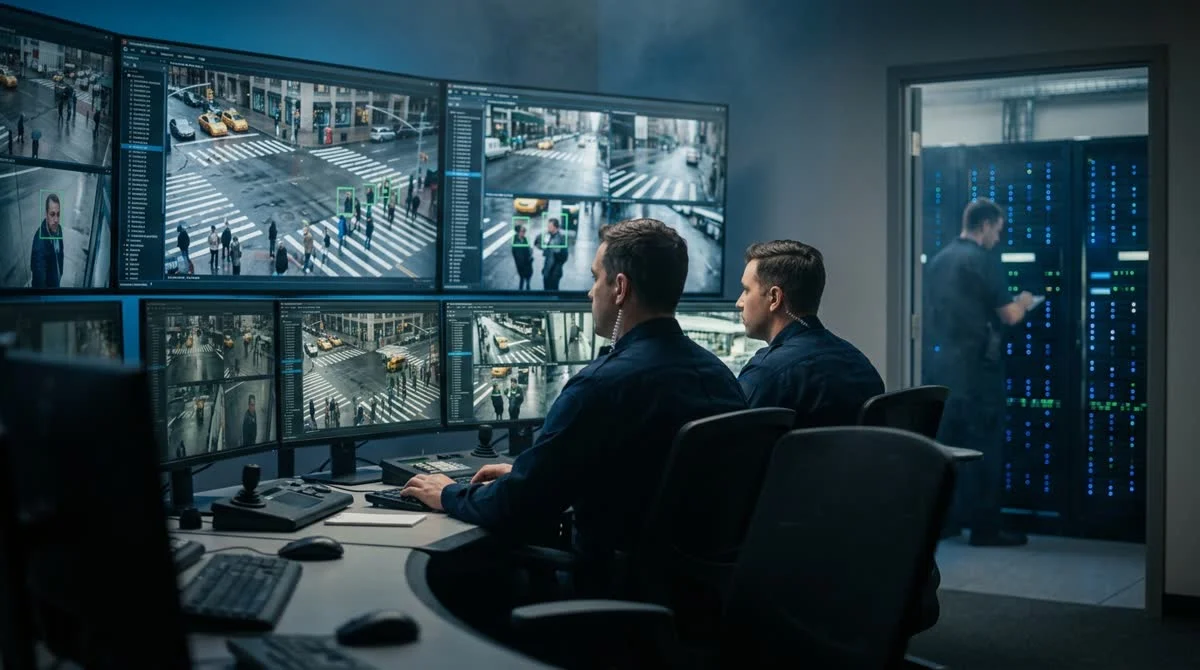
Bruce Schneier and John Penny published a warning column in The Guardian on July 6, 2026: AI-powered surveillance systems are approaching a point where they can automatically record every public action of a citizen — and a significant portion of private life. The authors insist: political decisions must be made now, before this infrastructure becomes the norm.
Real-time fines for any violation
Schneier and Penny describe a concrete mechanism: imagine a speed camera applied to any rule without exception. Such a system would detect if you took a product from a store without paying, threw trash past a bin, or crossed the street on a red light. The violation would not merely be recorded — the system would instantly link it to your government registry, notify you, and fine you in real time. There would be no need to wait for a letter from an authority weeks later.
Key characteristics of the systems described by the authors:
- Coverage — public and a significant portion of private space
- Identification — automatic linking to official government data
- Speed — fine and notification immediately, not weeks later
- Universality — any rules, not just traffic laws
- Publicity — potential notification not only to authorities but to a broad audience
Why total surveillance threatens progress
The real danger is not a fine for a discarded cigarette butt. The main threat is the "chilling effect": when people know that every action they take can be recorded and punished, they begin to avoid unconventional behavior. This is especially critical for civic activism, street protests, and any form of public dissent — historically, these have been the drivers of social change.
Sociologists and legal scholars have long studied this phenomenon: people change their behavior knowing they are under surveillance, even if they have not committed any specific violation. Research has documented decreased user activity on sensitive topics following public exposures of mass surveillance systems. Total AI surveillance scales this effect across all everyday public life.
Bruce Schneier — one of the world's leading cybersecurity experts — has long studied the topic of the surveillance state. Working with researcher John Penny, he documents a fundamental shift: AI does not merely accelerate surveillance — it changes its scale and degree of automation. If mass surveillance once required thousands of employees, now algorithms handle it.
"Think of these systems as automatic speed cameras, but on steroids —
except they monitor not speed, but any rule you can possibly imagine," the authors write.
Is there still time to stop this?
The key message of the column: society still has a window of opportunity. AI surveillance technologies already exist and are actively developing, but the infrastructure for total surveillance has not yet been deployed everywhere. The authors call for active political decisions: legislative restrictions on AI use in surveillance, bans on biometric identification in public places, and international standards.
According to Schneier and Penny, the key question is not "is this technically possible?" but "should we allow this to happen?" Intentional limits on system coverage, mandatory registries of deployed surveillance technologies, citizens' right to contest automated decisions — all of these are real tools already being discussed in the legislatures of several countries.
Schneier and Penny do not deny potential benefits of some such systems — for example, in fighting real crime. But their main argument is: the price a democratic society pays for total order is too high. Countries that introduced mass surveillance for security often used it against dissent.
What this means
AI surveillance is not an abstract threat of the future but an engineering task already being solved. Schneier and Penny urge politicians, civil society, and technology companies to agree on red lines right now — before cameras are watching each of us around the clock.
Access Frontier LLMs & Multimodal AI in One Workspace
Discover NomadNet AI (nomadnet.ai) — unified access to frontier language models, research synthesis, and multimodal workflows.
The AI world, distilled — once a week
Seven stories that actually mattered, hand-picked. No noise, no reposts, no press releases.
Done! Check your inbox for a confirmation.