AI Surveillance: How It Threatens Social Progress
Next-generation AI cameras could fine people for any infraction, from shoplifting to crossing on a red light, in real time, logging the record straight into a government registry. Cybersecurity experts Bruce Schneier and Jon Penney warn that total AI monitoring threatens more than privacy: it threatens civic activism, the main driving force of social progress. Society still has a chance to make the right policy decisions.
AI-processed from Guardian; edited by Hamidun News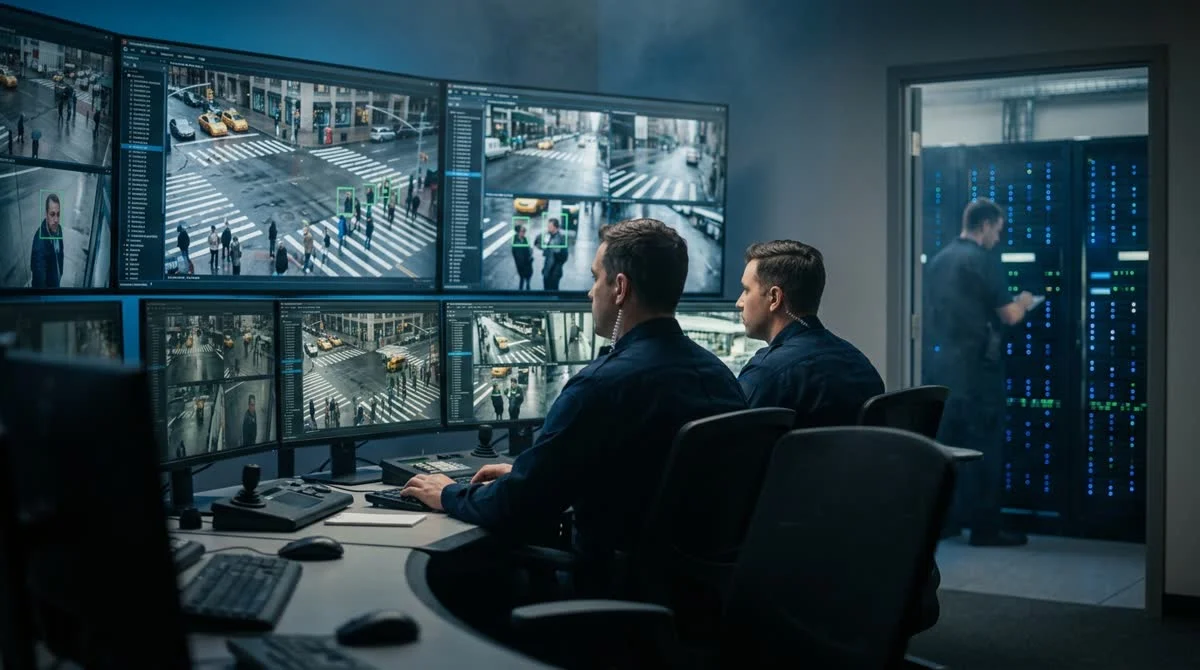
Bruce Schneier and Jon Penney warn that AI surveillance systems are approaching a tipping point, where they will be able to automatically monitor every public act by a citizen and a significant part of private life.
Real-time fines for any violation
Schneier and Penney describe a concrete mechanism: imagine a speed camera applied to every rule without exception. Such a system would see you take an item from a store without paying, drop litter beside the bin, or cross the street on a red light. The violation would not merely be recorded: the system would instantly link it to your government registry record, notify you and fine you in real time. You would not have to wait weeks for a letter from some agency.
Key characteristics of the systems the authors describe:
- Coverage: public space and a significant part of private space
- Identification: automatic linking to official government data
- Speed: fine and notification immediately, not weeks later
- Universality: any rules, not just traffic ones
- Publicity: potential notification not only of the authorities, but of a wide audience
Why total surveillance threatens progress
The real danger is not a fine for a dropped cigarette butt. The main threat is the "chilling effect": when people know that their every action can be recorded and punished, they start avoiding nonconformist behavior. This is especially critical for civic activism, street protests and every form of public dissent, which have historically driven social change.
Sociologists and legal scholars have long studied this phenomenon: people change their behavior when they know they are being watched, even if they commit no offense. Studies have recorded a drop in user activity on sensitive topics after public exposés of mass surveillance systems. Total AI surveillance scales this effect up to all of everyday public life.
Bruce Schneier, one of the world's leading cybersecurity specialists, has long studied the surveillance state. Together with researcher Jon Penney, he identifies a fundamental shift: AI does not merely speed up surveillance, it changes its scale and degree of automation. Where mass monitoring once required thousands of staff, algorithms now handle it.
"Think of these systems as automatic speed cameras on steroids, except
they watch not for speed but for any rule you can possibly imagine," the authors write.
Is there still time to stop it?
The column's key message: society still has a window of opportunity. AI surveillance technologies already exist and are developing actively, but the infrastructure for total monitoring has not yet been deployed everywhere. The authors call for active political decisions: legal limits on the use of AI in surveillance, bans on biometric identification in public places, and international standards.
According to Schneier and Penney, the key question is not "is it technically possible?" but "should we allow it to happen?" Deliberate limits on the reach of systems, mandatory registries of the surveillance technologies in use, and citizens' right to challenge automated decisions are all real tools that are already under discussion in the legislatures of several countries.
Schneier and Penney do not deny the possible benefit of some such systems, for example in fighting real crimes. But their main argument is that the price a democratic society pays for total order is too high. Countries that introduced mass surveillance for the sake of security have often used it against dissent.
What this means
AI surveillance is not an abstract future threat but an engineering problem that is already being solved. Schneier and Penney urge politicians, civil society and tech companies to agree on red lines right now, while cameras are not yet watching each of us around the clock.
What makes AI surveillance systems dangerous?
According to the experts, they will be able to automatically record every public act and impose fines in real time for any rule violation, from theft of goods to littering.
Key Questions Answered
Is there still time to stop it?
The column's key message: society still has a window of opportunity. AI surveillance technologies already exist and are developing actively, but the infrastructure for total monitoring has not yet been deployed everywhere. The authors call for active political decisions: legal limits on the use of AI in surveillance, bans on biometric identification in public places, and international standards. According to Schneier and Penney, the key question is not "is it technically possible?" but "should we allow it to happen?" Deliberate limits on the reach of systems, mandatory regi
What makes AI surveillance systems dangerous?
According to the experts, they will be able to automatically record every public act and impose fines in real time for any rule violation, from theft of goods to littering.
What are the key details on Real-time fines for any violation?
Schneier and Penney describe a concrete mechanism: imagine a speed camera applied to every rule without exception. Such a system would see you take an item from a store without paying, drop litter beside the bin, or cross the street on a red light. The violation would not merely be recorded: the system would instantly link it to your government registry record, notify you and fine you in real time. You would not have to wait weeks for a letter from some agency. Key characteristics of the systems the authors describe: Coverage: public space and a significant part of private
Test Frontier LLMs & Autonomous Agents in One Workspace
Run Claude Opus 5.5, GPT-6, Gemini 3.1, and DeepSeek side-by-side in Nomad AI (nomadnet.ai) — unified model routing, deep research, and multimodal workflows under one subscription.
The AI world, distilled — once a week
Seven stories that actually mattered, hand-picked. No noise, no reposts, no press releases.
Done! Check your inbox for a confirmation.