Australian authors demand the government not hand their books to AI companies for free
Australian writers, artists and musicians traveled to Canberra in July 2026 to stop the uncompensated use of their work to train AI models. Author Anna Funder said all of her books have already been loaded into American AI systems without her consent and without payment. The authors insist that the Australian government must not sacrifice copyright to serve the interests of Big Tech.
AI-processed from Guardian; edited by Hamidun News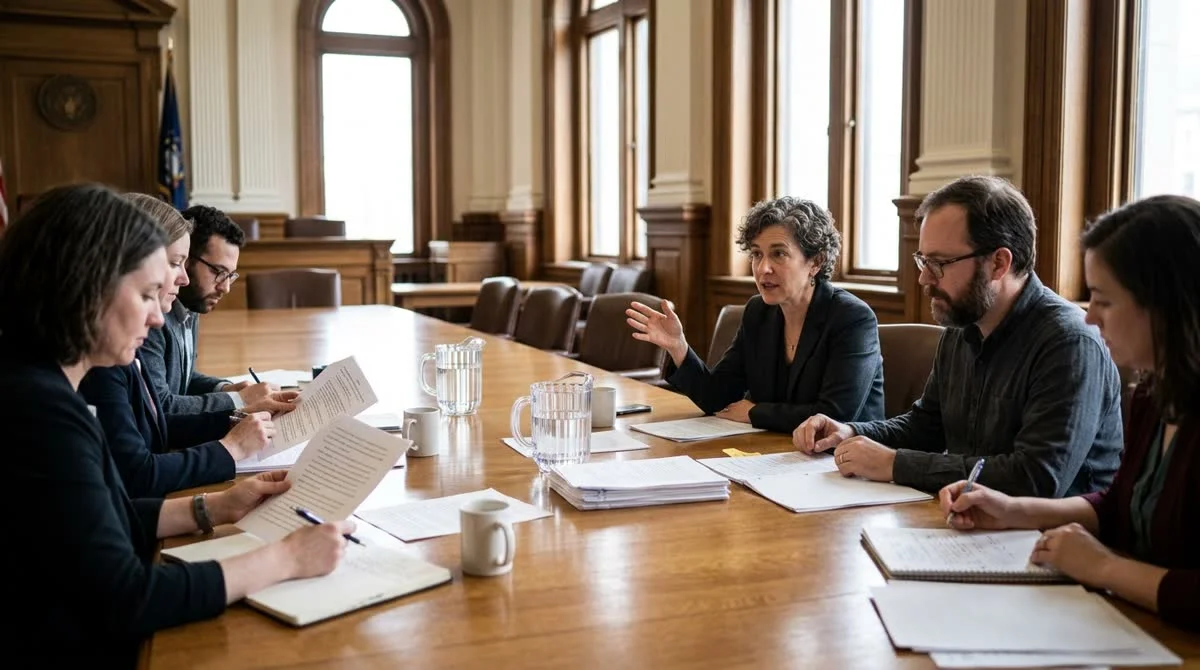
Australian writers, artists and musicians traveled to Canberra in early July 2026 to demand that the government not sacrifice copyright for the benefit of American AI companies. Their books, songs, films and paintings have already been loaded into training datasets without the authors' consent and without any payment.
Why did the authors come to Canberra?
The capital received representatives of a wide range of creative professions: book authors, musicians, filmmakers and visual artists, including Indigenous Australian artists. All of them earn a living by selling their creative work: books, albums, films and paintings. But their work matters beyond the market: it is through culture, the authors believe, that Australians understand their identity and stay connected to one another.
An attack on copyright is an attack on two things at once: the personal income of authors and the cultural sovereignty of the country. The delegation brought this twofold argument to the government.
What AI companies took without permission
Australian author Anna Funder explained how copyright works using her own case: she licenses her books to publishers around the world, they publish and sell them, and she receives 8–12% of revenue in royalties. In her words, copyright works the same way as the Torrens title system for real estate: a basic legal guarantee that what you create belongs to you. Without it, creating anything simply makes no sense.
And that is exactly the violation that has already taken place. All of Funder's books have been loaded into American AI programs without her consent and without any compensation. The same is true for every member of the delegation.
- Books, songs, films, paintings and works by Indigenous artists have been included in training datasets without licensing agreements
- The standard author's income is 8–12% of the publisher's sale price
- No permission has been obtained from rights holders
- No licensing payment has followed
"Without copyright, nobody would create anything.
Why would they, if it can be stolen immediately?" — Anna Funder.
What American AI companies want
US technology corporations building their business on generative AI want access to Australian creative content for free or for a token fee. In effect, they want to use the results of many years of work by thousands of authors as training data without market compensation: books that take years to write, songs and films with multimillion-dollar budgets.
The authors appeal to a fundamental principle: Australia is a country where honesty is considered a core value. They are counting on this in their negotiations with the government. Their question is simple: will the government side with its citizens or with American corporations?
What this means
The global debate over copyright and AI training is growing: courts in the US, the UK and the EU are hearing lawsuits from publishers, authors and musicians. Australia has reached a point where the government's position could set a precedent for the region.
The authors insist that a country with a long tradition of protecting property rights cannot set weaker standards for intellectual property than for physical property. If protection weakens under pressure from the AI lobby, it will send a signal to the whole world. If existing rules hold, authors in other countries will gain a strong precedent for demanding licensing payments from AI companies.
Key Questions Answered
Why did the authors come to Canberra?
The capital received representatives of a wide range of creative professions: book authors, musicians, filmmakers and visual artists, including Indigenous Australian artists. All of them earn a living by selling their creative work: books, albums, films and paintings. But their work matters beyond the market: it is through culture, the authors believe, that Australians understand their identity and stay connected to one another. An attack on copyright is an attack on two things at once: the personal income of authors and the cultural sovereignty of the country. The delegati
What AI companies took without permission?
Australian author Anna Funder explained how copyright works using her own case: she licenses her books to publishers around the world, they publish and sell them, and she receives 8–12% of revenue in royalties. In her words, copyright works the same way as the Torrens title system for real estate: a basic legal guarantee that what you create belongs to you. Without it, creating anything simply makes no sense. And that is exactly the violation that has already taken place. All of Funder's books have been loaded into American AI programs without her consent and without any co
What American AI companies want?
US technology corporations building their business on generative AI want access to Australian creative content for free or for a token fee. In effect, they want to use the results of many years of work by thousands of authors as training data without market compensation: books that take years to write, songs and films with multimillion-dollar budgets. The authors appeal to a fundamental principle: Australia is a country where honesty is considered a core value. They are counting on this in their negotiations with the government. Their question is simple: will the government
Test Frontier LLMs & Autonomous Agents in One Workspace
Run Claude Opus 5.5, GPT-6, Gemini 3.1, and DeepSeek side-by-side in Nomad AI (nomadnet.ai) — unified model routing, deep research, and multimodal workflows under one subscription.
The AI world, distilled — once a week
Seven stories that actually mattered, hand-picked. No noise, no reposts, no press releases.
Done! Check your inbox for a confirmation.