Ford rehires hundreds of engineers as employers regret mass AI layoffs
AI optimism is giving way to a hangover: companies that cut staff en masse for automation are now hiring those people back. Ford is bringing back hundreds of experienced engineers because its AI systems could not solve the production quality problems that humans used to handle. Experts see a trend: the claim that "AI can do everything" no longer works as an argument for layoffs.
AI-processed from 3DNews AI; edited by Hamidun News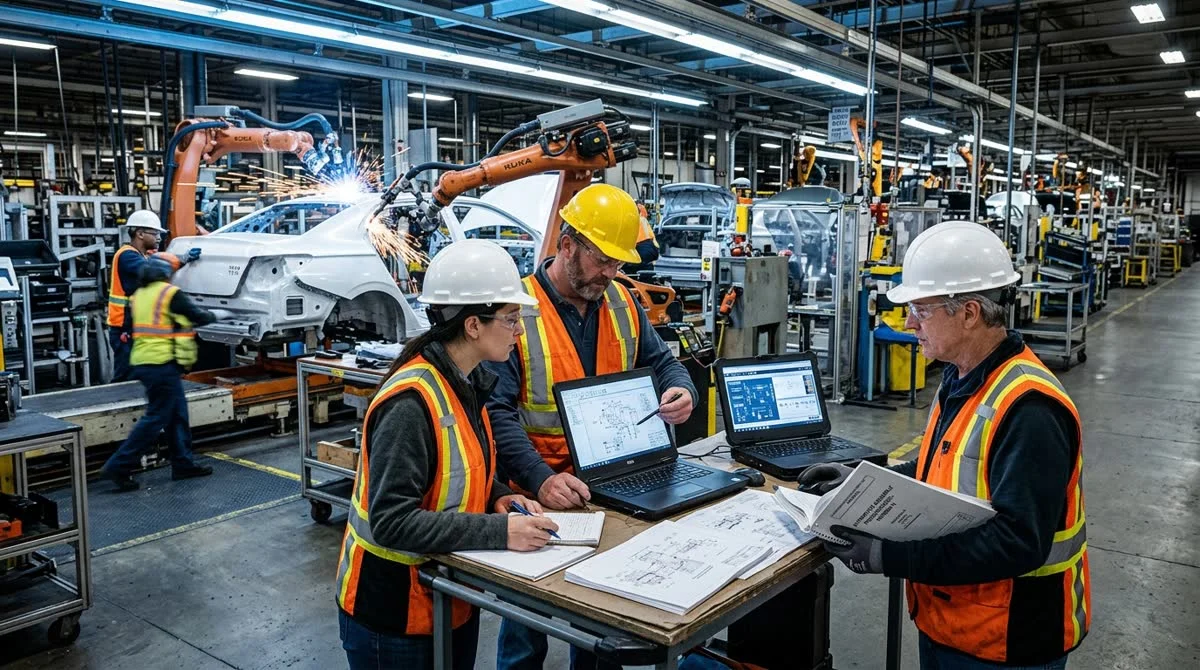
In 2026, Ford announced it would hire hundreds of experienced engineers, the very specialists the automaker cut during the period of AI optimism. Automated systems failed at production quality control, and Ford has become one of the most telling examples of a new trend: employers around the world are starting to regret mass layoffs made to make room for AI.
Why the bet on AI failed
During the generative AI boom, many large employers sharply cut headcount, convinced that algorithms would handle any task faster and cheaper than people. The thesis that "AI can do everything" became a convenient justification for waves of layoffs, from tech companies to industrial giants. Shareholders saw such decisions as sensible optimization, and top management reported savings on payroll.
Reality turned out differently. Ford is one of the first major public examples where the bet on automation failed noticeably in a critically important area. Production quality problems piled up for months, and AI systems could neither diagnose their nature accurately nor propose non-standard engineering solutions. As a result, the company went back to active hiring, and it is targeting experienced specialists with many years of practice rather than young graduates.
What automation overlooked
The key mistake companies made was overestimating how ready generative AI is for tasks with a high degree of uncertainty. Ford's engineers spent years accumulating empirical knowledge of production failures: they could recognize atypical patterns, make decisions with incomplete data and account for context that simply never made it into training sets. For generative models, such tasks proved significantly harder than they seemed at the deployment stage.
- In 2026 Ford is bringing back hundreds of engineers to fix production quality problems
- Automated systems failed at tasks that require contextual experience
- The "rehiring" trend is showing up in several industries, from automotive to tech companies
- Laid-off specialists went to competitors: bringing them back proved significantly more expensive than keeping them would have been
Beyond the technical failures, companies underestimated the long-term market consequences of mass layoffs. Experienced specialists did not wait for a callback: they moved to competitors, changed industries or started their own businesses. As a result, the pool of qualified talent shrank at exactly the moment employers felt an acute need for it again.
The hidden cost of optimization
The cost of recruiting specialists again often exceeds the savings that automation delivered in the short term. Companies known for aggressive AI layoffs have suffered reputational damage: candidates now consider their offers with caution, fearing new rounds of optimization.
Rethinking the situation is leading to a new positioning of AI, not as a replacement for people but as an amplifier of their capabilities. With this approach, more and more companies are moving from a strategy of total automation to a model of human-machine collaboration: a specialist with AI tools is more effective than a specialist without them, and more effective than automation without a specialist.
AI tools work significantly better when a qualified person is nearby who can set tasks, check results and correct the model's errors. Without such a specialist, system accuracy drops and errors accumulate unnoticed until they turn into production defects or operational failures.
What this means
The experience of Ford and other companies is forming a practical consensus: betting on total replacement of people with algorithms carries serious operational and reputational risks. AI is effective as a tool for amplifying expertise, not replacing it. Employers who grasped this earlier than others are already bringing back valuable specialists and paying a market premium for the mistakes of past years.
Key Questions Answered
Why the bet on AI failed?
During the generative AI boom, many large employers sharply cut headcount, convinced that algorithms would handle any task faster and cheaper than people. The thesis that "AI can do everything" became a convenient justification for waves of layoffs, from tech companies to industrial giants. Shareholders saw such decisions as sensible optimization, and top management reported savings on payroll. Reality turned out differently. Ford is one of the first major public examples where the bet on automation failed noticeably in a critically important area. Production quality proble
What automation overlooked?
The key mistake companies made was overestimating how ready generative AI is for tasks with a high degree of uncertainty. Ford's engineers spent years accumulating empirical knowledge of production failures: they could recognize atypical patterns, make decisions with incomplete data and account for context that simply never made it into training sets. For generative models, such tasks proved significantly harder than they seemed at the deployment stage. In 2026 Ford is bringing back hundreds of engineers to fix production quality problems Automated systems failed at tasks t
What are the key details on The hidden cost of optimization?
The cost of recruiting specialists again often exceeds the savings that automation delivered in the short term. Companies known for aggressive AI layoffs have suffered reputational damage: candidates now consider their offers with caution, fearing new rounds of optimization. Rethinking the situation is leading to a new positioning of AI, not as a replacement for people but as an amplifier of their capabilities. With this approach, more and more companies are moving from a strategy of total automation to a model of human-machine collaboration: a specialist with AI tools is m
Delegate Deep Research, Coding & Multi-Step Workflows to Nomad Agent
Deploy autonomous task execution with Nomad Agent (agent.nomadnet.ai) — automated web research, data synthesis, code generation, and MCP tool orchestration.
The AI world, distilled — once a week
Seven stories that actually mattered, hand-picked. No noise, no reposts, no press releases.
Done! Check your inbox for a confirmation.