Ford brings back "greybeard" engineers: AI failed to replace seasoned experts
Ford is bringing back "greybeard" engineers — veterans with decades of experience — after its bet on AI fell short of expectations for vehicle quality. Management admitted: "We mistakenly thought that implementing AI alone would ensure a high-quality product." It turned out that algorithms cannot replace the tacit knowledge that existed only in the heads of the laid-off veterans.
AI-processed from TechCrunch; edited by Hamidun News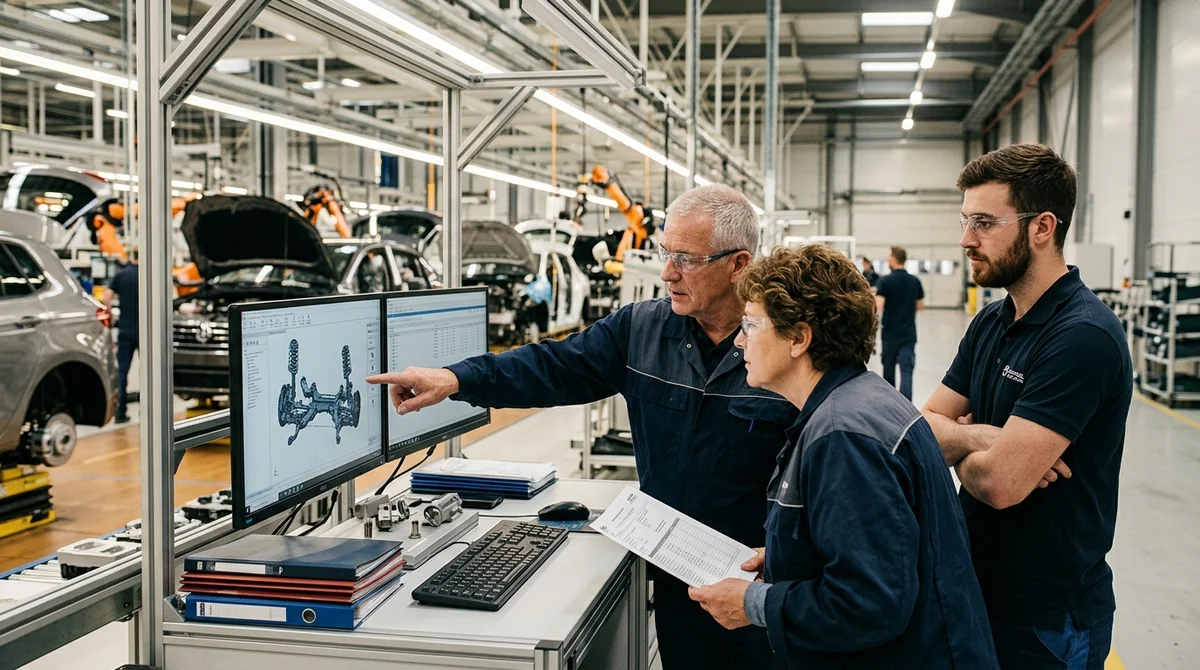
Ford recognized a mistake: the company believed that implementing AI alone would ensure high product quality — and miscalculated. Now the automaker is rehiring experienced "gray-bearded" engineers it previously laid off as part of production optimization.
AI Bet Didn't Pay Off
Ford had been actively cutting experienced staff for several years, betting on automation and artificial intelligence. The logic seemed sound: AI would take over complex engineering tasks, costs would drop, development speed would increase. The result was the opposite. Product quality declined — precisely in areas where experienced engineers had invisibly kept production processes under control. The company publicly acknowledged the miscalculation:
"We mistakenly believed that the implementation of artificial
intelligence itself... would ensure a high-quality product."
This is a frank admission — rare for a major automaker. Ford became one of the few companies openly discussing the failure of an "automation first, people second" strategy.
AI is effective where a task is well-defined and backed by quality data. But in automobile manufacturing, a significant portion of valuable knowledge exists implicitly: experience, intuition, memory of past mistakes. This is precisely the knowledge Ford lost along with its departed veterans.
Who Are the "Gray Beards"
"Gray beards" is an informal American term for engineers with years of production experience. These are specialists who remember why a particular technical decision was made a decade ago, who can read indirect signals of impending problems, and who know whom to consult in non-standard situations. Such expertise is poorly suited to formalization. It exists as intuition accumulated over years at a specific production facility — and this is precisely what AI could not replicate. An algorithm can process millions of data points — but it doesn't know what it doesn't know. An experienced engineer knows and warns.
The value of such specialists manifests across several dimensions:
- Knowledge of history: why exactly this way — and not another
- Ability to predict failures by indirect signs
- Informal connections within the production chain
- Ability to work with exceptions where algorithms fail
- Institutional memory of past mistakes and their cost
When companies mass-layoff such employees in pursuit of automation, they lose not just workers. They lose knowledge that cannot be loaded into a model: the carriers themselves cannot fully formulate it.
Why This Matters for the Entire Industry
Ford's story is not an exception. A similar cycle appears in aerospace, pharmaceuticals, energy: staff optimization → automation → quality decline → forced return to people. Everywhere the product is complex and the cost of error is high, this pattern repeats.
The problem is not AI as such. The problem is that the technology was implemented as a replacement for expertise, not as its amplifier. AI works well where a task is clearly defined, data is complete, and patterns repeat. In the production of complex products, a significant portion of valuable knowledge remains implicit — and here there is no doing without people.
It is telling that Ford, not a technology company, became the author of this admission. The automotive industry is where expertise is measured in decades, and one mistake can cost thousands of market recalls.
What This Means
Ford openly acknowledged: AI does not replace human expertise — it complements it. This lesson is important for the entire market. Before cutting experienced specialists for automation's sake, it's worth honestly answering the question: what exactly do they do that cannot be described as a task for an algorithm?
Executive AI Consulting, Custom Agents & Team Workshops
Work directly with Zhemal Khamidun at hamidun.com — enterprise AI architecture, production RAG & multi-agent systems, and executive training.
The AI world, distilled — once a week
Seven stories that actually mattered, hand-picked. No noise, no reposts, no press releases.
Done! Check your inbox for a confirmation.