Sber neural network learns to predict events using object detection methods
Andrey Savchenko and Ivan Karpukhin of Sber AI Lab presented a long-horizon event forecasting method at AAAI 2026. The method draws on an analogy with object detection. A detector answers "what" and "where" in an image. An event model answers "what" and "when" on a timeline. The method applies to predicting bank transactions, medical procedures and user activity on social networks.
AI-processed from Habr AI; edited by Hamidun News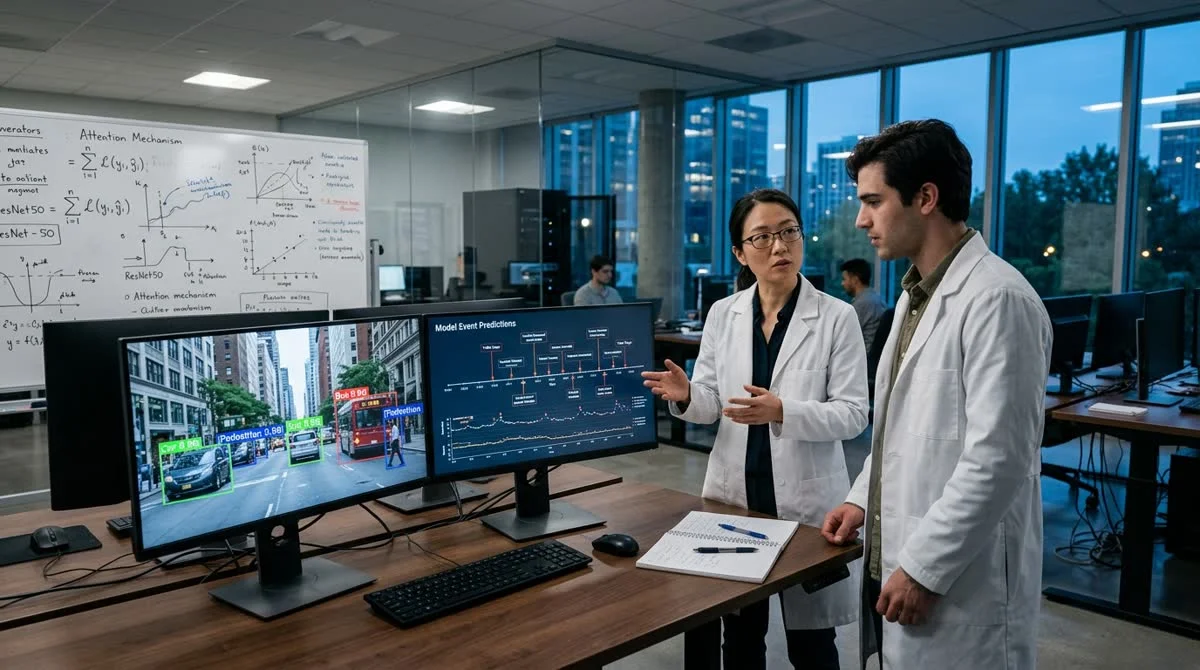
Sber AI Lab has unveiled a neural network that applies object detection methods from computer vision to forecasting event sequences.
What analogy underpins the method
Object detection in an image answers exactly two questions: what is in the photo, and where exactly the object is. Event forecasting works the same way: which event happens next, and exactly when it will happen. The researchers proposed formally mapping the two-dimensional image space onto a one-dimensional time axis. That mapping let them carry an entire class of object detection algorithms over to time series modeling.
At first glance, the parallel isn't obvious. A detector looks for cars, people and road signs in a photo, while a forecasting model predicts a bank customer's next transaction or a sequence of medical prescriptions. But at the level of the mathematical problem statement, the gap turned out to be smaller than it looks. An object detector outputs "class + coordinate" pairs; an event model outputs "event type + time of occurrence" pairs. In essence, it is the same two-part problem laid out in different spaces.
Which tasks does this method work for?
The authors identify several applied areas where transferring the methodology makes particular sense:
- Banking analytics — predicting a customer's next transactions and purchases from their transaction history
- Medical modeling — forecasting the sequence of procedures and the intervals between them
- Social media behavior — predicting user activity and how it changes over time
In each of these scenarios, the model has to predict both the type of the next event and when it will occur. That is exactly the setup an object detector faces: not just "what," but also "when." This structural similarity made it possible to transfer architectural designs and training heuristics that computer vision researchers have refined for years.
The authors stress that the choice of these areas is deliberate. All three deal with long historical sequences, where identifying the type of the next event matters as much as predicting its timing accurately.
Why is this approach promising?
The authors place the work within a broader trend in AI research over the past decade: the most productive ideas have emerged not within a single field but where several fields meet. Transformers first appeared in natural language processing, then radically changed computer vision, and today form the basis of virtually every modern ML architecture.
"Unexpectedly, it turned out that many ideas that have long been standard in object detection offer a fundamentally different way to look at forecasting future events,"
Savchenko and Karpukhin said in their AAAI 2026 presentation.
Transferring the object detection toolkit means that years of accumulated experience — architectures, training methods, heuristics for working with annotated data — are not limited to computer vision. They can be rethought for banking AI, medical analytics and behavioral modeling.
Publication at AAAI 2026, one of the most authoritative artificial intelligence conferences, means the research passed rigorous peer review by the scientific community.
What this means
Sber AI Lab's work illustrates a productive strategy: instead of building specialized architectures from scratch, look for structural similarities with problems that are already well solved. The boundary between computer vision and time series forecasting turns out to be arbitrary. That opens a direct path for carrying decades of accumulated methods into fields where they have not yet been applied.
How does Sber's neural network predict events?
It uses the same principle as object detection systems: it determines what will happen next in a video sequence and exactly when it will happen.
- Nov 1, 2026Pika Labs releases open video model H3 Flex: 6 steps instead of 50
- Nov 1, 2026Google taught its StreamVibe video agent to decide when to step in on its own: +10.7%
- Oct 31, 2026AI cartoon series: a 24-second episode built ten ways, the best cost 162 credits
- Oct 31, 2026Anthropic: Fold Subagents Back Into a Single Loop — One Customer's Tasks Ran Twice as Fast
Key Questions Answered
Which tasks does this method work for?
The authors identify several applied areas where transferring the methodology makes particular sense: Banking analytics — predicting a customer's next transactions and purchases from their transaction history Medical modeling — forecasting the sequence of procedures and the intervals between them Social media behavior — predicting user activity and how it changes over time In each of these scenarios, the model has to predict both the type of the next event and when it will occur. That is exactly the setup an object detector faces: not just "what," but also "when." This stru
Why is this approach promising?
The authors place the work within a broader trend in AI research over the past decade: the most productive ideas have emerged not within a single field but where several fields meet. Transformers first appeared in natural language processing, then radically changed computer vision, and today form the basis of virtually every modern ML architecture. "Unexpectedly, it turned out that many ideas that have long been standard in object detection offer a fundamentally different way to look at forecasting future events," Savchenko and Karpukhin said in their AAAI 2026 presentation
How does Sber's neural network predict events?
It uses the same principle as object detection systems: it determines what will happen next in a video sequence and exactly when it will happen.
Test Frontier LLMs & Autonomous Agents in One Workspace
Run Claude Opus 5.5, GPT-6, Gemini 3.1, and DeepSeek side-by-side in Nomad AI (nomadnet.ai) — unified model routing, deep research, and multimodal workflows under one subscription.
The AI world, distilled — once a week
Seven stories that actually mattered, hand-picked. No noise, no reposts, no press releases.
Done! Check your inbox for a confirmation.