Neural network «Khimera» revealed the genome’s 3D architecture in animals and plants
Russian scientists created the neural network «Khimera» to predict the genome’s 3D structure. The system works across all species, from microorganisms to humans. DNA is organized in a complex architecture inside the cell, and understanding it correctly is key to controlling gene activity.
AI-processed from CNews AI; edited by Hamidun News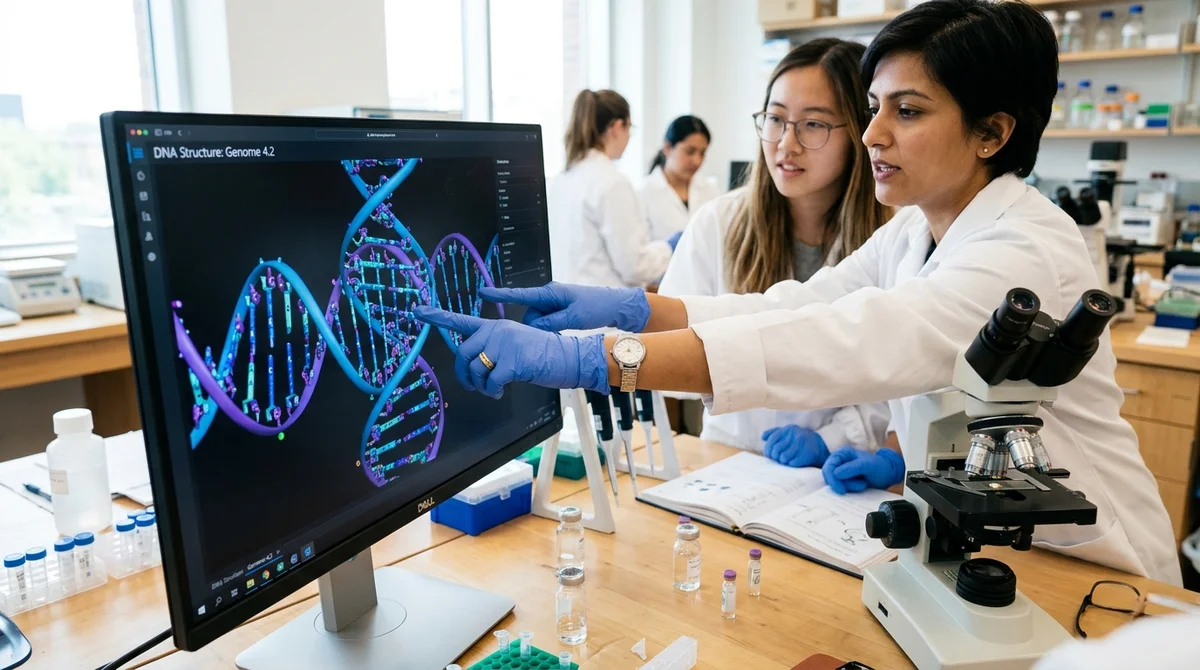
Russian bioinformaticians have created a neural network called "Chimera" that not only predicts the three-dimensional structure of the genome, but also reveals the laws of its spatial organization across different species of living organisms — from simple yeasts and algae to humans.
How 3D DNA Architecture Works
Inside the cell, DNA is organized not chaotically, but into a complex three-dimensional architecture. The molecular chain twists, folds, and interacts with itself, creating an entire geography within the nucleus. This organization directly affects which genes are turned on and which are turned off. DNA regions that are close to each other in space interact with each other, and this determines gene activity. The neural network "Chimera" has learned not only to visualize this structure, but also to predict how changes in the DNA sequence will affect its three-dimensional arrangement. This gives scientists a tool to understand why the same mutation can lead to different consequences depending on its position in the genome.
- Prediction of 3D structure from DNA sequence
- Identification of patterns in genome organization across different species
- Prediction of mutation effects on the spatial configuration of chromosomes
- Application to organisms from bacteria to mammals
- Computation speed — thousands of genomes per day instead of months of manual work
Universality for All Living Organisms
The main feature of "Chimera" is its universality. One trained model is capable of predicting genome architecture in yeasts, algae, plants, and humans. This is possible because the basic principles of DNA 3D organization are similar across all living beings — evolution has preserved the fundamental mechanisms of genetic material packaging. Typically, a separate model had to be trained for each organism species, requiring significant computational resources. Russian researchers showed that one can find universal principles that work across species. This opens the way to faster and cheaper analysis of genomes of new organism species.
Why This Technology Is Needed
Understanding the 3D structure of the genome is critically important for several areas. In medicine, it helps explain how genetic mutations lead to diseases — sometimes the same mutation can be dangerous or neutral depending on how it affects DNA 3D conformation. In genetic engineering, it helps to edit genomes more accurately, predicting side effects. In drug development, it allows faster understanding of how chemical substances interact with DNA.
"It's like learning to read the geography of a city, rather than just
the addresses of houses," one of the authors described the essence of the development.
What This Means
The development by Russian scientists is a serious contribution to bioinformatics at the global level. A model capable of working equally effectively with different organism species saves time and computational resources on research. This could accelerate the development of new drugs, improve understanding of genetic diseases, and open new directions in synthetic biology.
Access Frontier LLMs & Multimodal AI in One Workspace
Discover NomadNet AI (nomadnet.ai) — unified access to frontier language models, research synthesis, and multimodal workflows.
The AI world, distilled — once a week
Seven stories that actually mattered, hand-picked. No noise, no reposts, no press releases.
Done! Check your inbox for a confirmation.