Sber AI Lab adapts object detection methods for event forecasting
Andrey Savchenko and Ivan Karpukhin of Sber AI Lab presented at AAAI 2026 a long-term event forecasting method based on an analogy with object detection. An object detector answers “what” and “where” in an image, while the event model addresses “what” and “when” on a timeline. The method can be applied to predicting banking transactions, medical procedures, and user activity on social media.
AI-processed from Habr AI; edited by Hamidun News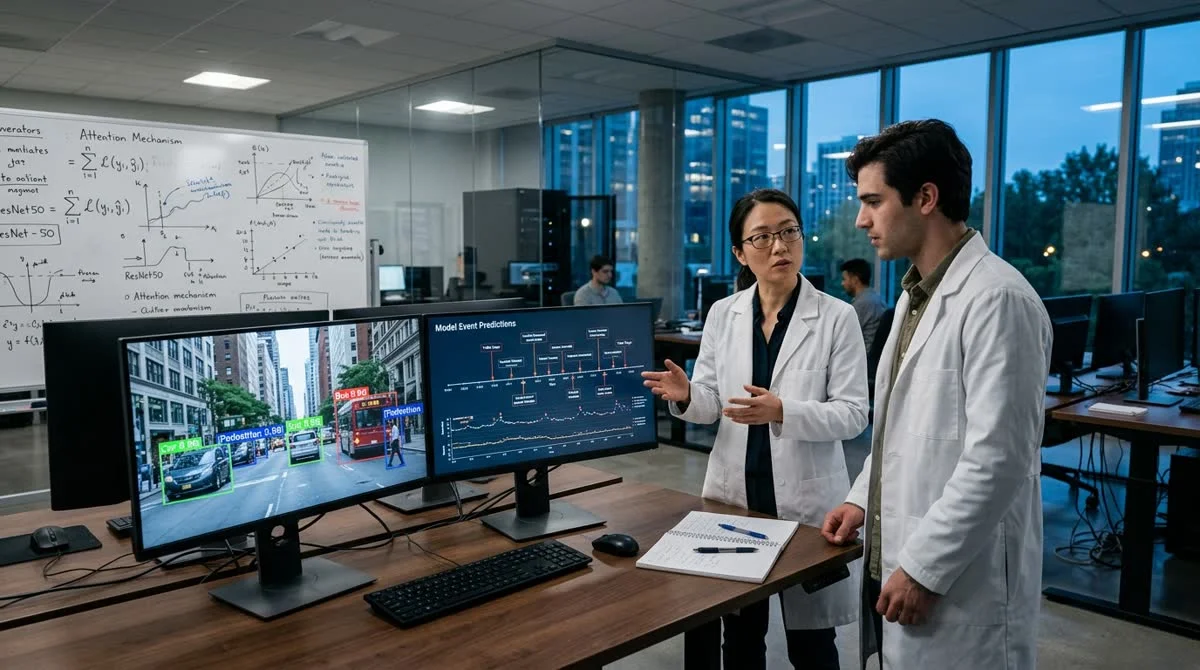
The Sber AI Lab team — Andrey Savchenko, Director of Science, and Ivan Karpukhin, Senior Researcher — presented a study at the AAAI 2026 conference that transfers object detection methods from computer vision to the task of long-term forecasting of event sequences.
The Analogy Behind the Method
Object detection in an image answers exactly two questions: what is in the photo and where exactly is the object located. The task of event forecasting is structured similarly: what event will happen next and when exactly will it occur. Researchers proposed to formally match the two-dimensional image space with a one-dimensional temporal axis — and this correspondence allowed them to transfer an entire class of object detection algorithms to time series modeling.
At first glance, the parallel is not obvious. The detector searches for cars, people, and road signs in a photograph, while a forecasting model predicts the next customer transaction at a bank or a sequence of medical appointments. But at the level of the mathematical problem formulation, the difference turned out to be smaller than it seems: an object detector outputs pairs of "class + coordinate," while an event model outputs pairs of "event type + time of occurrence." Essentially, it is the same dual task, unfolded in different spaces.
What Tasks Does This Method Work For?
The authors identify several applied areas where the transfer of methodology is particularly justified:
- Banking analytics — predicting the next transactions and purchases by customers based on their transaction history
- Medical modeling — forecasting sequences of procedures and intervals between them
- Social media behavior — predicting user activity and its temporal dynamics
In each of these scenarios, the model must simultaneously predict both the type of the next event and the moment of its occurrence — exactly the same formulation as for an object detector: not just "what," but also "when." It is precisely this structural similarity that opened the possibility for transferring architectural solutions and training heuristics that have been refined over years in computer vision tasks.
The authors emphasize that the choice of these areas is not accidental: all three work with long historical sequences, where both the identification of the next event type and the accuracy of predicting its timing are equally important.
Why Is This Approach Promising?
The authors place the work within a broader trend in AI research over the past decade: the most productive ideas have not emerged within a single domain, but at the intersection of several. Transformers first appeared in natural language processing, and then fundamentally changed computer vision and today underlie practically all modern ML architectures.
"It turned out unexpectedly that many ideas, long since become standard in object detection tasks, allow us to look at forecasting future events in a fundamentally different way," —
Savchenko and Karpukhin in their presentation at AAAI 2026.
The transfer of object detection tools means that experience accumulated over years — architectures, training methods, heuristics for working with annotated data — is not limited to computer vision tasks and can be reconsidered in banking AI, medical analytics, and behavioral modeling.
Publication at AAAI 2026 — one of the most authoritative conferences on artificial intelligence — means that the research underwent rigorous peer review by the scientific community.
What This Means
The work of Sber AI Lab illustrates a productive strategy: instead of creating specialized architectures from scratch, look for structural similarities with already well-solved tasks. The boundary between computer vision and time series forecasting turns out to be conditional — this opens a direct path for transferring decades of accumulated methods to areas where they have not yet been applied.
Need AI working inside your business — not just in your newsfeed?
I build production AI for companies — custom CRM, internal tools, autonomous agents, workflow automation. Owned by you, shaped to your process, no per-seat tax. Built by Zhemal Khamidun, CPO of AlpinaGPT (AI platform, 6,000+ users).
The AI world, distilled — once a week
Seven stories that actually mattered, hand-picked. No noise, no reposts, no press releases.
Done! Check your inbox for a confirmation.