AI data centers are changing the nature of power grid loads and creating new risks for operators
AI data centers are consuming more and more electricity, but the real problem is not volume, but the nature of the load. Model training synchronizes thousands of GPUs, generating consumption spikes within milliseconds. Inference is unpredictable in time and location. Together, they create a new type of load that traditional power infrastructure was not designed for.
AI-processed from IEEE Spectrum AI; edited by Hamidun News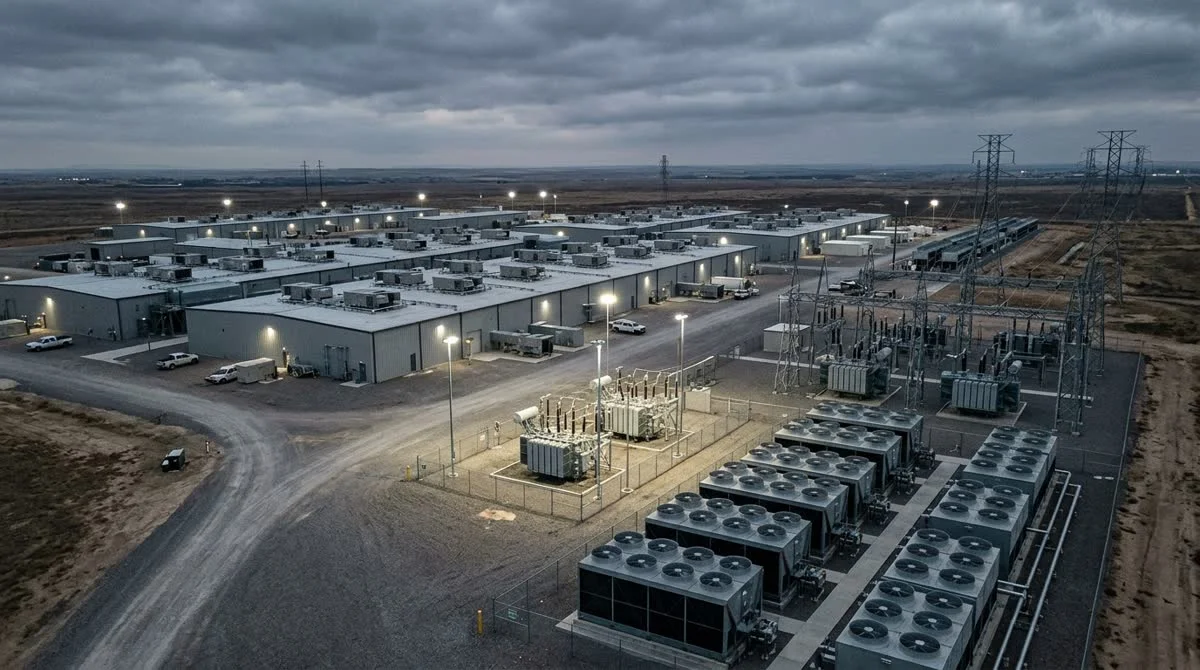
Power grids in data center concentration zones are facing a new type of stress — not simply growth in AI infrastructure consumption, but sharp and unpredictable load spikes from synchronized compute clusters. The International Energy Agency forecasts that by the 2030s, data centers will account for 3–4% of global electricity consumption, yet the real problem extends far beyond simple consumption arithmetic.
How AI Load Differs from Industrial Load
Traditional power grid planning relies on predictable demand profiles: industrial, commercial, and residential consumers follow established patterns that can be forecasted with reasonable accuracy. AI computational infrastructure breaks this rule in two ways simultaneously. Model training — synchronized parallel operation of thousands of GPUs, TPUs, and specialized accelerators — creates sharp, stepwise consumption spikes, including fluctuations in the millisecond range. Inference, that is, operation of already-trained models with actual user requests, is distributed across time and space, and therefore less predictable in location and timing.
- The IEA estimates data centers' share of global electricity consumption at 3–4% by the end of the 2020s
- Load spikes from GPU clusters can occur in the millisecond range
- Operators deploy battery storage, supercapacitors, and power conditioning systems
- The U.S. National Renewable Energy Laboratory (NREL) points to growing complexity in integrating such loads into the grid
Unlike wind and solar generation instability, which arises on the supply side and depends on weather, computational instability is born on the demand side: it is generated by workload synchronization and model training schedules. This creates additional uncertainty for operators regarding reserve management, balancing, and forecasting.
Why Geographic Concentration Matters
The problem intensifies sharply where data centers form clusters. Regions with good fiber optic infrastructure, tax incentives, and historically low electricity rates attract new facilities by the hundreds. The most telling example is Northern Virginia, known as "Data Center Alley": the world's largest concentration of data centers processing a significant share of global internet traffic. The local provider Dominion Energy has repeatedly stated in long-term planning documents that hyperscale facilities became the primary driver of load growth in the region.
Sharp consumption growth in a geographically limited zone creates pressure on substations, transmission lines, and local balancing systems — even when total power system capacity remains sufficient overall. Cooling systems exacerbate the effect: as computational load rises, heat dissipation increases nonlinearly, creating cascading consumption spikes simultaneously across multiple levels of facility infrastructure. The concentration of power converters and high-frequency equipment also generates harmonics that stress distribution infrastructure.
What This Means
Electrical infrastructure scales more slowly than computational infrastructure: while a new data center can be deployed in a few quarters, power system expansion takes years. Regulators, including Texas's ERCOT, acknowledge that large flexible loads — including data centers — require a rethinking of long-term planning approaches. Existing regulatory frameworks were built assuming stable industrial loads and do not account for the highly dynamic behavior of compute clusters. The answer to this challenge is not slowing AI development, but recognizing that hyperscale computing represents a fundamentally new type of electrical load: what matters is not just how much is consumed, but how.
Frequently Asked Questions
What share of global electricity consumption will data centers take up by 2030?
According to International Energy Agency forecasts, by the end of the 2020s, data centers will consume 3–4% of global electricity — comparable to the consumption of entire industrialized nations.
How do data center operators smooth load spikes?
Currently, battery storage, supercapacitors, and power conditioning systems are deployed directly on-site. In parallel, flexible scheduling of compute tasks, local backup generation, and joint demand management programs with utility companies are being explored.
Want to stop reading about AI and start using it?
AI News is a curated feed of AI/tech news. Hamidun Academy teaches you to use AI systematically in your work.
The AI world, distilled — once a week
Seven stories that actually mattered, hand-picked. No noise, no reposts, no press releases.
Done! Check your inbox for a confirmation.