ASML CEO on demand for AI chips, space data centers, and Musk's Terafab plant
ASML CEO Christophe Fouquet said in an interview with Bloomberg that demand for AI infrastructure remains "huge." The company is making sure it does not face supply shortages while serving megaprojects — in particular Elon Musk's Terafab plant. Fouquet also said orbital data centers could become a realistic long-term scenario for the industry.
AI-processed from Bloomberg Tech; edited by Hamidun News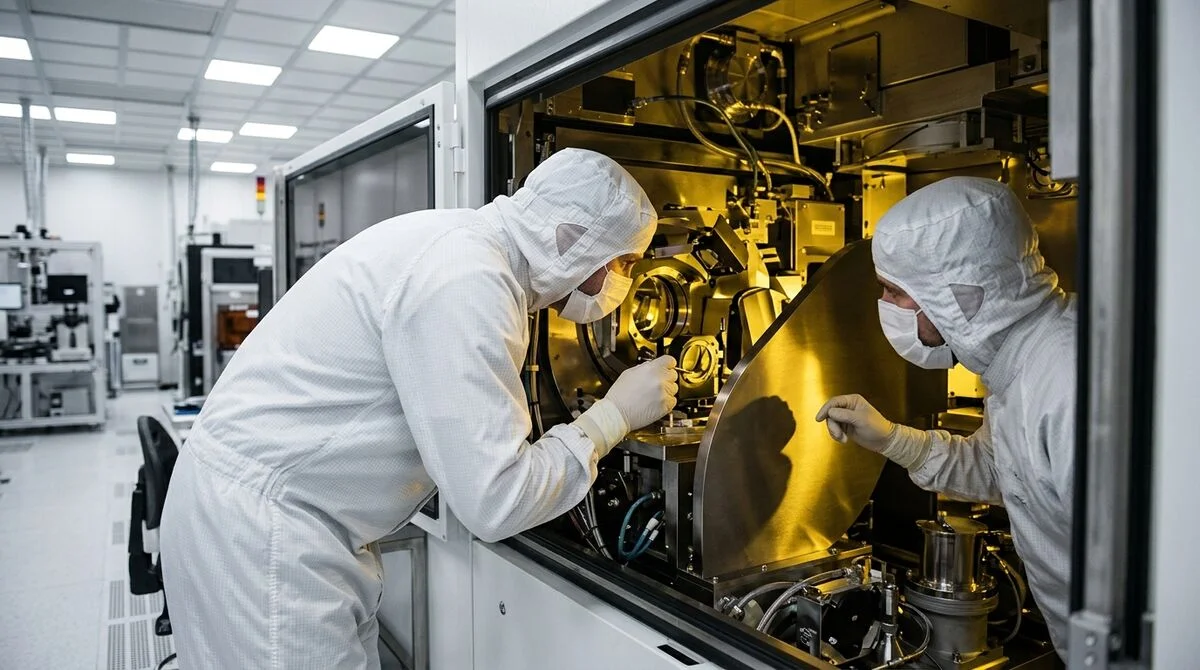
CEO of ASML Christophe Fouquet gave an interview to Bloomberg Television in which he assessed the state of the AI-chip market, outlined promising directions for data centers, and commented on cooperation with new mega-projects — including Ilona Musk's Terafab factory.
Demand is not falling
Despite concerns from some analysts that the AI investment bubble could burst, Fouquet is optimistic. According to him, the need for equipment to build AI data centers remains "enormous" — and he does not expect market saturation in the near future.
ASML produces EUV lithography machines — the only equipment in the world capable of creating structures of 5 nanometers and smaller. Without it, it is impossible to produce modern AI accelerators: neither NVIDIA will build the next Blackwell, nor TSMC will open new capacities. This makes ASML a unique indicator of real demand: contracts for EUV machines reflect what technology companies plan to build in 2–3 years. In Fouquet's opinion, this investment cycle is still far from complete.
Terafab Musk: a new class of load
One of the loudest new clients — Terafab, Ilona Musk's production mega-project. If previous ASML customers are established semiconductor giants with proven processes, then Terafab represents a different category: rapidly growing, ambitious, and difficult to predict in terms of request volumes. Fouquet acknowledged that when such projects scale up, ASML must be confident that there are no bottlenecks in the supply chain.
- Terafab — Musk's mega-project for producing next-generation AI chips
- ASML supplies EUV equipment, without which it is impossible to produce advanced chips
- The company is working to prevent interruptions during rapid order growth
- Pressure from mega-projects strains ASML's own production capacities
- The question "who produces machines for chip manufacturers" becomes strategic
Data centers in space
Fouquet touched on an unexpected topic — the possibility of placing computing power beyond Earth. A CEO at ASML's level spoke about this not as fiction, but as a realistic long-term scenario.
"Demand for AI infrastructure remains enormous,"
Fouquet said on Bloomberg Television.
The topic of space data centers is gaining momentum against the backdrop of growing power consumption of AI clusters. Modern centers for training neural networks consume hundreds of megawatts — and this leads to competition with residential areas for access to the power grid and a shortage of cooling water. In theory, orbital facilities can receive solar energy around the clock and dissipate heat into the vacuum. The main obstacles so far remain channel delay and the cost of launching equipment into orbit.
What this means
ASML is a key supplier in the global semiconductor supply chain, and the words of its CEO are a market signal: the AI boom continues. Mega-projects like Terafab create a new class of pressure on equipment manufacturers, and ASML's ability to handle it without failures will largely determine the speed of building next-generation AI infrastructure.
Want to stop reading about AI and start using it?
AI News is a curated feed of AI/tech news. Hamidun Academy teaches you to use AI systematically in your work.
The AI world, distilled — once a week
Seven stories that actually mattered, hand-picked. No noise, no reposts, no press releases.
Done! Check your inbox for a confirmation.