NVIDIA: how to design battery energy storage systems for AI factories
AI factories consume power differently from conventional data centers: loads are unpredictable, power density is higher, and downtime is unacceptable. NVIDIA has published guidance on designing battery energy storage systems (BESS) specifically for such facilities, taking into account agentic models, peak loads, and power reliability requirements.
AI-processed from NVIDIA Developer Blog; edited by Hamidun News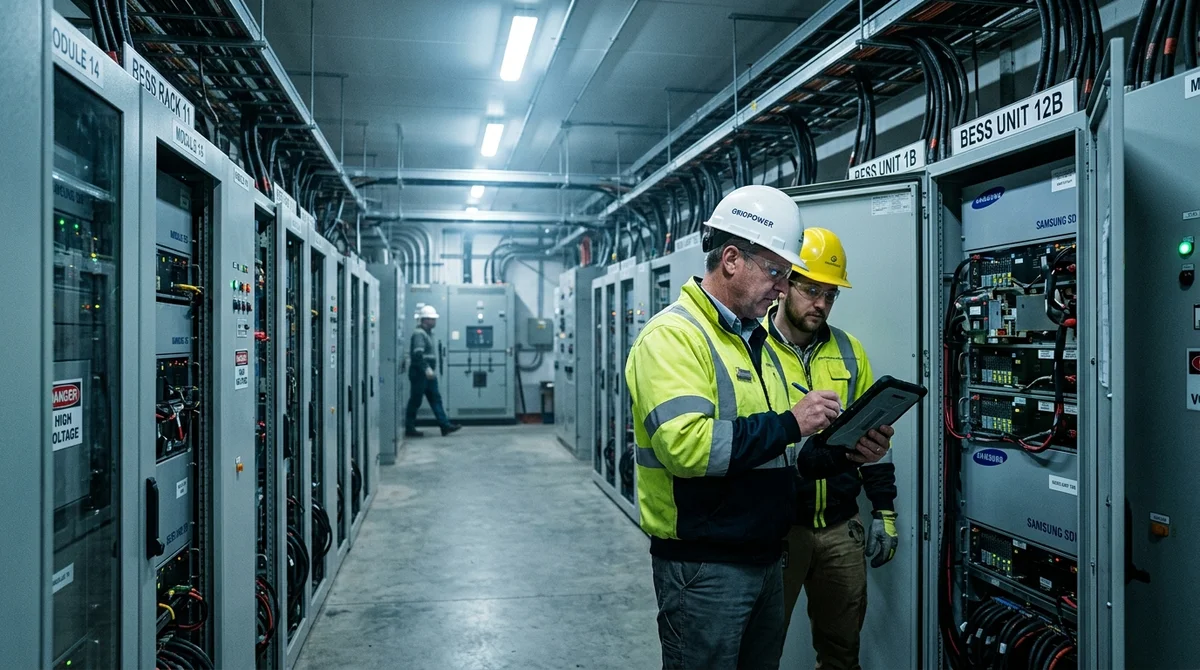
AI factories are not just more powerful data centers. They are facilities that produce intelligence at industrial scales, where each power outage costs significantly more than in a typical server room.
Why AI factories need a special approach
Traditional uninterruptible power supply (UPS) systems were designed for loads that change gradually and predictably. AI factories operate differently: training large language models creates sharp spikes in energy consumption, inference loads change on a schedule, and agent and reasoning systems add non-stationary patterns that are almost impossible to predict in advance. Under such conditions, standard UPS solutions cannot do their job. Battery Energy Storage Systems (BESS) take on a fundamentally different role: they don't just maintain power during network failure, but actively participate in consumption management on an ongoing basis. BESS smooths peak loads, provides bridging power when switching between sources, and reduces costs by optimizing consumption during low-tariff periods.
Key requirements for BESS
NVIDIA describes several technical aspects that fundamentally distinguish BESS for AI factories from standard data center solutions:
- Power density — GPU clusters consume from 30 to 120+ kW per rack, which is tens of times higher than standard server racks. The storage system must withstand such levels without cell degradation and capacity loss.
- Response time — BESS must respond to load changes in milliseconds to avoid interrupting delay-sensitive computations.
- Thermal management — high discharge density heats batteries significantly faster than in standard modes; without proper cooling, battery lifespan is dramatically reduced and risks increase.
- BMS integration — the battery management system must work closely with the energy orchestrator of the entire facility, receiving and processing load data in real time.
- Fault tolerance — the architecture must eliminate single points of failure, because unplanned GPU cluster downtime costs significantly more than ordinary server downtime.
Proactive management instead of reactive
The key shift that NVIDIA describes is the transition from reactive to proactive energy management. A traditional data center responds to failures after they occur: the network goes down — the generator switches on. An AI factory must operate fundamentally differently: predict consumption in advance, coordinate BESS with diesel generators and the grid simultaneously, and do this in fully automatic mode.
"AI factories must produce intelligence with predictable performance even with rapidly changing demand for computing,"
NVIDIA states. This requires a different design philosophy: not "how to maintain power at a critical moment," but "how to optimize energy flow continuously." BESS ceases to be a backup solution for emergencies and becomes an active element of the energy architecture that works all the time.
Another important aspect is scalability. AI factories increase computing capacity quickly and iteratively, and energy infrastructure must scale with them. This means a modular BESS architecture that can be expanded in stages without redesigning the entire system and lengthy downtime.
What this means
NVIDIA's guidance sets benchmarks for an industry that is only beginning to form. As AI factories become the primary infrastructure for training and running large models, proper BESS design transforms from a technical detail into a strategic decision — it affects both operational reliability and the total cost of ownership of the facility. Companies that don't account for these requirements when building will face costly upgrades within a few years.
- Oct 24, 2026GPT-6 Sol Daybreak Blue Tops Cyber Index: +32 Points and $1.77 per Task
- Oct 24, 2026Harvey LAB-AA v1.1: Grok 4.7 Leads With 9.4% After Hallucination Check
- Oct 24, 2026Anthropic's agents submitted 20 visa applications on a US State Department website
- Oct 24, 2026Artificial Analysis launches AA-3D: Claude Sonnet 5.5 leads with 1194 Elo
Key Questions Answered
Why AI factories need a special approach?
Traditional uninterruptible power supply (UPS) systems were designed for loads that change gradually and predictably. AI factories operate differently: training large language models creates sharp spikes in energy consumption, inference loads change on a schedule, and agent and reasoning systems add non-stationary patterns that are almost impossible to predict in advance. Under such conditions, standard UPS solutions cannot do their job. Battery Energy Storage Systems (BESS) take on a fundamentally different role: they don't just maintain power during network failure, but a
What are the key details on Key requirements for BESS?
NVIDIA describes several technical aspects that fundamentally distinguish BESS for AI factories from standard data center solutions: Power density — GPU clusters consume from 30 to 120+ kW per rack, which is tens of times higher than standard server racks. The storage system must withstand such levels without cell degradation and capacity loss. Response time — BESS must respond to load changes in milliseconds to avoid interrupting delay-sensitive computations. Thermal management — high discharge density heats batteries significantly faster than in standard modes; without pr
What are the key details on Proactive management instead of reactive?
The key shift that NVIDIA describes is the transition from reactive to proactive energy management. A traditional data center responds to failures after they occur: the network goes down — the generator switches on. An AI factory must operate fundamentally differently: predict consumption in advance, coordinate BESS with diesel generators and the grid simultaneously, and do this in fully automatic mode. "AI factories must produce intelligence with predictable performance even with rapidly changing demand for computing," NVIDIA states. This requires a different design philos
Delegate Deep Research, Coding & Workflows to an AI Agent
Deploy autonomous multi-step execution with NomadNet Agent (agent.nomadnet.ai) — automated web research, data synthesis, code generation, and complex task orchestration.
The AI world, distilled — once a week
Seven stories that actually mattered, hand-picked. No noise, no reposts, no press releases.
Done! Check your inbox for a confirmation.