Proception settles Tesla lawsuit and raises $11M for robotic hands
Startup Proception, founded by Jay Lee, a former Tesla Optimus engineer, has settled a year-long trade-secret theft lawsuit with Tesla and immediately closed an $11M round led by First Round Capital. The company builds high-precision robotic hands, a problem Tesla has so far failed to solve for Optimus. The first batch has already shipped to researchers.
AI-processed from TNW; edited by Hamidun News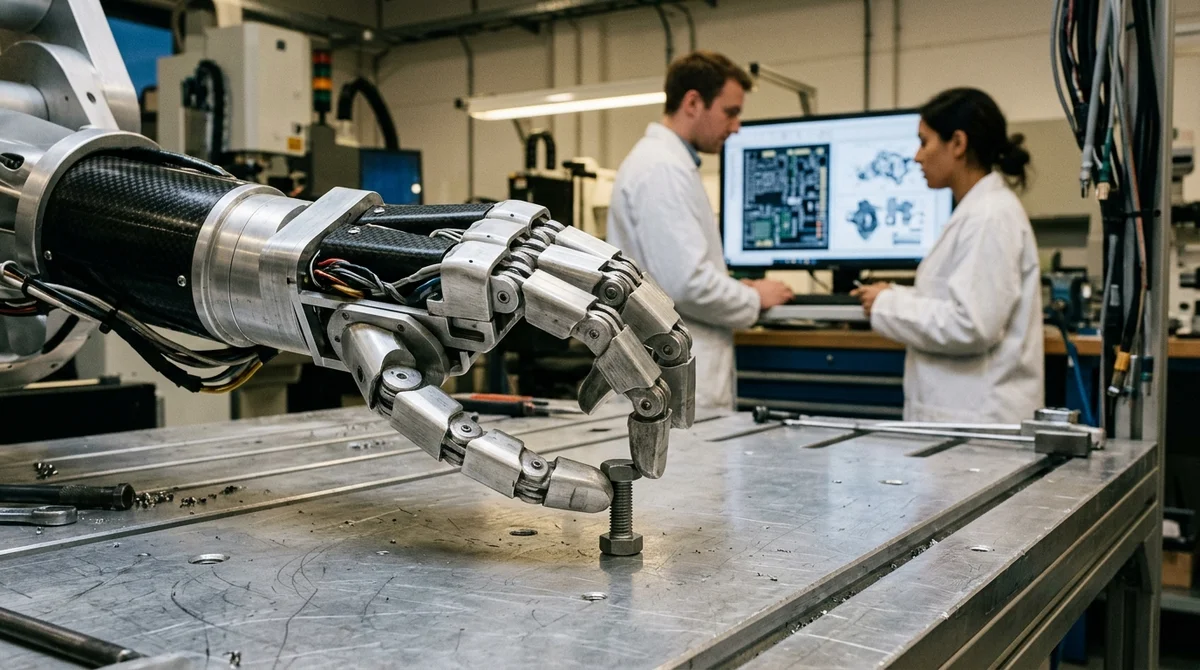
Startup Proception has settled a year-long legal dispute with Tesla over the alleged theft of trade secrets and immediately raised $11M in seed funding. Behind the story is Jay Lee, a former Tesla Optimus engineer, and a problem Musk has yet to solve for his flagship robot: truly dexterous, high-precision robotic hands.
A year in court, then a settlement
Tesla sued Jay Lee soon after he left the Optimus team and founded Proception. The company accused the former engineer of using confidential developments and trade secrets to build a competing technology in the same field: robotic manipulators. The dispute lasted about a year.
The parties are not disclosing the terms of the settlement, which is standard practice in cases like this. But the settlement itself matters a great deal: Proception can now work without legal uncertainty hanging over it. The fact that the company announced the close of its round right after the settlement suggests that talks with investors ran in parallel, and that investors wanted a clean legal slate before coming in.
$11M from First Round Capital
The round was led by First Round Capital, one of the most respected early-stage venture funds. Over the years its portfolio has included Uber, Airbnb and Notion. An investor knowingly backing a startup that has only just emerged from a legal fight with Tesla is a strong signal of confidence in the team and the technology.
Proception has already moved from development to an actual product: the first batch of high-precision robotic hands has shipped to research teams. That means the product exists in metal, not just in a pitch deck.
The problem Tesla did not solve
High-precision robotic hands, known as dexterous hands, are among the hardest engineering frontiers in humanoid robotics. The human hand performs thousands of types of movement with fine control of force and speed. Nobody has yet reproduced this mechanically at industrial level.
This is the problem Jay Lee worked on at Tesla. According to Proception, Optimus still cannot reliably handle a number of basic manipulations:
- Handling small fasteners such as bolts, nuts and connectors
- Controlling grip force on fragile or soft objects
- Adapting the grip to an unfamiliar object shape in real time
- Coordinating all five fingers on complex tasks
"We are building hands that Tesla has still not managed to build,"
Proception representatives said in an interview with TechCrunch.
The humanoid boom as backdrop
Proception's story unfolds at a time of record investor interest in humanoid robots. Figure AI, 1X Technologies, Agility Robotics and Apptronik have each raised hundreds of millions of dollars in pursuit of the "robot worker" niche in factories and warehouses. Tesla Optimus remains the highest-profile player in this race, but its concrete technical results do not yet match the scale of its promises.
Modular solutions like Proception's hands could become a strategically important link for the whole industry. If the startup has really solved a problem others could not, it has a chance to become a key component supplier to competitors.
What this means
The settlement removed the main legal risk, the First Round Capital round provides resources to scale, and the first deliveries to researchers confirm that the product is real. If Proception's high-precision hands really outperform what Optimus has, the company holds a rare position: a key technology for an industry that is only beginning to pick up speed.
- Oct 31, 2026Author puts his script before an AI jury: the verdict cost 850 thousand tokens
- Oct 29, 2026OvisOCR3: an 0.8B-parameter model that reads documents better than specialized systems
- Oct 29, 2026Tencent releases Youtu-Parsing-Omni: one model parses documents, audio and video
- Oct 28, 2026Liquid AI releases LFM2.5-24B-A2B: an agent model with 2B active parameters
Key Questions Answered
What are the key details on A year in court, then a settlement?
Tesla sued Jay Lee soon after he left the Optimus team and founded Proception. The company accused the former engineer of using confidential developments and trade secrets to build a competing technology in the same field: robotic manipulators. The dispute lasted about a year. The parties are not disclosing the terms of the settlement, which is standard practice in cases like this. But the settlement itself matters a great deal: Proception can now work without legal uncertainty hanging over it. The fact that the company announced the close of its round right after the settl
What are the key details on $11M from First Round Capital?
The round was led by First Round Capital, one of the most respected early-stage venture funds. Over the years its portfolio has included Uber, Airbnb and Notion. An investor knowingly backing a startup that has only just emerged from a legal fight with Tesla is a strong signal of confidence in the team and the technology. Proception has already moved from development to an actual product: the first batch of high-precision robotic hands has shipped to research teams. That means the product exists in metal, not just in a pitch deck.
What are the key details on The problem Tesla did not solve?
High-precision robotic hands, known as dexterous hands, are among the hardest engineering frontiers in humanoid robotics. The human hand performs thousands of types of movement with fine control of force and speed. Nobody has yet reproduced this mechanically at industrial level. This is the problem Jay Lee worked on at Tesla. According to Proception, Optimus still cannot reliably handle a number of basic manipulations: Handling small fasteners such as bolts, nuts and connectors Controlling grip force on fragile or soft objects Adapting the grip to an unfamiliar object shape
Test Frontier LLMs & Autonomous Agents in One Workspace
Run Claude Opus 5.5, GPT-6, Gemini 3.1, and DeepSeek side-by-side in Nomad AI (nomadnet.ai) — unified model routing, deep research, and multimodal workflows under one subscription.
The AI world, distilled — once a week
Seven stories that actually mattered, hand-picked. No noise, no reposts, no press releases.
Done! Check your inbox for a confirmation.