Tesla prepares a serial rollout of Optimus Gen 3 and shows almost human-like robot hands
Tesla is moving Optimus from the stage of a flashy prototype to production preparation. At a demonstration in Austin, the robot carefully handed out bottles of water, while the main news was its new hands with 22 degrees of freedom and tactile feedback. At the same time, the company is expanding its robotics team and preparing Gen 3 for a pilot production run as early as 2026.
AI-processed from Habr AI; edited by Hamidun News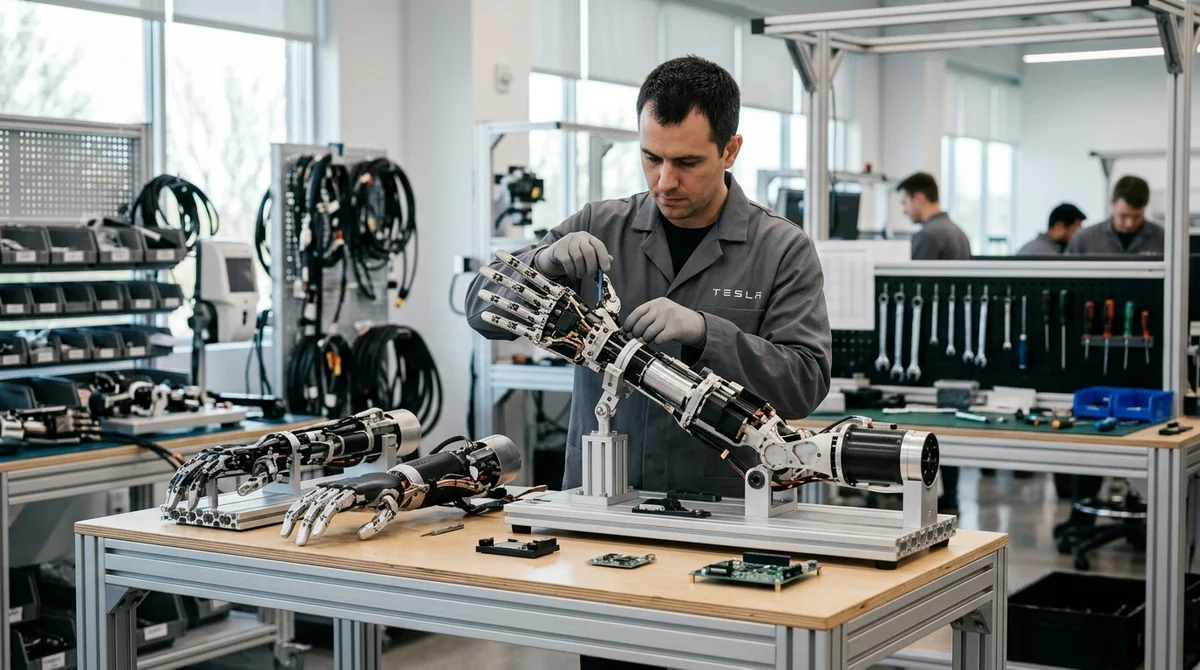
Tesla has unveiled the most significant upgrade to its Optimus humanoid robot ahead of serial production: new hands that are structurally and dextrously much closer to human hands. At the same time, the company is expanding its robotics division and preparing Gen 3 for the production phase.
New Hands for Optimus
At a recent Tesla event in Austin, the public saw for the first time an intermediate version of Optimus 2.5, which is intended to become the basis for Gen 3. Rather than a lab demonstration, the robot worked in a public environment and handed water bottles to guests.
Such a scenario looks simple from the sidelines: the machine needs to recognize the object, assess its shape and fragility, and then adjust the force so that the bottle doesn't slip out and doesn't get crushed in the grip. Tesla's main emphasis was on the hands. The company brought the mechanics closer to human anatomy and achieved finer motor skills than in the previous version.
For a humanoid robot, this is a critical point: many can already walk and carry boxes, but few can carefully interact with objects of different shapes and rigidity. If early Optimus prototypes were perceived more as an industrial manipulator in human form, the project is now starting to look like a platform for more universal physical work.
"The finished product won't even look like a classical robot."
What Changed in the Hand
The new hand design was a key engineering step towards Gen 3. Tesla is trying to solve two tasks at once: maintain strength for real work and simultaneously give the robot delicacy, without which it cannot safely interact with objects, tools, and people. Hence the noticeable shift in architecture: some heavy components are moved from the hand higher up the arm, so the palm itself becomes lighter, faster, and more precise in movement.
- 22 degrees of freedom in the hand and 3 more in the wrist instead of 11 in the previous generation
- 25 actuators are placed in the forearm, with fingers controlled through a tendon-like cable system
- the claimed motor precision reaches 0.08 mm with hand lifting capacity up to 20 kg
- tactile sensors are built into fingertips for force feedback
- in the final version, moisture protection is expected for working with water, soap, and hot steam
This set of characteristics is not needed just for an impressive demo. If Tesla truly brings this mechanics to stable operation, Optimus will be able to handle fragile objects, work on assembly lines, perform cleaning, and execute repetitive operations where ordinary industrial robots lack flexibility. For business, this is more important than any presentation scene: value will only emerge when the robot can reliably do useful work in shifts, not minutes.
Path to Series Production
The Austin presentation demonstrated progress while reminding that fully autonomous product is still far off. In the street demonstration, the robot operated with a connected power cable, and after the event it was transported in wooden shipping boxes on a hand cart. This is a good indicator of the current stage: the mechanics itself already looks convincing, but the infrastructure for operation, charging, logistics, and service maintenance is still being formed. Nevertheless, Tesla promises up to 24 hours of autonomous operation from its own batteries at release.
Still, Tesla is clearly accelerating the program. The company has opened over 140 positions in robotics and is building a roadmap for scaling. HW5, conceptually close to the system Tesla is developing for autonomous driving, is being used as the computational platform for Optimus. According to plan, pre-production of Gen 3 should begin in summer 2026 in Fremont, then over 1000 robots are to be deployed in their own factories, and limited B2B sales at prices above $100,000 could start by the end of 2026. The company links entry to the mass market with 2027.
What This Means
Optimus is ceasing to be a showpiece project and becoming Tesla's production stake. If the company can combine precise hand mechanics, autonomy, service infrastructure, and acceptable manufacturing cost, the humanoid robot market may for the first time get not an exhibition sample, but a working platform for factories, warehouses, and some service tasks. This very transition from an impressive prototype to repeatable real-world operation will be the true test for the entire category.
Need AI working inside your business — not just in your newsfeed?
I build production AI for companies — custom CRM, internal tools, autonomous agents, workflow automation. Owned by you, shaped to your process, no per-seat tax. Built by Zhemal Khamidun, CPO of AlpinaGPT (AI platform, 6,000+ users).
The AI world, distilled — once a week
Seven stories that actually mattered, hand-picked. No noise, no reposts, no press releases.
Done! Check your inbox for a confirmation.