AI companies aren't raising prices for users while Nvidia and Micron book windfall profits
Nvidia and Micron Technology are setting profit records on the AI boom, and the memory shortage for neural networks will last until at least the end of 2026. Meanwhile, the developers of the models themselves, including OpenAI, Anthropic and Google, are in no rush to raise prices for users. The current "banquet" is being paid for by investors: API prices are being held artificially low while venture capital covers the losses.
AI-processed from 3DNews AI; edited by Hamidun News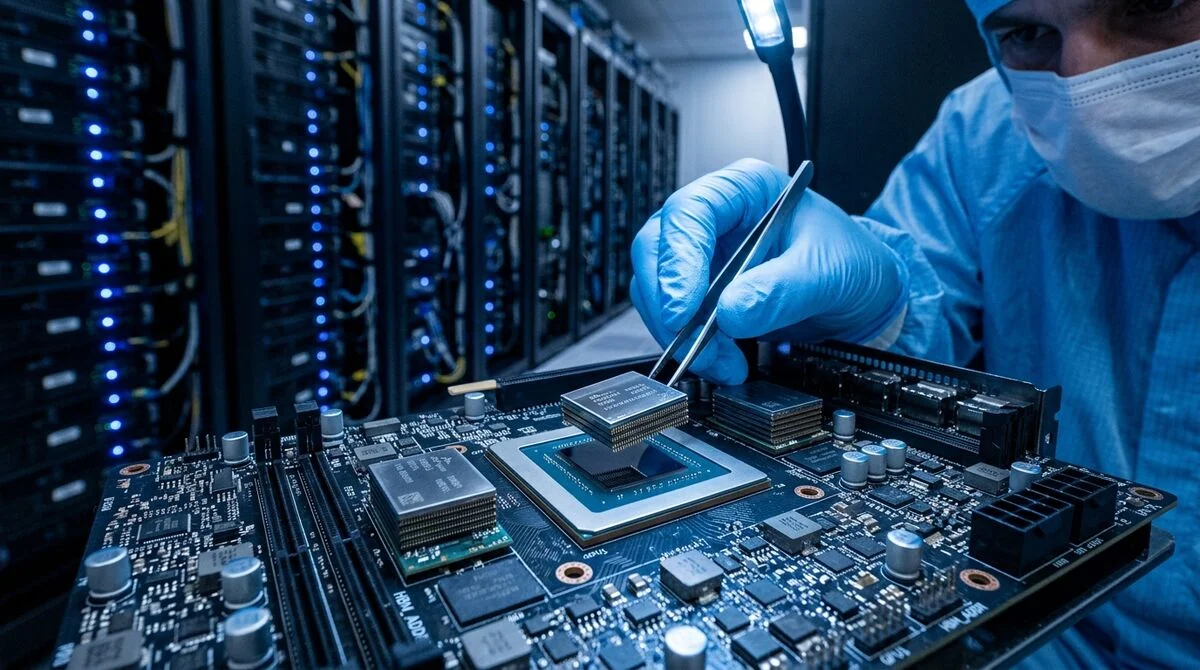
Makers of AI chips and memory are posting record profits on the generative AI boom. But the companies that build the models themselves are in no hurry to pass rising infrastructure costs on to end users, and that is changing the pricing logic of the entire industry.
Windfall profits for hardware suppliers
For several quarters in a row, Nvidia has posted margins that are unusual even by the standards of the semiconductor industry's best periods. Memory makers have now joined it. Micron Technology is reporting comparable results amid frenzied demand for HBM (High Bandwidth Memory), specialized memory for AI accelerators.
SK Hynix, Samsung and Micron together cannot expand HBM production faster than demand from data centers is growing. Analysts forecast that the shortage will last until at least the end of 2026. That means component prices will stay high and suppliers' margins will keep rising.
- HBM3E is a key component for next-generation GPUs (Nvidia H200, B200)
- HBM prices have more than doubled over the past two years
- Production capacity is expanding, but it still lags demand
- The shortage is forecast to last through all of 2025–2026
- New players (Broadcom, Marvell) are entering the segment but have not yet changed the situation
Investors, not users, are closing the gap
Despite rising costs, major AI model developers are generally holding or cutting the price of API access. Competition at this level is so intense that openly passing costs on to customers is risky: a company would simply lose market share to a cheaper rival.
Infrastructure costs are currently covered by three factors. The first is optimization of the models themselves: more efficient architectures lower the cost of inference. The second is economies of scale: the more requests run through a single cluster, the lower the unit cost. The third is venture subsidies: investors are putting in billions in expectation of future monetization, covering current losses.
OpenAI, by analysts' estimates, still operates at a loss at the operating-cost level. Anthropic receives investment from Amazon and Google that effectively subsidizes developers' access to its models. This creates artificially low prices in the market that do not reflect the real cost of compute.
Who ends up paying
The AI industry's value chain works paradoxically today: hardware makers make money, model developers run at a loss or near zero, and end users get services at subsidized prices. The question is how long this can continue.
If the market consolidates and only 2–3 large players survive, the price war will subside and the cost of services will start to rise. If a technological breakthrough arrives, costs will fall naturally. If large corporate customers start moving to their own models and infrastructure, that would shift the entire balance of power. For now, venture capital is paying for the "banquet," but its patience is not infinite.
What this means
The current pricing situation benefits everyone building AI-based products right now: API costs are historically low relative to the real cost of compute. For businesses this is a window of opportunity: while the market subsidizes the infrastructure, it makes sense to build up AI expertise and AI-based products as much as possible. A repricing is inevitable; the only question is when.
- Nov 1, 2026Habr author fine-tunes YOLOv8l on dental X-rays and pushes mAP50 to 0.642
- Nov 1, 2026Voice bots built on LLMs turn to Jev, a fast classifier, for decisions in 200–500 ms
- Nov 1, 2026MoneyGate safety layer blocked all 42 fraudulent requests to local AI models
- Oct 31, 202622B-Parameter LTX-2.5 Runs on a 10 GB RTX 3080, but Takes 5 Minutes per Shot
Key Questions Answered
What are the key details on Windfall profits for hardware suppliers?
For several quarters in a row, Nvidia has posted margins that are unusual even by the standards of the semiconductor industry's best periods. Memory makers have now joined it. Micron Technology is reporting comparable results amid frenzied demand for HBM (High Bandwidth Memory), specialized memory for AI accelerators. SK Hynix, Samsung and Micron together cannot expand HBM production faster than demand from data centers is growing. Analysts forecast that the shortage will last until at least the end of 2026. That means component prices will stay high and suppliers' margins
What are the key details on Investors, not users, are closing the gap?
Despite rising costs, major AI model developers are generally holding or cutting the price of API access. Competition at this level is so intense that openly passing costs on to customers is risky: a company would simply lose market share to a cheaper rival. Infrastructure costs are currently covered by three factors. The first is optimization of the models themselves: more efficient architectures lower the cost of inference. The second is economies of scale: the more requests run through a single cluster, the lower the unit cost. The third is venture subsidies: investors a
Who ends up paying?
The AI industry's value chain works paradoxically today: hardware makers make money, model developers run at a loss or near zero, and end users get services at subsidized prices. The question is how long this can continue. If the market consolidates and only 2–3 large players survive, the price war will subside and the cost of services will start to rise. If a technological breakthrough arrives, costs will fall naturally. If large corporate customers start moving to their own models and infrastructure, that would shift the entire balance of power. For now, venture capital i
Test Frontier LLMs & Autonomous Agents in One Workspace
Run Claude Opus 5.5, GPT-6, Gemini 3.1, and DeepSeek side-by-side in Nomad AI (nomadnet.ai) — unified model routing, deep research, and multimodal workflows under one subscription.
The AI world, distilled — once a week
Seven stories that actually mattered, hand-picked. No noise, no reposts, no press releases.
Done! Check your inbox for a confirmation.