Startup founded by former Nvidia engineers built a humanoid robot to replace office interns
Flexion Robotics, a startup founded by former Nvidia engineers, unveiled a humanoid robot capable of replacing an office intern. The company developed an unconventional training method that allows the robot to handle a wide range of tasks — from computer work to carrying out verbal instructions. Wired calls the result “frighteningly competent”.
AI-processed from Wired; edited by Hamidun News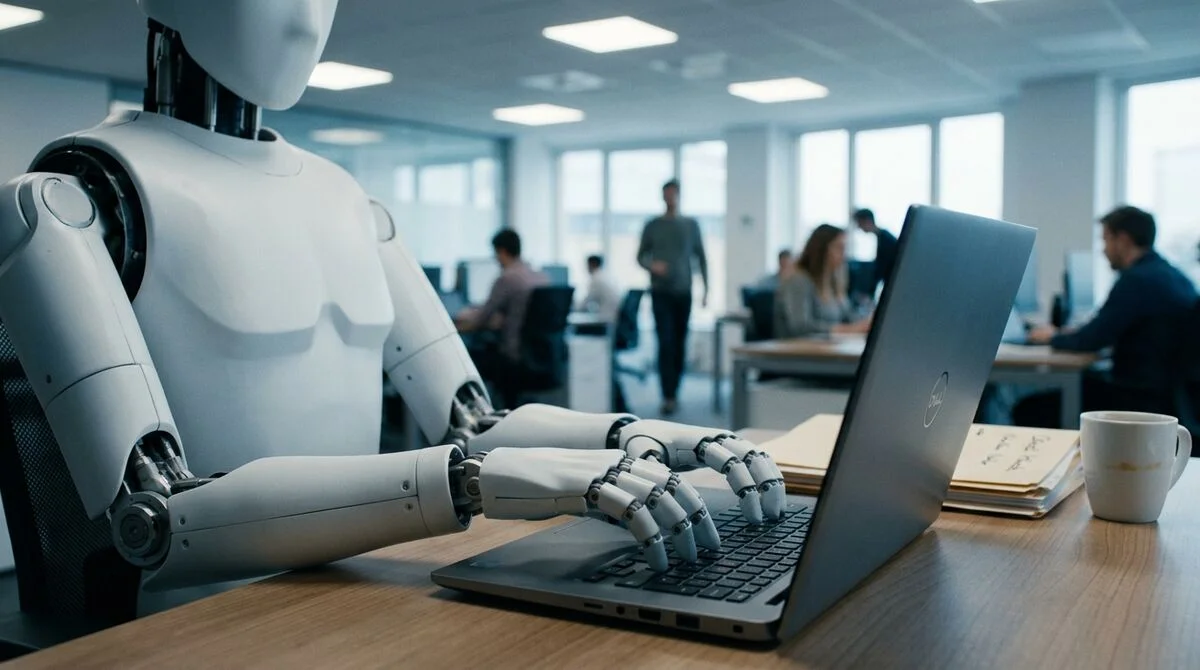
Startup founded by former Nvidia engineers creates humanoid office intern robot
Flexion Robotics, a startup founded by former Nvidia engineers, has revealed a humanoid robot capable of replacing an office intern. Wired, which tested the system, called it "eerily competent" — a characterization rarely used casually in the industry: most modern humanoids struggle to handle even basic tasks in unstructured office environments.
Heirs to Nvidia
The Flexion team came from Nvidia — the company whose GPUs became the foundation for the entire modern AI boom. Engineers who spent years working on neural network architectures and parallel computing systems decided to apply their accumulated expertise differently: not building hardware for training models, but creating a physical agent that learns to act in the real world. This focus is no accident. The office environment is one of the most challenging for robots: infinite variety of objects, unpredictable interactions with people, tasks constantly changing in form and context. This is why industrial manipulators, which work flawlessly on an assembly line, are practically helpless in open office spaces.
Non-Standard Training Method
Flexion's main competitive advantage is their approach to robot training. Most systems either require rigid programming for a specific action or suffer from the "transfer problem": skills learned in a lab don't translate well to real-world conditions. Flexion, according to Wired, found a "clever way" to bypass this limitation. The company keeps the method details private, but the results speak for themselves: the humanoid handles a wide range of tasks typical for an office intern:
- locating and moving objects around the office without prior mapping
- working with computers — keyboard, mouse, navigating interfaces
- executing verbal instructions for unfamiliar tasks
- adapting to non-standard objects and changing conditions
- interacting with employees in shared spaces without protective barriers
"An eerily competent intern" — that's how
Wired headlined the piece, rarely resorting to such superlatives in humanoid reports.
Office as the Next Frontier
The humanoid robotics market is experiencing an investment boom — billions of dollars have been poured into it over the past two years. Figure AI, Physical Intelligence, Agility Robotics are accelerating their pace, yet most players focus on warehouses and manufacturing, where the environment is more predictable and controllable. Flexion is betting on the office — a segment long considered too chaotic for automation.
Intern work seems low-skill, but it actually consumes significant time in any organization: distributing documents, printing materials for meetings, entering data from paper forms into systems. If Flexion's training method truly scales without reprogramming for each new task, the economics of implementation change radically: one robot can be quickly retrained instead of ordering a specialized system.
What This Means
Office robots might transition from the category of "someday" to "within this decade." For business, this is not a threat from the distant future — it's a competitive question for the next three to five years. Flexion is one of those startups worth watching closely.
Need AI working inside your business — not just in your newsfeed?
I build production AI for companies — custom CRM, internal tools, autonomous agents, workflow automation. Owned by you, shaped to your process, no per-seat tax. Built by Zhemal Khamidun, CPO of AlpinaGPT (AI platform, 6,000+ users).
The AI world, distilled — once a week
Seven stories that actually mattered, hand-picked. No noise, no reposts, no press releases.
Done! Check your inbox for a confirmation.