Qwen, Gemma, Phi-4: five open-source omni-models for every data type
Five open AI models that process text, audio, images, and video in a single interface — no cloud and no separate pipelines. Alibaba's Qwen2.5-Omni accepts speech and video and responds with real-time voice. InternVL3 is the best for OCR and document analysis. Gemma 3n runs on a phone. Microsoft's Phi-4 is for technical diagrams. MiniCPM-o supports streaming processing.
AI-processed from KDnuggets; edited by Hamidun News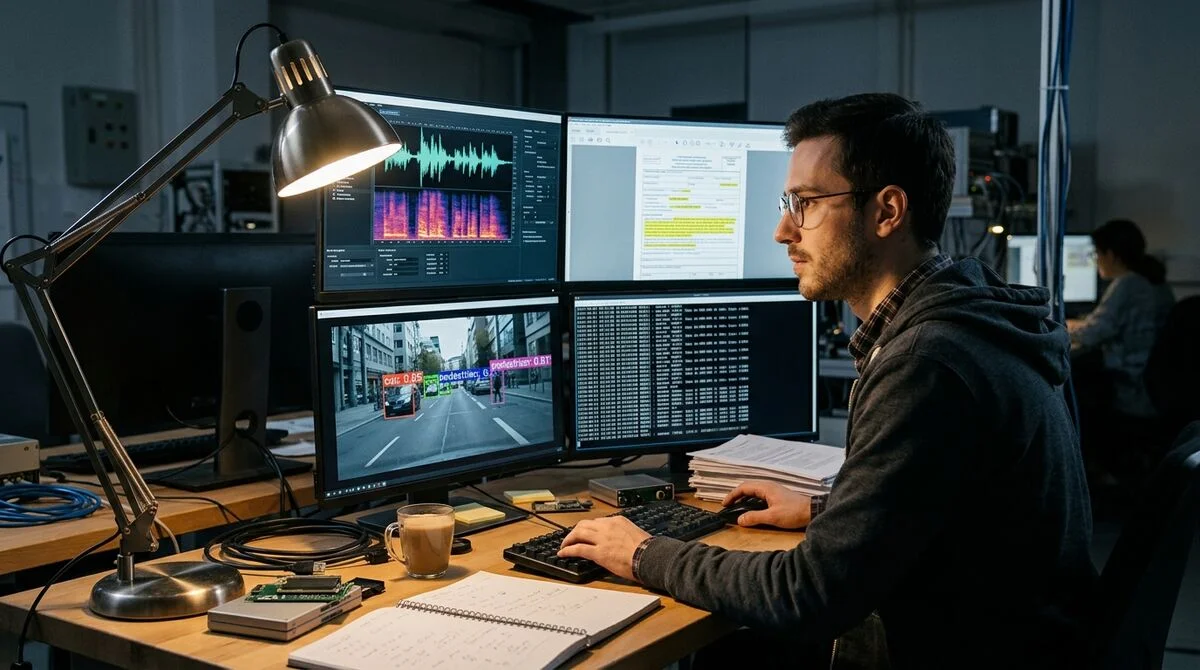
Open-source omni-models — systems capable of simultaneously processing text, images, audio, and video — have moved out of the experimental phase. Five projects already run locally and are suitable for production deployment.
Why omni, not pipeline
A classic AI stack looks like a pipeline: Whisper transcribes audio, a language model analyzes text, a separate model processes images. Omni-models work differently — a single encoder accepts any type of input data, a single decoder produces the output. This reduces architectural complexity and improves context understanding: the model sees an image and hears a question simultaneously, not sequentially.
Five models that work now
Qwen2.5-Omni from Alibaba Research — the most mature project of the five. Accepts text, audio, images, and video; responds with text and synthesized speech. Voice interaction latency is below 500 ms. Available in sizes from 3B to 72B parameters, the license permits commercial use.
InternVL3 from OpenGVLab — focus on understanding images, video clips, and documents. Extracts structured data from tables, forms, and PDFs more accurately than most specialized OCR systems. Supports over 20 languages, including Cyrillic.
Gemma 3n from Google — multimodal model optimized for edge devices. With 4B parameters, it uses less than 3 GB of memory and runs on phones. Processes text and images; audio through a separate adapter.
Phi-4 Multimodal from Microsoft — emphasis on reasoning about images and text. Handles scientific diagrams, mathematical formulas, and schematics well. Suitable for technical and educational applications.
MiniCPM-o 2.6 from ModelBest — compact any-to-any model with 8B parameters supporting streaming processing. Good for voice chatbots with low latency. Summary of capabilities:
- Qwen2.5-Omni — full any-to-any including speech generation, 3B–72B
- InternVL3 — best at OCR and document intelligence, up to 78B
- Gemma 3n — most compact, optimized for mobile devices
- Phi-4 Multimodal — strong reasoning about images and diagrams
- MiniCPM-o 2.6 — streaming processing, good for real-time assistants
How to choose for your task
For a voice assistant with low latency — Qwen2.5-Omni or MiniCPM-o. For document and form analysis — InternVL3. For running on weak hardware or mobile devices — Gemma 3n. For technical applications with diagrams — Phi-4. During testing, check whether the model supports streaming audio input, how OCR behaves on handwritten text and non-standard fonts, how much VRAM is required, and whether CPU inference is possible. Separately, licensing: Apache 2.0 allows commercial use without restrictions, Gemma requires a separate agreement with Google.
What this means
Open-source omni-models are transitioning from academic benchmarks to real-world deployment. Companies that built complex pipelines from multiple specialized models can now replace them with one — with lower overhead and more holistic context understanding. For products with voice, images, and documents, this changes architecture from pipeline-based to monolithic.
Want to stop reading about AI and start using it?
AI News is a curated feed of AI/tech news. Hamidun Academy teaches you to use AI systematically in your work.
The AI world, distilled — once a week
Seven stories that actually mattered, hand-picked. No noise, no reposts, no press releases.
Done! Check your inbox for a confirmation.