VisionLabs found a way to train CV models with 50 images and no coding
VisionLabs openly explained how the Luna Line no-code platform works: a specialist without programming skills labels the data, clicks a button, and gets a trained CV model even with a dataset of just 50 images. The research team ran a series of experiments in search of a universal recipe for classification tasks — and found that no single solution exists for every case.
AI-processed from Habr AI; edited by Hamidun News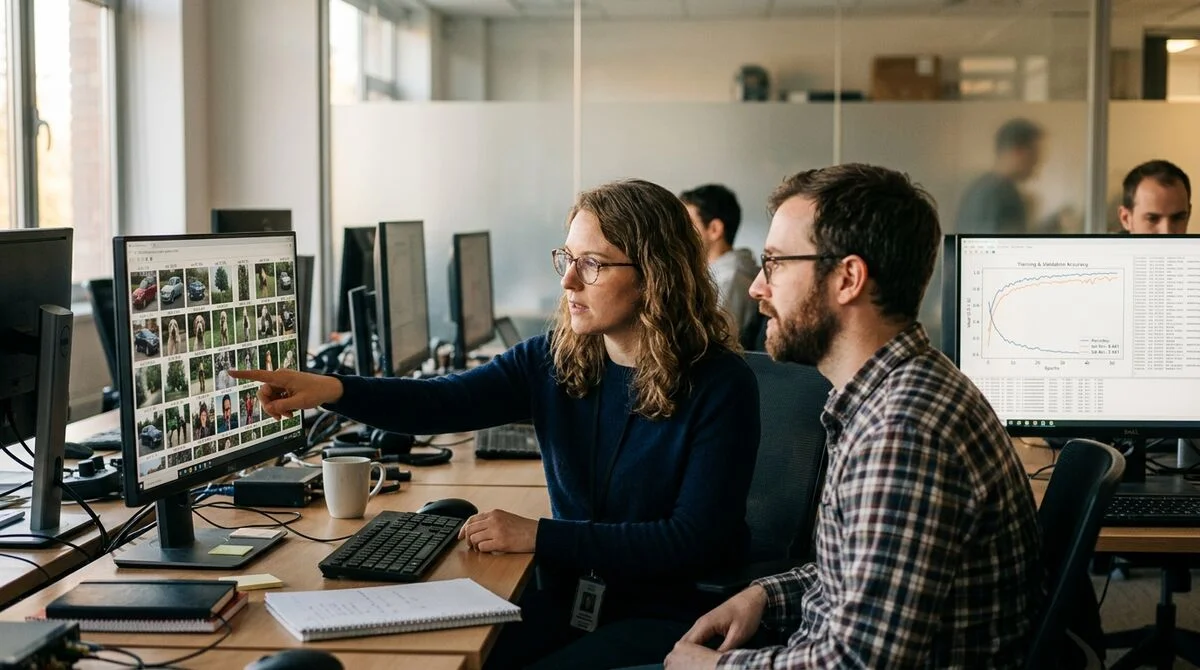
VisionLabs (part of MWS AI) has published the first part of a technical series on the development of Luna Line. Anastasia Belozerova, team lead of the research team, provides a detailed account of how engineers searched for a "universal recipe" for training classification models — and what came of it.
Platform for Non-Specialists
Luna Line is a no-code computer vision platform created by VisionLabs for users without programming skills. An agronomist, production technologist, quality controller, or logistics specialist can label a set of images, click a button — and get a ready-trained CV model for their specific task.
A fundamental requirement for the product: it must work with very small datasets. The team is targeting a scenario starting from 50 images — this is a real constraint for most manufacturing enterprises that lack both the time and specialists to label thousands of examples. It is precisely this constraint that defines the entire complexity of the engineering challenge: standard recipes from academic datasets don't work here.
Search for a Universal Recipe
The task the team set out to accomplish is ambitious: find a single training configuration that consistently delivers good quality on an arbitrary classification dataset. If such a recipe exists, the platform can work as a "black box" — the user brings the data, the system configures everything else automatically.
To verify hypotheses, a rigorous experimental methodology was built:
- Hypothesis — a specific configuration is formulated: backbone architecture, augmentations, learning rate schedule, optimizer
- Testing — the configuration runs on several datasets of different nature, size, and subject domain
- Comparison — results are compared with baseline and previous hypotheses
- Decision — the configuration is accepted as "universal" or rejected based on analysis
This approach allows for systematic movement rather than random trial-and-error, and gradually narrows the search space to genuinely working solutions.
Why Methodology Changed
One of the key findings of the series proved unexpected: configurations that performed best for classification tasks did not automatically transfer to segmentation. When switching task class, the team discovered that some previously accepted decisions needed to be reconsidered from scratch.
"I'll share what hypotheses we put forward, how we tested them, and why we revised the experimental methodology when moving from one task to another," —
Belozerova announces.
This led to the conclusion that a universal recipe exists only within a single task class. There is no direct transfer between tasks — but there is something valuable: the methodology itself proved to be transferable. It can be applied to segmentation and detection, each time starting an experimental "branch" anew, but with a properly structured hypothesis verification process. The second part of the series, dedicated to segmentation, will be published later.
What This Means
VisionLabs demonstrates rare engineering openness for the Russian ML market: the company publishes not marketing theses, but honest chronicles of experiments with negative results and revised hypotheses. For specialists building their own MLOps pipelines or no-code tools, this is a valuable practical reference — especially regarding work with small datasets, where academic benchmarks are nearly useless.
Want to stop reading about AI and start using it?
AI News is a curated feed of AI/tech news. Hamidun Academy teaches you to use AI systematically in your work.
The AI world, distilled — once a week
Seven stories that actually mattered, hand-picked. No noise, no reposts, no press releases.
Done! Check your inbox for a confirmation.