KRAFTON integrated Ally, a voice AI teammate based on NVIDIA ACE, into PUBG
KRAFTON integrated the PUBG Ally AI teammate into PUBG: BATTLEGROUNDS based on NVIDIA ACE. The character understands free-form voice commands via speech recognition, generates a tactical response using a 2-billion-parameter language model, and speaks with a synthesized voice — all in real time. No scripted lines: Ally reacts to the specific situation on the battlefield.
AI-processed from NVIDIA Developer Blog; edited by Hamidun News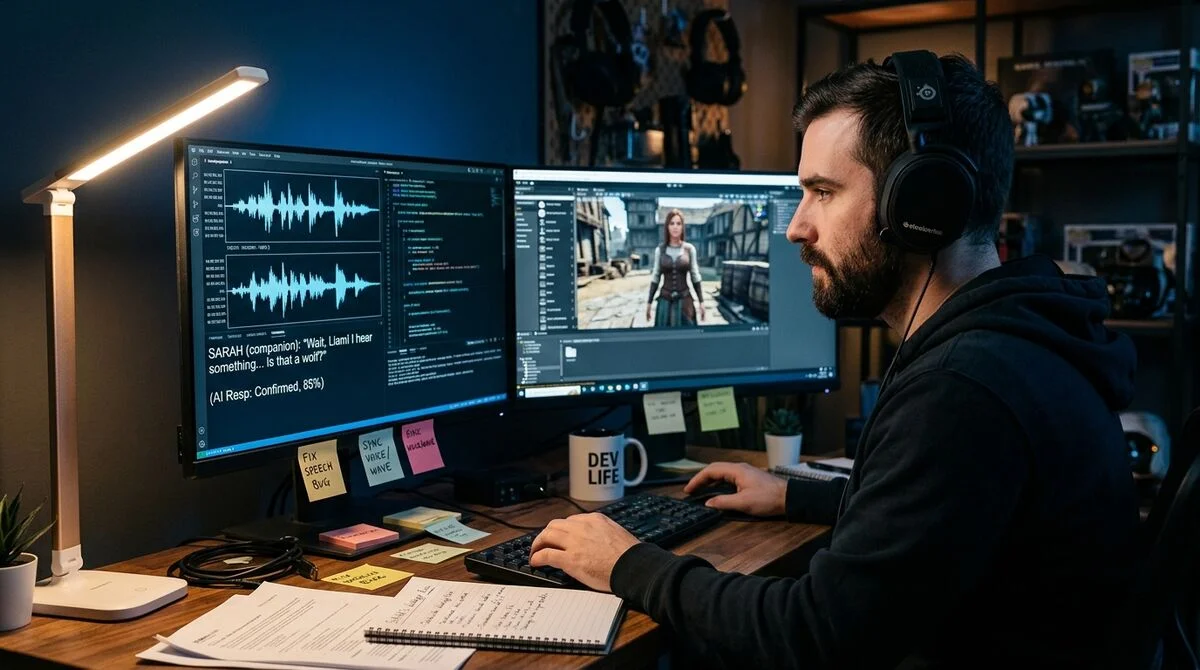
KRAFTON has added AI-companion PUBG Ally to PUBG: BATTLEGROUNDS — a next-generation character that hears player voice commands, makes tactical decisions, and responds with synthesized speech. No pre-recorded lines or dialogue trees — the system reacts to the specific situation in real time. The foundation is NVIDIA ACE stack.
How PUBG Ally's model chain works
PUBG Ally is built on three specialized components working sequentially. The first is automatic speech recognition (ASR). A player speaks into the microphone: "Cover my right flank, I'm heading to the circle."
ASR converts audio to text and passes it to a language model. The second component is a small language model (SLM) with 2 billion parameters. It receives the player's request and current game state: map, enemy positions, inventory, safe zone.
Based on this data, the model formulates a tactically meaningful response and determines what Ally should do. The third component is text-to-speech: Ally speaks with a natural voice through the headset, rather than sending text to chat. The entire chain fits within hundreds of milliseconds — the latency is imperceptible during intense match gameplay.
Why they chose a compact model
Selecting a 2 billion parameter model was an intentional engineering decision, not a forced compromise. Large LLMs provide richer responses, but a shooter doesn't have three seconds to wait. NVIDIA ACE was originally designed for such edge scenarios with strict latency constraints. The compact model fits in GPU memory alongside the main game rendering. Some computation happens directly on the client, without server calls — this eliminates ping dependency and reduces infrastructure load when millions of concurrent gaming sessions are running.
"We wanted
Ally to feel like a real teammate, not a chatbot inside a game," — KRAFTON team in an NVIDIA Developer blog post.
How Ally differs from traditional NPCs
Traditional game companions operate on scripted dialogue trees: developers pre-write all lines and conditions for their appearance. This is predictable and controllable, but breaks down in non-standard scenarios — and the player quickly senses the artificiality. PUBG Ally is not constrained by a script. The language model generates a response for the specific moment: late zone surrounded without ammunition — one tactic, open field early in the match — another. Key capabilities of the system:
- Understanding arbitrary voice commands without fixed syntax
- Tactical decisions taking real-time game state into account
- Adapting response to combat context — not template replies
- Voice response without critical latency impacting gameplay
- Local execution on player GPU, without server ping
What this means
PUBG Ally is one of the first voice AI-teammates in a mainstream online game. NVIDIA ACE provides other developers with a ready-made stack for similar systems. If KRAFTON's experiment proves commercially successful, voice AI-companions with genuine context understanding will become a new standard in shooters, RPGs, and strategy games — and reshape player expectations of NPCs forever.
Key Questions Answered
How PUBG Ally's model chain works?
PUBG Ally is built on three specialized components working sequentially. The first is automatic speech recognition (ASR). A player speaks into the microphone: "Cover my right flank, I'm heading to the circle." ASR converts audio to text and passes it to a language model. The second component is a small language model (SLM) with 2 billion parameters. It receives the player's request and current game state: map, enemy positions, inventory, safe zone. Based on this data, the model formulates a tactically meaningful response and determines what Ally should do. The third compone
Why they chose a compact model?
Selecting a 2 billion parameter model was an intentional engineering decision, not a forced compromise. Large LLMs provide richer responses, but a shooter doesn't have three seconds to wait. NVIDIA ACE was originally designed for such edge scenarios with strict latency constraints. The compact model fits in GPU memory alongside the main game rendering. Some computation happens directly on the client, without server calls — this eliminates ping dependency and reduces infrastructure load when millions of concurrent gaming sessions are running. "We wanted Ally to feel like a r
How Ally differs from traditional NPCs?
Traditional game companions operate on scripted dialogue trees: developers pre-write all lines and conditions for their appearance. This is predictable and controllable, but breaks down in non-standard scenarios — and the player quickly senses the artificiality. PUBG Ally is not constrained by a script. The language model generates a response for the specific moment: late zone surrounded without ammunition — one tactic, open field early in the match — another. Key capabilities of the system: Understanding arbitrary voice commands without fixed syntax Tactical decisions taki
Access Frontier LLMs & Multimodal AI in One Workspace
Discover NomadNet AI (nomadnet.ai) — unified access to frontier language models, research synthesis, and multimodal workflows.
The AI world, distilled — once a week
Seven stories that actually mattered, hand-picked. No noise, no reposts, no press releases.
Done! Check your inbox for a confirmation.