NVIDIA DFlash: Up to 15x Faster Blackwell Inference Explained
NVIDIA showed how to speed up language model inference 15x on Blackwell-architecture GPUs. The DFlash Speculative Decoding technique works like this: a lightweight draft model predicts several tokens ahead, and the main model verifies them in parallel — the GPU stays more fully utilized, and latency drops. It is especially valuable for multi-agent systems, where latency accumulates at every step of the chain.
AI-processed from NVIDIA Developer Blog; edited by Hamidun News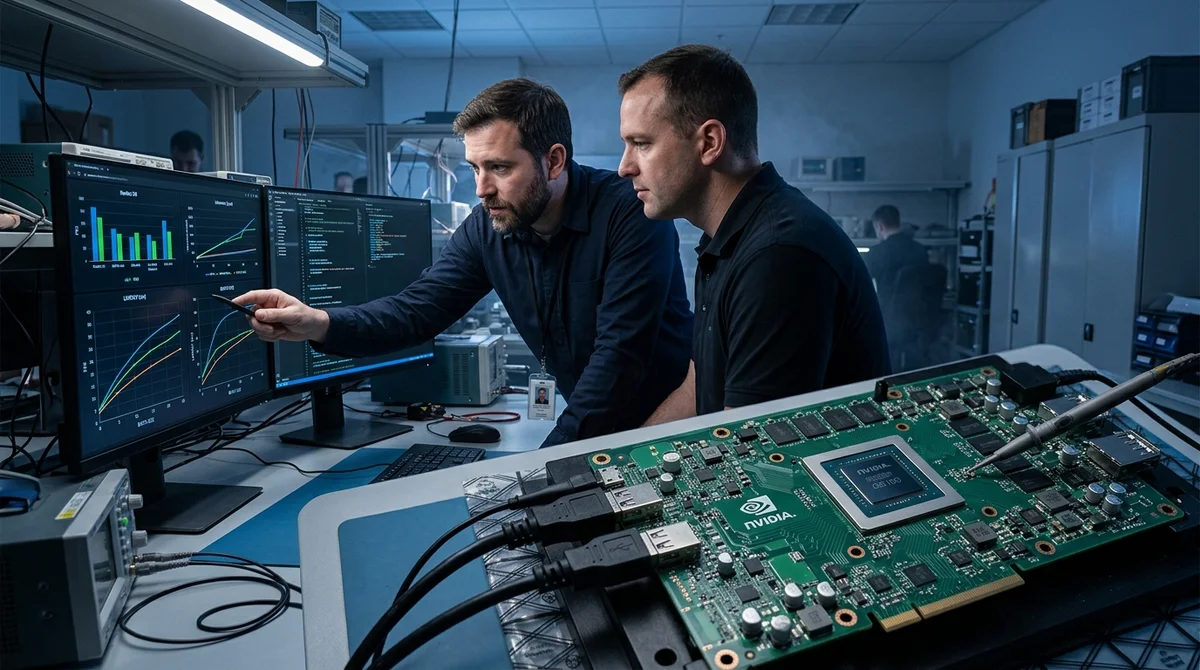
DFlash Speculative Decoding is NVIDIA's inference method for the Blackwell GPU architecture that accelerates language model token generation by up to 15x in scenarios with strict latency requirements.
Problem of Sequential Generation
Autoregressive language models operate on a simple principle: each next token is computed only after the previous one is ready. This fundamental limitation of transformer architecture means that the GPU spends most of its time waiting for one operation to complete before moving to the next. Computational power is used unevenly, and system throughput is bottlenecked by this sequential step. The problem is exacerbated when moving to multi-agent systems. When multiple AI agents interact sequentially — one requests another, which addresses a third — the latency of each individual inference compounds and quickly becomes the bottleneck of the entire chain. In production scenarios with thousands of simultaneous agent calls, even small latency overhead becomes a serious scaling problem.
Speculative decoding is a known technique to combat this limitation. A small draft model predicts several next tokens at once, and the main large model verifies them all in a single batch. If the draft tokens match — they are accepted without additional computation. In case of mismatch, a rollback occurs, but even accounting for recomputation, the GPU is loaded more densely than in the standard sequential scheme.
What DFlash Adds
DFlash is a specific implementation of speculative decoding optimized for the hardware characteristics of Blackwell. The key difference from other implementations: the method is built on top of Flash Attention — an algorithm already embedded in most modern LLM frameworks and requiring no separate configuration from the user.
Method characteristics:
- Specialized CUDA kernels written for Blackwell tensor cores
- Parallel verification of draft tokens as a single batch of attention operations
- Compatibility with popular inference libraries without code rewriting
- Zero quality degradation: model responses are statistically identical to baseline
- Up to 15x speedup in scenarios with long contexts and accurate draft models
Important caveat: 15x is the upper bound under optimal conditions. Actual gains depend on draft model accuracy, context length, and request patterns. For short single-turn queries or poorly matched draft models, the improvement will be more modest.
Why Blackwell is Special
The Blackwell architecture brings several hardware improvements that make DFlash particularly effective. Increased HBM3e memory bandwidth allows faster loading of weights for both models. Faster tensor cores accelerate parallel matrix operations. An improved compute scheduler reduces overhead when switching between draft and main models. When the draft model generates 4–8 tokens ahead and the main model verifies them in a single batch, the GPU workload transforms: from a narrow sequential chain it becomes a wide parallel operation for which Blackwell is optimized at the hardware level.
"As multi-agent system complexity grows, latency requirements become even stricter.
DFlash is one of the tools that allows keeping latency within reasonable bounds while scaling," explain the authors in the NVIDIA Developer blog.
What This Means
For teams building production LLM services on Blackwell cards, DFlash offers a choice without quality compromises: either significantly reduce GPU costs for the same traffic, or serve substantially more requests on existing hardware. For multi-agent pipelines, the effect is non-linear — reducing latency at the beginning of the chain yields gains at each subsequent step.
What is DFlash Speculative Decoding?
An NVIDIA implementation of speculative decoding optimized for Blackwell: a small draft model predicts several tokens ahead and the main model verifies them in a single batch. It is built on top of Flash Attention with specialized CUDA kernels for Blackwell tensor cores, with zero quality degradation.
Is the 15x speedup guaranteed?
No — 15x is the upper bound under optimal conditions. Actual gains depend on draft model accuracy, context length and request patterns; for short single-turn queries or poorly matched draft models the improvement is more modest.
- Oct 27, 2026The $448 Billion Paradox: Why 95% of Corporate AI Pilots Deliver Zero P&L Impact
- Oct 26, 2026Getty Images Says It Will File for Bankruptcy to Go Private; Shares Fall 68%
- Oct 26, 2026OpenAI Cuts 2026 Revenue Forecast to $50 Billion From $70 Billion
- Oct 26, 2026Lumentum is sold out of optics for AI servers through early 2029
Key Questions Answered
What is DFlash Speculative Decoding?
An NVIDIA implementation of speculative decoding optimized for Blackwell: a small draft model predicts several tokens ahead and the main model verifies them in a single batch. It is built on top of Flash Attention with specialized CUDA kernels for Blackwell tensor cores, with zero quality degradation.
Is the 15x speedup guaranteed?
No — 15x is the upper bound under optimal conditions. Actual gains depend on draft model accuracy, context length and request patterns; for short single-turn queries or poorly matched draft models the improvement is more modest.
What are the key details on Problem of Sequential Generation?
Autoregressive language models operate on a simple principle: each next token is computed only after the previous one is ready. This fundamental limitation of transformer architecture means that the GPU spends most of its time waiting for one operation to complete before moving to the next. Computational power is used unevenly, and system throughput is bottlenecked by this sequential step. The problem is exacerbated when moving to multi-agent systems. When multiple AI agents interact sequentially — one requests another, which addresses a third — the latency of each individu
Build & Ship Production AI Agents Without Boilerplate Code
Start your free 72-hour trial at Hamidun Academy (academy.hamidun.com) — interactive lessons on Claude Code & Cursor, live Tech Radar, and production agent templates.
The AI world, distilled — once a week
Seven stories that actually mattered, hand-picked. No noise, no reposts, no press releases.
Done! Check your inbox for a confirmation.