Ford Brings Back Its "Gray Beard" Engineers: AI Could Not Replace Experienced People
Ford is bringing back its "gray beard" engineers, veterans with decades of experience, after its AI bet fell short on vehicle quality. Management conceded: "We mistakenly thought that simply adopting AI would deliver a high-quality product." It turns out algorithms cannot replace the unformalized knowledge that lived in the heads of the laid-off veterans.
AI-processed from TechCrunch; edited by Hamidun News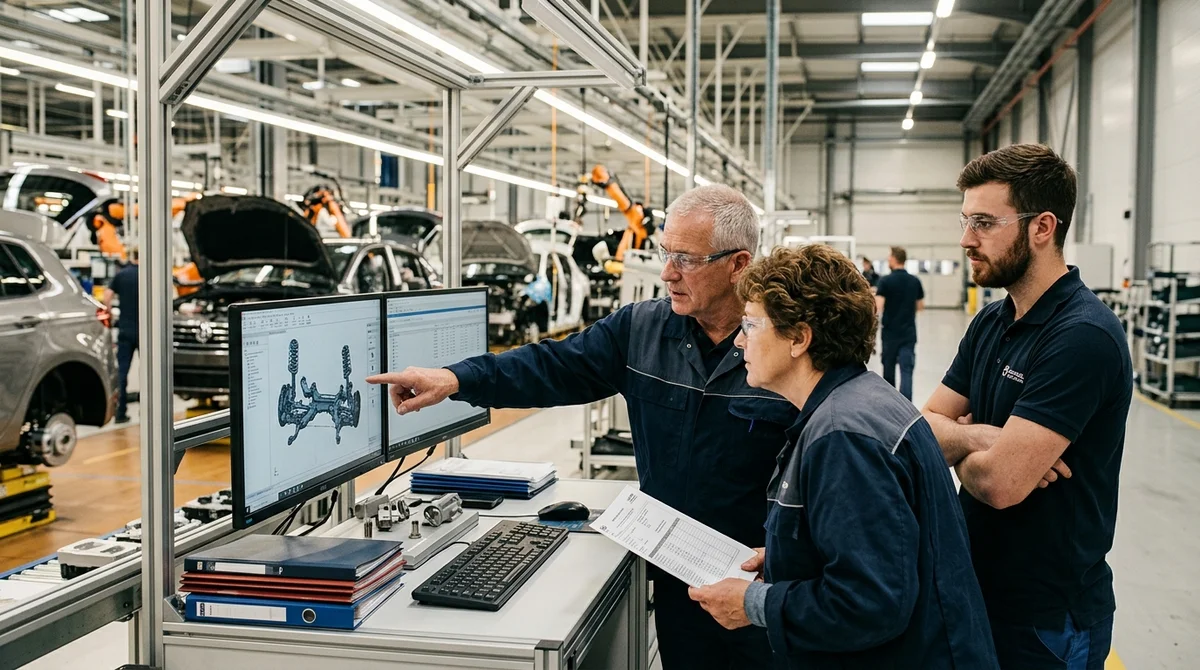
Ford has admitted a mistake: the company assumed that adopting AI would, on its own, deliver high product quality, and it miscalculated. The automaker is now rehiring the experienced "gray beard" engineers it previously let go as part of a production streamlining effort.
The AI bet did not work
For several years, Ford actively cut experienced staff, betting on automation and artificial intelligence. The logic seemed reasonable: AI would take over complex engineering tasks, costs would fall, and development would speed up.
The result was the opposite. Product quality dropped, precisely where experienced engineers had quietly kept production processes under control. The company publicly acknowledged the miscalculation:
"We mistakenly thought that simply adopting artificial intelligence...
would deliver a high-quality product."
Such a candid admission is rare for a major automaker. Ford has become one of the few companies to openly discuss the failure of a "automation first, people later" strategy.
AI is effective where a task is well defined and backed by good data. But in car manufacturing, a significant share of valuable knowledge is tacit: experience, intuition, memory of past mistakes. That is exactly the knowledge Ford lost along with the veterans it laid off.
Who the "gray beards" are
"Gray beards" is an informal American term for engineers with many years of production experience. They remember why a particular technical decision was made ten years ago, can read indirect signals of looming problems, and know whom to call in a non-standard situation.
This kind of expertise resists formalization. It exists as intuition built up over years at a specific plant, and that is what AI failed to reproduce. An algorithm can process millions of data points, but it does not know what it does not know. An experienced engineer does, and will raise the alarm.
The value of these specialists shows up in several dimensions at once:
- Knowing the history: why it was done this way and not another
- Ability to predict failures from indirect signs
- Informal connections across the production chain
- Skill in handling exceptions, where an algorithm gets lost
- Institutional memory of past mistakes and what they cost
When companies laid off such employees en masse in pursuit of automation, they lost more than pairs of hands. They lost knowledge that cannot be uploaded into a model, because the people who hold it cannot fully articulate it themselves.
Why this matters for the whole industry
Ford's story is not an exception. A similar cycle can be seen in aircraft manufacturing, pharmaceuticals and energy: staff optimization → automation → quality decline → forced return to people. Wherever the product is complex and the cost of error is high, this pattern repeats.
The problem is not AI as such. The problem is that the technology was deployed as a replacement for expertise rather than an amplifier of it. AI works well where the task is clearly defined, the data is complete and the patterns repeat. In manufacturing complex products, much of the valuable knowledge stays tacit, and here you cannot do without people.
It is telling that Ford, rather than a technology company, made this admission. The auto industry measures expertise in decades, and a single mistake can cost thousands of recalls.
What this means
Ford has openly acknowledged that AI does not replace human expertise; it complements it. This lesson matters for the entire market. Before cutting experienced specialists for the sake of automation, it is worth honestly answering one question: what exactly do they do that cannot be described as a task for an algorithm?
Key Questions Answered
What are the key details on The AI bet did not work?
For several years, Ford actively cut experienced staff, betting on automation and artificial intelligence. The logic seemed reasonable: AI would take over complex engineering tasks, costs would fall, and development would speed up. The result was the opposite. Product quality dropped, precisely where experienced engineers had quietly kept production processes under control. The company publicly acknowledged the miscalculation: "We mistakenly thought that simply adopting artificial intelligence... would deliver a high-quality product." Such a candid admission is rare for a m
Who the "gray beards" are?
"Gray beards" is an informal American term for engineers with many years of production experience. They remember why a particular technical decision was made ten years ago, can read indirect signals of looming problems, and know whom to call in a non-standard situation. This kind of expertise resists formalization. It exists as intuition built up over years at a specific plant, and that is what AI failed to reproduce. An algorithm can process millions of data points, but it does not know what it does not know. An experienced engineer does, and will raise the alarm. The valu
Why this matters for the whole industry?
Ford's story is not an exception. A similar cycle can be seen in aircraft manufacturing, pharmaceuticals and energy: staff optimization → automation → quality decline → forced return to people. Wherever the product is complex and the cost of error is high, this pattern repeats. The problem is not AI as such. The problem is that the technology was deployed as a replacement for expertise rather than an amplifier of it. AI works well where the task is clearly defined, the data is complete and the patterns repeat. In manufacturing complex products, much of the valuable knowledg
Ship AI Faster with Founders, Engineers & Weekly Architecture Reviews
Inside Vibe Club (hamidun.com/club) — weekly live masterminds with Zhemal Khamidun, Tech Radar, full LMS access, and 370+ production Claude Code skills.
The AI world, distilled — once a week
Seven stories that actually mattered, hand-picked. No noise, no reposts, no press releases.
Done! Check your inbox for a confirmation.