AI labs are paying XDOF to collect robot training data, and it's grueling, unglamorous work
For robots to learn to move and handle objects, they need millions of hours of real-world demonstrations, much as LLMs learned from the internet. Collecting that data is monotonous and punishing: people spend hours teleoperating robots by hand or walking around in motion-capture suits. AI labs are already paying companies like XDOF to outsource that work.
AI-processed from TechCrunch; edited by Hamidun News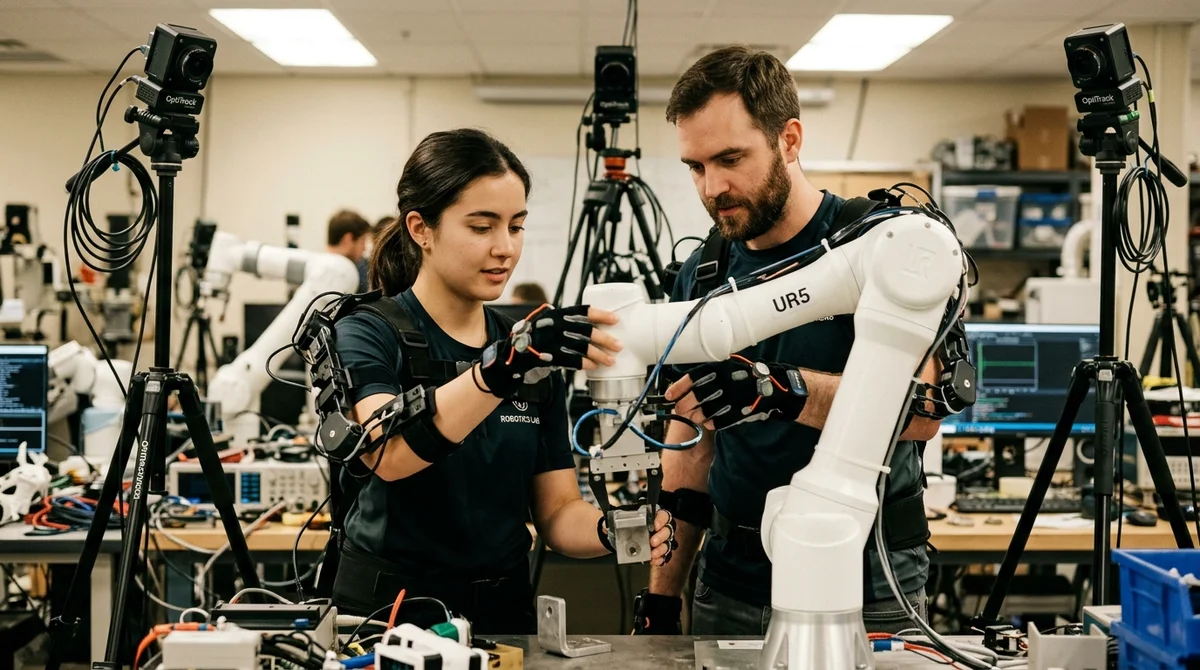
Physical AI faces the same problem that would have stalled language models without the internet humanity had built up: a shortage of training data. For now, labs are solving it by hand, and paying real money to companies like XDOF to do it.
Why there isn't enough data
Large language models learned to reason from trillions of words humanity had accumulated online. Physical robots have no such head start. Movements, grasps, balancing, handling fragile objects: all of it has to be demonstrated live, over and over, in dozens of different scenarios. A single hour of quality demonstrations takes a lot of effort. An operator puts on an exoskeleton or drives the robot with a joystick, repeating the same motion hundreds of times under different lighting, with different objects, in different poses. The resulting data is expensive, slow to produce and tightly bound to physical space. The internet won't help here.
That is why the leading teams in physical AI, from Physical Intelligence to labs inside Google DeepMind and humanoid robot developers, have hit the same wall: you can improve the models as much as you like, but without a sufficient volume of quality demonstrations they will not learn.
What XDOF does
XDOF is one of the companies AI labs bring in to outsource this work. It runs the whole process: recruiting operators, setting up equipment, monitoring annotation quality and scaling production to individual clients' needs. The model resembles the early days of Scale AI, which hired an army of annotators to label text and images. The difference is that this is physical labor in real space.
A typical data-collection session looks like this:
- The operator controls the robot by hand, and the system captures motion trajectories and force data
- Several cameras record the scene from different angles at once
- Each attempt is labeled: success, failure, edge case
- The scenario is repeated under different lighting, with different objects and in different poses
- A final review filters out defective demonstrations
This work does not require an engineering degree, but it does demand attention, patience and physical stamina. It is exactly the kind of "dirty, unglamorous work" the industry warns about.
Who pays and why it matters
Scaling data collection runs into physics: you cannot download millions of robot movements from the web, and you cannot replace them with synthetic data without risking model degradation. Outsourcing lets labs focus on architecture and training while specialists handle the routine.
It also creates a new kind of "hidden labor" in the AI industry: invisible to the wider public but critically important. Much as with content moderation for LLMs, the market for collecting robot demonstrations will grow quickly, and will just as quickly land at the center of debates over working conditions and quality standards.
What this means
The era of physical AI will require the same data-collection infrastructure the internet provided for language models. Companies that are first to build efficient pipelines for collecting and labeling physical demonstrations will gain a structural advantage, regardless of who develops the models themselves.
- Nov 1, 202616 models tested on 7 search tools: Exa averaged 10.5 out of 14, SearXNG about 3
- Nov 1, 2026Google's StreamVibe video agent beats other models by 10.7% on response timing and quality
- Nov 1, 2026OpenAI Rewrites GPT Behavior Rules: Five Values and a Chain of Command
- Nov 1, 2026Voice bots built on LLMs turn to Jev, a fast classifier, for decisions in 200–500 ms
Key Questions Answered
Why there isn't enough data?
Large language models learned to reason from trillions of words humanity had accumulated online. Physical robots have no such head start. Movements, grasps, balancing, handling fragile objects: all of it has to be demonstrated live, over and over, in dozens of different scenarios. A single hour of quality demonstrations takes a lot of effort. An operator puts on an exoskeleton or drives the robot with a joystick, repeating the same motion hundreds of times under different lighting, with different objects, in different poses. The resulting data is expensive, slow to produce
What XDOF does?
XDOF is one of the companies AI labs bring in to outsource this work. It runs the whole process: recruiting operators, setting up equipment, monitoring annotation quality and scaling production to individual clients' needs. The model resembles the early days of Scale AI, which hired an army of annotators to label text and images. The difference is that this is physical labor in real space. A typical data-collection session looks like this: The operator controls the robot by hand, and the system captures motion trajectories and force data Several cameras record the scene fro
Who pays and why it matters?
Scaling data collection runs into physics: you cannot download millions of robot movements from the web, and you cannot replace them with synthetic data without risking model degradation. Outsourcing lets labs focus on architecture and training while specialists handle the routine. It also creates a new kind of "hidden labor" in the AI industry: invisible to the wider public but critically important. Much as with content moderation for LLMs, the market for collecting robot demonstrations will grow quickly, and will just as quickly land at the center of debates over working
Test Frontier LLMs & Autonomous Agents in One Workspace
Run Claude Opus 5.5, GPT-6, Gemini 3.1, and DeepSeek side-by-side in Nomad AI (nomadnet.ai) — unified model routing, deep research, and multimodal workflows under one subscription.
The AI world, distilled — once a week
Seven stories that actually mattered, hand-picked. No noise, no reposts, no press releases.
Done! Check your inbox for a confirmation.