Niantic shows how Pokémon Go turns player actions into AI datasets
Niantic uses Pokémon Go not only as a game but also as a way to collect spatial data. reCAPTCHA, Strava Metro, Waze and even StarCraft II replays have long worked on the same principle: users solve their own problem while the platform gets a valuable AI dataset on the side. This changes how navigation, robots and urban services are built.
AI-processed from Habr AI; edited by Hamidun News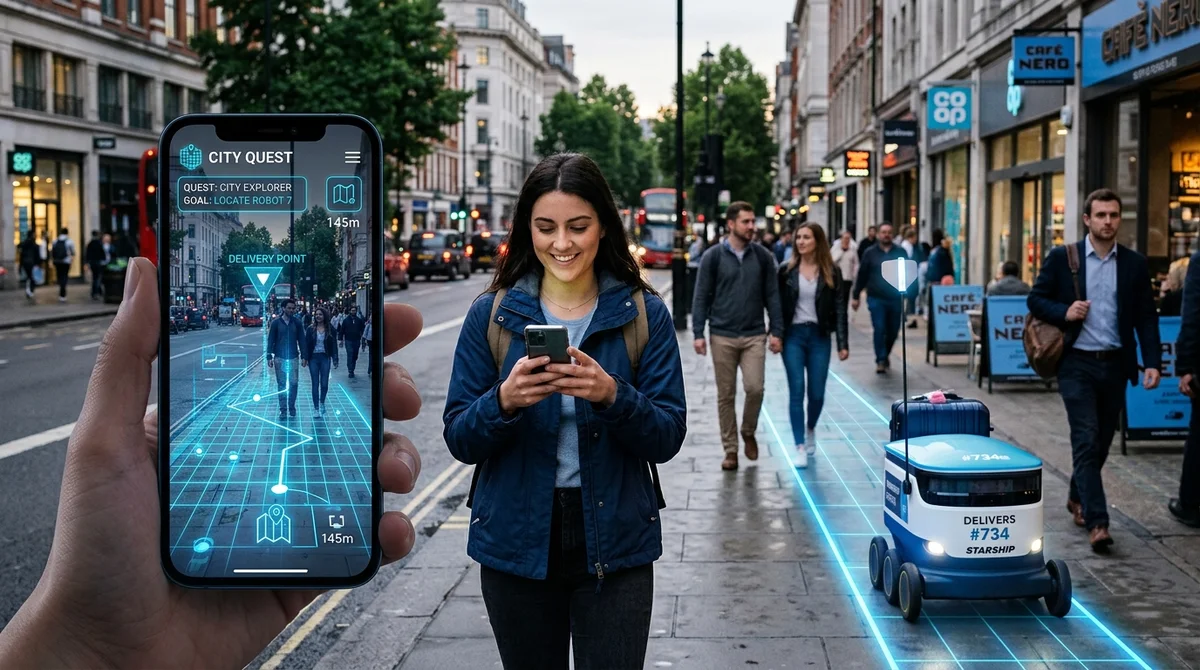
The main takeaway is simple: the most valuable AI datasets are often gathered not in a lab, but while a person is playing a game, driving across town, typing a CAPTCHA or planning a route in a familiar app. The Pokémon Go case shows this especially clearly. For years, Niantic built augmented reality infrastructure around the game: visual positioning, 3D maps of locations and collection of real-world images through users' smartphones.
At first this looked like a convenient way to scan the surroundings, but it grew into a full system for building spatial datasets. As a result, Pokémon Go became more than a mobile game with geotags: it became an environment where the actions of millions of people help models better understand physical space. That data was later used for large geospatial models and spatial AI systems, which need not just to recognize an image but to match a specific point to a global map of the terrain.
That is why Niantic's partnership with Coco Robotics looks logical: technology created for AR scenarios turned out to be useful for delivery robots, which also need to navigate a city with confidence.
The mechanism is universal. Users do something useful for themselves, such as scanning an object, bypassing a traffic jam, cycling a familiar route or confirming they are not a bot, while the system collects structured observations: images tied to coordinates, movement trajectories, road events, or human answers where automation makes mistakes. After cleaning and aggregation, all of this becomes datasets for vision, navigation, planning and decision-making.
The classic example of this approach appeared long before the generative AI boom: reCAPTCHA. For users it was a simple check, but in practice people helped the system recognize words that OCR could not handle when digitizing old books and newspapers. As early as 2008, reCAPTCHA ran on more than 40 thousand websites and helped correctly recognize over 440 million words. It is an early but very clean demonstration of how a routine action becomes part of a machine learning production pipeline.
In urban services this principle matters even more, because the data directly describes the physical world. Strava Metro aggregates and anonymizes user tracks so that city planners can better understand how people actually move through streets, not just how the road network is drawn. Waze collects live information on traffic jams, accidents, roadworks and closures, turning the map from a static layer into an almost continuous stream of events.
For navigation AI, robotics and delivery, such data is especially valuable: it describes not a theoretical city but a city in motion. There is a limitation, though: a given service's audience does not always match the structure of the whole population, so even a useful dataset may not be fully representative and requires careful interpretation.
Games have also long served as a training ground for AI, even when they have nothing to do with streets and maps. In StarCraft II, researchers use replays of human matches as records of complex decisions under incomplete information, where players must allocate resources, change plans and react to an opponent's behavior. One dataset retained about 1.4 million games, 2.8 million episodes and 3.5 billion training observations after filtering, a scale that is hard to reach manually in any other environment. GTA V and similar virtual worlds, meanwhile, provide synthetic scenes for computer vision and navigation: weather, lighting, traffic density and camera position can be changed quickly, producing large datasets without expensive field trips or manual labeling.
Modern AI therefore learns either from traces of human behavior or from realistic digital worlds built specifically for data collection.
What this means in practice: competition in AI depends more and more not only on model quality, but on who has managed to build data collection into users' natural behavior. The winner is not necessarily whoever talks loudest about a new neural network, but whoever builds a service where people, almost without noticing, produce data for the next generation of AI.
- Nov 8, 2026World models train robots and self-driving cars in simulations, while humans collect their data
- Apr 22, 2026Nomadic raises $8.4M to turn drone and robot video into training datasets
- Jul 8, 2026AI World Models: How Video Games Train Neural Networks
- May 2, 2026AI for Business: How Colleague Skill Digitizes Employees
Test Frontier LLMs & Autonomous Agents in One Workspace
Run Claude Opus 5.5, GPT-6, Gemini 3.1, and DeepSeek side-by-side in Nomad AI (nomadnet.ai) — unified model routing, deep research, and multimodal workflows under one subscription.
The AI world, distilled — once a week
Seven stories that actually mattered, hand-picked. No noise, no reposts, no press releases.
Done! Check your inbox for a confirmation.