Kioxia overtakes Toyota to become Japan's most valuable company on the AI boom
Kioxia Holdings, Japan's largest maker of NAND memory, has overtaken Toyota Motor in market capitalization to become the country's most valuable company. It is the first time in history that Toyota has lost the top spot, and it lost it not to a rival automaker but to a chip supplier for AI data centers. Analysts call the shift a direct result of the global AI infrastructure boom.
AI-processed from Bloomberg Tech; edited by Hamidun News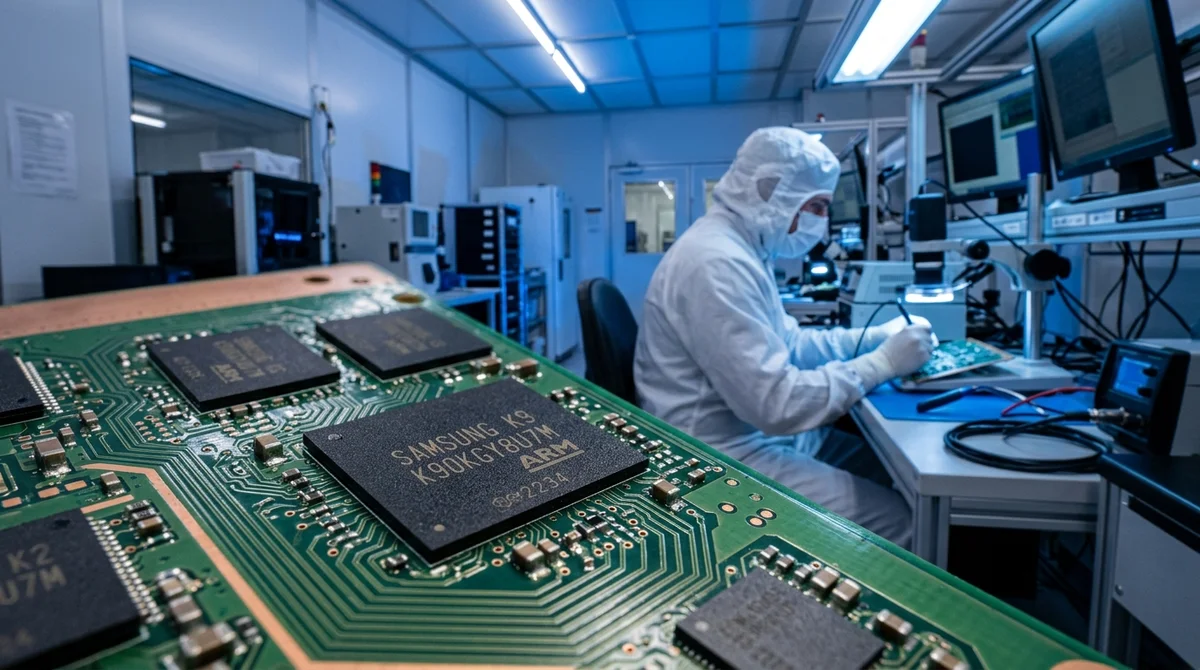
Memory chipmaker Kioxia Holdings has overtaken Toyota Motor in market capitalization, becoming Japan's most valuable company for the first time in history. The shift shows how the global AI boom is redrawing corporate hierarchies even in the world's most established economies.
A new leader in the Land of the Rising Sun
For decades, Toyota held the title of Japan's most valuable company, an undisputed symbol of the country's industrial strength and global reach. The automaker looked unshakable: massive production scale, a presence in every key market, and a reputation for reliability built over seven decades. Now its place has gone to a NAND flash memory maker whose products power data center server racks, smartphones, and solid-state drives around the world.
Kioxia started out as Toshiba's semiconductor division. In 2018, a consortium led by Bain Capital bought the company, and in late 2024 it went public on the Tokyo Stock Exchange. The road to listing was rocky: several postponed dates, the pandemic, trade restrictions, and cyclical slumps in the NAND market. But Kioxia waited for its moment, and that moment turned out to be the global AI boom.
Why the market cap grew
Several factors converged at once to push Kioxia's shares past Toyota's:
- A shortage of enterprise-grade NAND memory — AI server makers are competing for supply, and Kioxia ranks among the world's five largest suppliers
- Growing purchases from cloud giants — Microsoft, Google, and AWS are buying more flash memory for language models and AI clusters
- A weak yen — it makes Japanese exports cheaper for foreign buyers and inflates profits when converted into the domestic currency
- Expectations of a new memory supercycle — analysts forecast sustained demand growth through at least 2028 as AI infrastructure scales up
- The IPO effect — institutional investors who missed the offering aggressively bought up positions on the secondary market
Together, these factors turned Kioxia from a "recovering chipmaker" into a "pure-play AI infrastructure bet" — which is exactly how analysts describe the company's revaluation in 2025–2026.
What's happening to Toyota
Toyota is not in decline. The automaker remains the global leader in vehicle sales and still generates one of the largest operating profits in the world. The issue is not operational trouble at the company but a structural shift in investor preferences toward the tech sector.
Global funds are increasingly betting on companies that power the AI revolution rather than those that make traditional physical goods. By that logic, Toyota is a business with predictable but relatively slow growth, while Kioxia supplies a key material without which the AI revolution is physically impossible.
A similar revaluation has already played out in the US: Nvidia and Microsoft long ago surpassed industrial giants in market value. Japan's market is moving in the same direction, just a few years behind.
What it means
For the first time in the history of the Tokyo Stock Exchange, a technology company — a semiconductor maker — has surpassed an industrial giant in market value. It's a signal that the AI boom keeps radically reshuffling corporate rankings far beyond Silicon Valley. Japan is rejoining the global tech race, this time not through cars but through memory chips.
- Nov 1, 2026Google's StreamVibe video agent beats other models by 10.7% on response timing and quality
- Nov 1, 2026OpenAI Rewrites GPT Behavior Rules: Five Values and a Chain of Command
- Nov 1, 2026Voice bots built on LLMs turn to Jev, a fast classifier, for decisions in 200–500 ms
- Nov 1, 2026Google admits AI Mode cuts search revenue, shares fall 15%
Key Questions Answered
What are the key details on A new leader in the Land of the Rising Sun?
For decades, Toyota held the title of Japan's most valuable company, an undisputed symbol of the country's industrial strength and global reach. The automaker looked unshakable: massive production scale, a presence in every key market, and a reputation for reliability built over seven decades. Now its place has gone to a NAND flash memory maker whose products power data center server racks, smartphones, and solid-state drives around the world. Kioxia started out as Toshiba's semiconductor division. In 2018, a consortium led by Bain Capital bought the company, and in late 20
Why the market cap grew?
Several factors converged at once to push Kioxia's shares past Toyota's: A shortage of enterprise-grade NAND memory — AI server makers are competing for supply, and Kioxia ranks among the world's five largest suppliers Growing purchases from cloud giants — Microsoft, Google, and AWS are buying more flash memory for language models and AI clusters A weak yen — it makes Japanese exports cheaper for foreign buyers and inflates profits when converted into the domestic currency Expectations of a new memory supercycle — analysts forecast sustained demand growth through at least 2
What's happening to Toyota?
Toyota is not in decline. The automaker remains the global leader in vehicle sales and still generates one of the largest operating profits in the world. The issue is not operational trouble at the company but a structural shift in investor preferences toward the tech sector. Global funds are increasingly betting on companies that power the AI revolution rather than those that make traditional physical goods. By that logic, Toyota is a business with predictable but relatively slow growth, while Kioxia supplies a key material without which the AI revolution is physically imp
Test Frontier LLMs & Autonomous Agents in One Workspace
Run Claude Opus 5.5, GPT-6, Gemini 3.1, and DeepSeek side-by-side in Nomad AI (nomadnet.ai) — unified model routing, deep research, and multimodal workflows under one subscription.
The AI world, distilled — once a week
Seven stories that actually mattered, hand-picked. No noise, no reposts, no press releases.
Done! Check your inbox for a confirmation.