Bezos-backed Prometheus raises $12 billion to build a "general engineer" for the physical world
Prometheus, the startup tied to Jeff Bezos, has closed a $12 billion round at a $41 billion valuation. The company is building an "artificial general engineer" for the physical world: AI to automate heavy industrial design and the development of new drugs. It is one of the largest rounds in the physical AI sector in 2026.
AI-processed from TechCrunch; edited by Hamidun News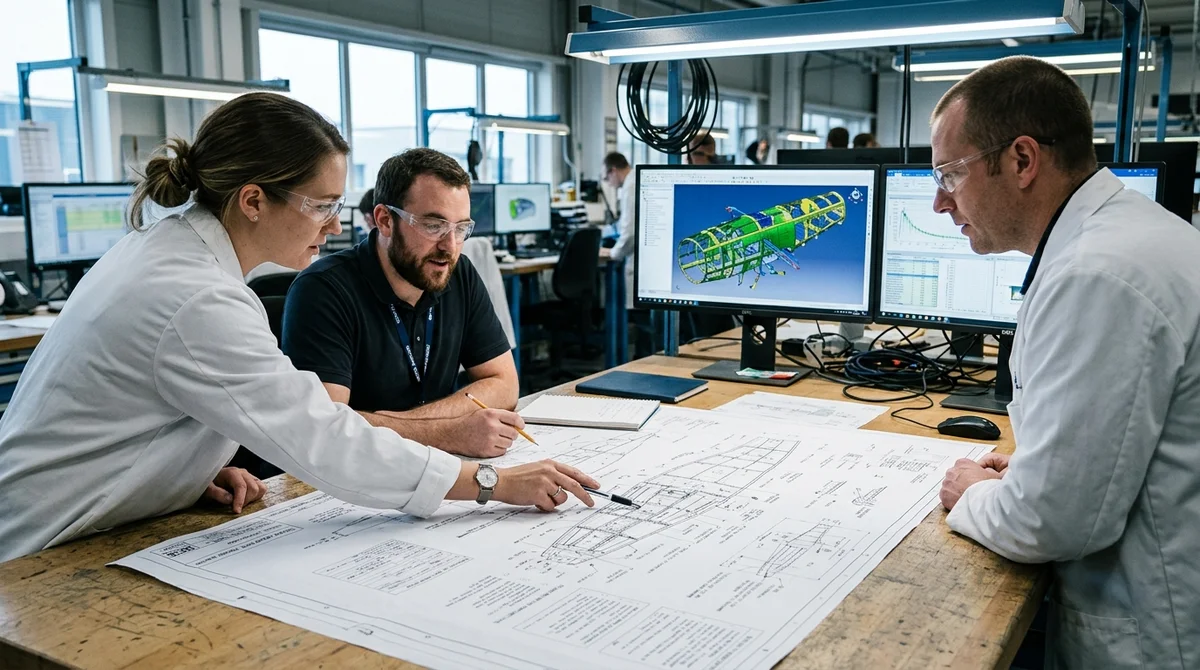
Prometheus, a startup linked to Jeff Bezos, has completed one of the largest AI rounds of 2026: the company raised $12 billion and was valued at $41 billion. Its goal is to build an "artificial general engineer" for the physical world.
What is "physical AI"?
Most modern AI systems work with text, code and images, and keep getting better at it. Prometheus is tackling a fundamentally different problem: automating the work of an engineer in a real physical environment, where a mistake costs not a lost token but a lost prototype or a halted production run.
Today, developing complex industrial equipment, designing infrastructure or creating a new drug requires teams of dozens of specialists and years of experience. The company wants to shorten that cycle with AI that can model physical constraints, predict structural failures at the design stage and generate ready-to-use engineering solutions.
The name "artificial general engineer" (AGEng), which Prometheus uses, deliberately echoes the term AGI. The difference matters: if AGI is general intelligence for intellectual work, AGEng is a general-purpose executor for tasks with real material constraints: mass, strength, temperature, chemical properties and regulatory requirements.
Two key focus areas
Prometheus has concentrated on two applications:
- Heavy engineering — automating the design of industrial equipment, production lines and infrastructure. Here the AI must understand physics, materials science and industry standards.
- Drug development — speeding up medical research by modeling molecules, predicting compound efficacy and analyzing clinical data.
- Digital twins — building accurate simulations to test prototypes without physical production. The cost of errors drops by an order of magnitude.
- Production optimization — engineering analysis of supply chains and technological processes to identify bottlenecks.
Both core markets are enormous: the global engineering services market exceeds $1 trillion, and pharmaceuticals bring in about $1.5 trillion a year. If Prometheus manages to automate even 20–30% of routine engineering work, the return on the $12 billion invested could be a multiple within a few years.
Why Bezos's bet makes sense
Jeff Bezos's involvement in Prometheus is no accident. The founder of Amazon and Blue Origin has always bet on physical infrastructure, not only on software products. Amazon was built around logistics, robotic warehouses and complex supply chains. Blue Origin is built around rocket engines, control systems and life support.
Physical AI is the next step in the same logic: automating not the writing of code but engineering thinking itself, the ability to see a physical system as a whole and design its improvement.
A $41 billion valuation for a product that has not yet reached the market is a bet on market potential, not on current revenue. For context: OpenAI is valued at around $300 billion, Anthropic at about $60 billion. With a significantly narrower niche, Prometheus is already close to Anthropic's level, which says something about investors' expectations for the scale of the physical AI market.
The competitive context matters: several startups work on physical AI, from humanoid robot makers to molecular design labs. But Prometheus is betting on a different level of abstraction: not narrow automation of a specific task, but a general engineering system as such.
What this means
The Prometheus round signals the next wave of AI investment. After the boom in "soft AI" (chatbots, text and image generators), capital is starting to flow toward "hard" AI: systems that can work within real physical constraints and answer for a material result.
For industry and pharmaceuticals, this could potentially mean a radical reduction in development cycles over the next decade. For engineers, it means a transformation of the very content of the profession. That is why $12 billion is not just a large round but a signal of where the next stage of AI development is heading.
- Nov 1, 2026OpenAI Rewrites GPT Behavior Rules: Five Values and a Chain of Command
- Nov 1, 2026Google admits AI Mode cuts search revenue, shares fall 15%
- Oct 31, 2026Author puts his script before an AI jury: the verdict cost 850 thousand tokens
- Oct 31, 2026Anthropic: Fold Subagents Back Into a Single Loop — One Customer's Tasks Ran Twice as Fast
Key Questions Answered
What is "physical AI"?
Most modern AI systems work with text, code and images, and keep getting better at it. Prometheus is tackling a fundamentally different problem: automating the work of an engineer in a real physical environment, where a mistake costs not a lost token but a lost prototype or a halted production run. Today, developing complex industrial equipment, designing infrastructure or creating a new drug requires teams of dozens of specialists and years of experience. The company wants to shorten that cycle with AI that can model physical constraints, predict structural failures at the
What are the key details on Two key focus areas?
Prometheus has concentrated on two applications: Heavy engineering — automating the design of industrial equipment, production lines and infrastructure. Here the AI must understand physics, materials science and industry standards. Drug development — speeding up medical research by modeling molecules, predicting compound efficacy and analyzing clinical data. Digital twins — building accurate simulations to test prototypes without physical production. The cost of errors drops by an order of magnitude. Production optimization — engineering analysis of supply chains and techno
Why Bezos's bet makes sense?
Jeff Bezos's involvement in Prometheus is no accident. The founder of Amazon and Blue Origin has always bet on physical infrastructure, not only on software products. Amazon was built around logistics, robotic warehouses and complex supply chains. Blue Origin is built around rocket engines, control systems and life support. Physical AI is the next step in the same logic: automating not the writing of code but engineering thinking itself, the ability to see a physical system as a whole and design its improvement. A $41 billion valuation for a product that has not yet reached
Test Frontier LLMs & Autonomous Agents in One Workspace
Run Claude Opus 5.5, GPT-6, Gemini 3.1, and DeepSeek side-by-side in Nomad AI (nomadnet.ai) — unified model routing, deep research, and multimodal workflows under one subscription.
The AI world, distilled — once a week
Seven stories that actually mattered, hand-picked. No noise, no reposts, no press releases.
Done! Check your inbox for a confirmation.