Jeff Bezos seeks $100 billion for Project Prometheus — an AI startup for industry
Jeff Bezos is seeking funding for Project Prometheus, an AI startup focused on industrial sectors. The amount in question is up to $100 billion, and the project’s core idea is to use AI where speed, precision, and lower costs matter. If the round goes through, it will become one of the most ambitious bets on industrial AI and a signal that big money is moving into the real economy.
AI-processed from 3DNews AI; edited by Hamidun News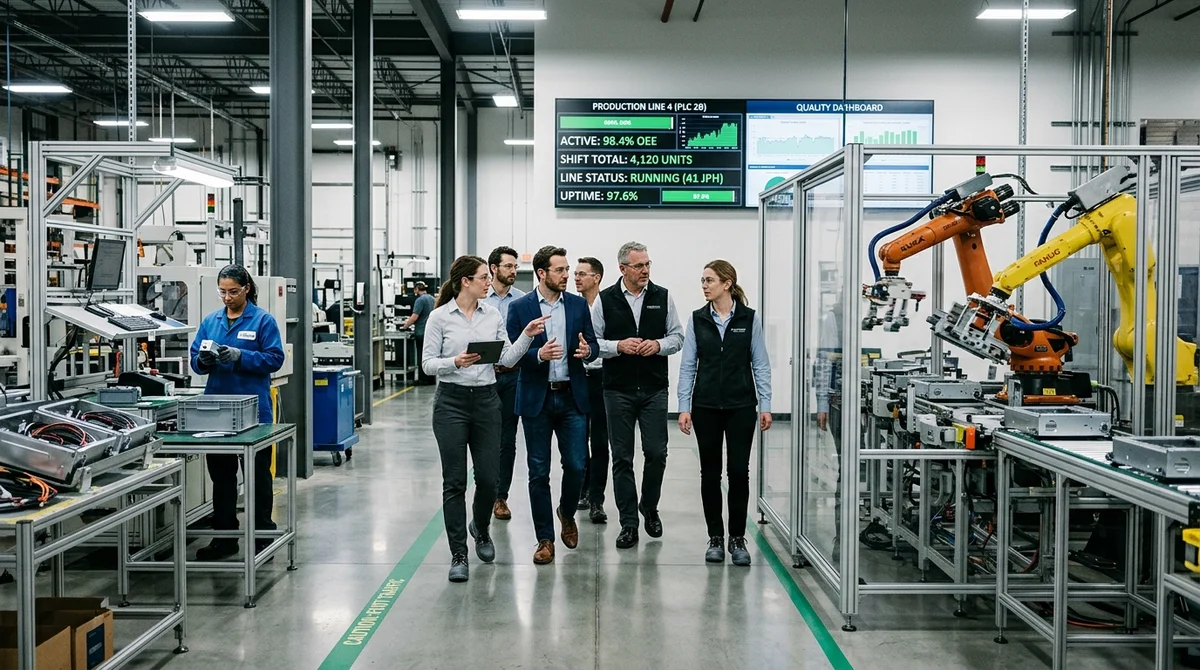
Jeff Bezos is seeking up to $100 billion to develop Project Prometheus — a startup that plans to apply artificial intelligence in manufacturing. Judging by the project's description, the bet is not on yet another office chatbot, but on tools designed to improve the efficiency of real industries.
What Bezos is betting on
Project Prometheus is associated with the idea of deploying AI across various industrial segments, where results are measured not by the number of generated texts, but by process speed, operational precision, and reduction of losses. For this kind of approach, what matters is not only the models, but also access to data, integration with equipment, enterprise digital systems, and management layers.
If the project is truly aimed at several industries simultaneously, it will have to operate at the intersection of software, infrastructure, and industrial expertise. Bezos has long been associated with projects requiring a long investment logic and the willingness to build platforms with extended payback horizons. In the case of Project Prometheus, this is especially evident: industrial AI rarely develops along the trajectory of fast consumer applications. What matters more here is reliability, predictability, compatibility with existing processes, and the ability to demonstrate economic impact not in a demo, but on the shop floor, in a warehouse, or in a supply chain.
That is precisely why such a project requires not only a strong brand, but also very serious capital. Context matters here too. The founder of Amazon and Blue Origin does not come from the world of narrow AI experiments, but from an environment where competitive advantage is built on operational efficiency, automation, and scale. For the market, this makes Project Prometheus not merely a venture idea, but an attempt to turn AI into a tool of industrial discipline: fewer downtime incidents, higher process accuracy, better resource utilization, and a clearer economics of implementation in the day-to-day operations of enterprises.
Why the amount matters
The $100 billion threshold immediately places Project Prometheus in the category of projects with nearly government-scale ambitions. Even if this does not mean closing the entire volume in a single round, but rather raising capital sequentially, the figure itself shows that Bezos regards industrial AI as an infrastructure bet. Such funds may be needed not only for model development, but also for the team, computing resources, on-site deployment, and a long sales cycle with large corporate clients. Among the likely focus areas:
- automation of manufacturing operations
- optimization of logistics and supply
- quality control and defect reduction
- forecasting of load, maintenance, and downtime
- improved planning accuracy in complex supply chains
This particular set of tasks is typically considered the most grounded and the most lucrative scenario for AI. Enterprises are willing to pay where defects can be reduced, production accelerated, demand more accurately forecast, or equipment downtime minimized. But the barrier to entry here is also higher than in consumer software: integrations are required, training on domain-specific data is needed, alignment with safety standards is necessary, and there must be readiness to support solutions in a mode close to critical infrastructure.
In practice, this is one of the most difficult segments for AI companies. It is not enough to build a strong model — one must integrate into existing processes, prove the safety of solutions, demonstrate measurable return on investment, and meet the conservative requirements of large enterprises. This is why Bezos's interest in this format looks logical: if the bet pays off, the winner will not be an individual application, but an entire layer of industrial infrastructure where the economic impact is usually visible faster than in consumer scenarios.
What this means
The story of Project Prometheus shows where the big game around AI is shifting: from showcase products to heavy industry systems. If Bezos manages to raise such capital, the market will receive a strong signal that the next major investment cycle may unfold not only around assistants and content generation, but also around factories, logistics, and operational efficiency.
Want to stop reading about AI and start using it?
AI News is a curated feed of AI/tech news. Hamidun Academy teaches you to use AI systematically in your work.
The AI world, distilled — once a week
Seven stories that actually mattered, hand-picked. No noise, no reposts, no press releases.
Done! Check your inbox for a confirmation.