OpenAI launches a platform to study AI's impact on the economy and labor market
OpenAI has launched the Economic Research Exchange, a dedicated platform for independent research on how artificial intelligence affects the economy, employment and labor productivity. The company is looking for scholars and researchers willing to analyze AI's real-world effects on the labor market, wage levels and regional economic growth. Applications are already open for selected projects.
AI-processed from OpenAI Blog; edited by Hamidun News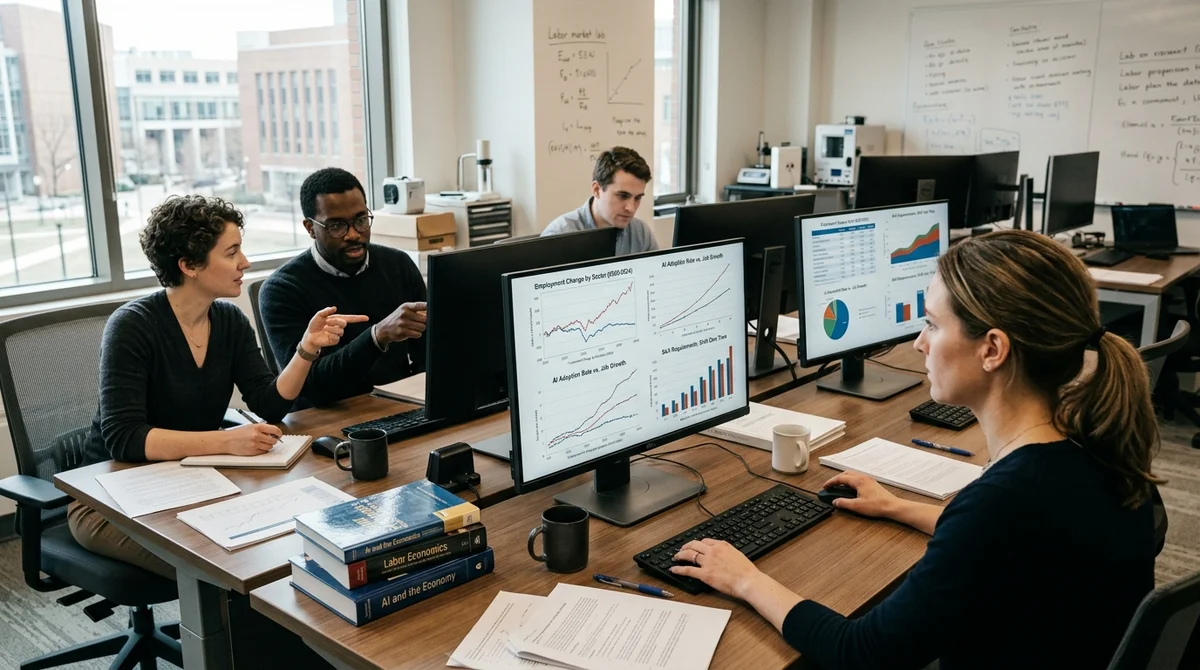
OpenAI has launched the Economic Research Exchange, a platform for studying the real impact of AI on the economy, employment and labor productivity. It is the company's first major initiative aimed at giving researchers the resources they need to study the effects of modern AI on economic systems. Applications are open now for selected research projects.
Why economic research is critical right now
Questions about how AI will affect work and economic growth are no longer theoretical prophecies. They are a practical reality that companies, workers and governments face every day. As AI spreads quickly through manufacturing, call centers, offices and logistics, there is surprisingly little objective data on the scale of these effects. OpenAI has decided to invest in independent science to get an objective understanding of what is happening.
The company recognizes that the long-term development of AI depends not only on technology, but also on public trust, sound policy and social consensus. And policy and social consensus should rest on facts, not on fears, rumors or hasty assumptions.
How the program works and what it covers
The Economic Research Exchange gives selected researchers access to funding, computing resources and data for projects in several key areas:
- The impact of AI on the labor market, employment and wage levels
- Labor and capital productivity
- Innovation, competitiveness and economic growth
- How the gains from automation are distributed across different layers of society
- Education, retraining and adapting to a new world
- Regional effects and deepening inequality
Selected researchers receive not only grants but also direct access to OpenAI's models, cloud computing and collaboration with the company's internal team. This removes the main obstacle to high-quality independent research: the lack of real access to tools and data.
What it means for policy and business
Until now, most analyses of AI's impact on the economy have relied either on extrapolating historical data from other technology waves (electricity, the internet, mobile) or on small pilot projects. The Economic Research Exchange will let scholars work with large, current datasets, build realistic models and offer well-founded recommendations to policymakers and business.
This matters especially now. Governments are making decisions on AI regulation without full information about the economic consequences. Corporations decide where to invest in automation based on intuition rather than data. Workers and students fear their skills will lose relevance. All of these critical decisions are being made under high uncertainty.
At stake is how society will distribute the gains from AI: among countries, companies, workers and owners of capital.
Objective research can help society arrive at an adequate and fair answer to this challenge.
What this means for the ecosystem
OpenAI is signaling that major AI companies are starting to see the economic and social consequences as an integral part of their responsibility. For researchers, it is a rare chance to get the resources and access for large-scale work. For society, it is an opportunity to get objective data before the effects of AI on the labor market become irreversible.
- Nov 2, 2026Meta's Muse assistant keeps dossiers on loved ones and gets root on Ubuntu by default
- Nov 1, 2026Local models lose to Opus and Codex: 0.21 on a MacBook versus 1.00 for Codex
- Nov 1, 2026Kimi scores 96.2% on a 1C database analytics test and emerges as a fallback if Claude access is blocked
- Nov 1, 2026OpenAI Rewrites GPT Behavior Rules: Five Values and a Chain of Command
Key Questions Answered
Why economic research is critical right now?
Questions about how AI will affect work and economic growth are no longer theoretical prophecies. They are a practical reality that companies, workers and governments face every day. As AI spreads quickly through manufacturing, call centers, offices and logistics, there is surprisingly little objective data on the scale of these effects. OpenAI has decided to invest in independent science to get an objective understanding of what is happening. The company recognizes that the long-term development of AI depends not only on technology, but also on public trust, sound policy a
How the program works and what it covers?
The Economic Research Exchange gives selected researchers access to funding, computing resources and data for projects in several key areas: The impact of AI on the labor market, employment and wage levels Labor and capital productivity Innovation, competitiveness and economic growth How the gains from automation are distributed across different layers of society Education, retraining and adapting to a new world Regional effects and deepening inequality Selected researchers receive not only grants but also direct access to OpenAI's models, cloud computing and collaboration
What it means for policy and business?
Until now, most analyses of AI's impact on the economy have relied either on extrapolating historical data from other technology waves (electricity, the internet, mobile) or on small pilot projects. The Economic Research Exchange will let scholars work with large, current datasets, build realistic models and offer well-founded recommendations to policymakers and business. This matters especially now. Governments are making decisions on AI regulation without full information about the economic consequences. Corporations decide where to invest in automation based on intuition
Test Frontier LLMs & Autonomous Agents in One Workspace
Run Claude Opus 5.5, GPT-6, Gemini 3.1, and DeepSeek side-by-side in Nomad AI (nomadnet.ai) — unified model routing, deep research, and multimodal workflows under one subscription.
The AI world, distilled — once a week
Seven stories that actually mattered, hand-picked. No noise, no reposts, no press releases.
Done! Check your inbox for a confirmation.