NVIDIA Unveiled Tool for Generating 3D Medical Images
NVIDIA released NV-Generate-CTMR for synthesis of realistic 3D CT and MRI images. On the MR-RATE dataset (700 thousand volumes from 83 thousand patients), the system creates medical images with anatomical accuracy. MAISI-v2 runs 33 times faster, helping train more generalized diagnostic models.
AI-processed from NVIDIA Developer Blog; edited by Hamidun News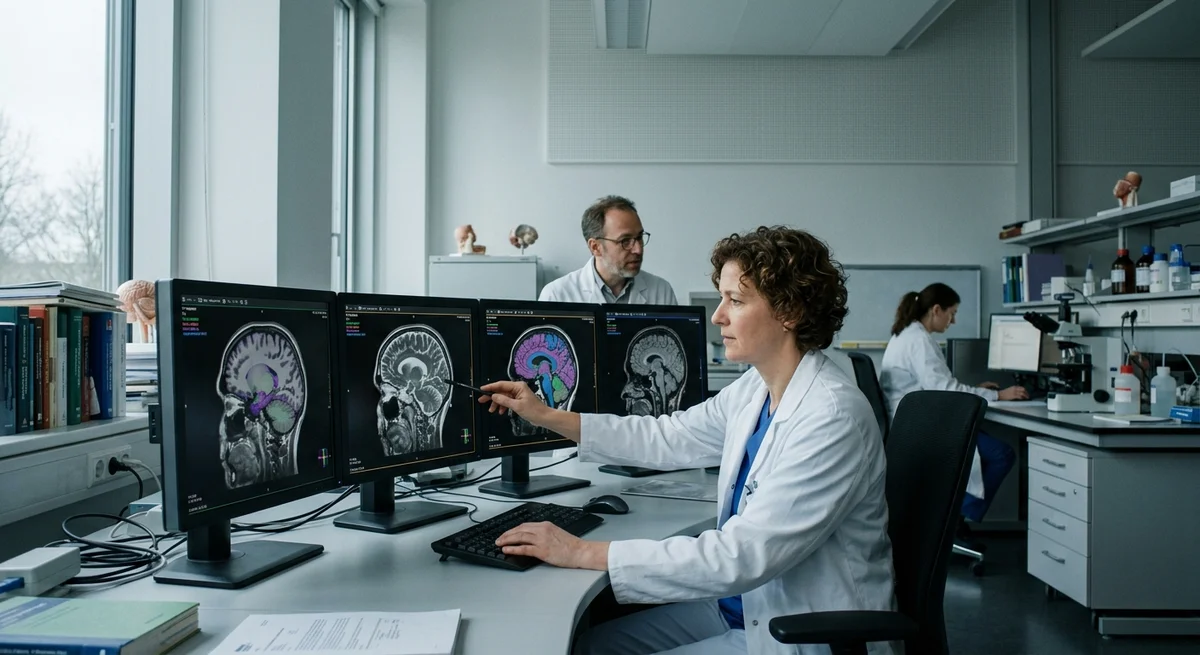
NVIDIA presented NV-Generate-CTMR — an open framework for synthesizing realistic 3D medical images. This solution relies on a new MR-RATE dataset — the largest open collection of multimodal brain MRI studies.
Data Shortage Problem
High-quality data for AI in radiology is a bottleneck in the development of diagnostic systems. Main challenges include limited availability of datasets, patient privacy compliance, and high cost of specialist annotation. Models trained on narrow data generalize poorly and fail to work on different scanner types and clinical protocols. As a result, developers spend long months collecting tens of thousands of images, negotiating access with hospitals, and coordinating with regulators. This freezes development for months.
How NVIDIA NV-Generate Works
The framework is based on two variants of the MAISI architecture: MAISI-v1 uses latent diffusion probabilistic models for diverse generation. MAISI-v2 applies Latent Rectified Flow — which achieved 33x speedup in inference and improved quality. The specialized NV-Generate-MR-Brain model synthesizes brain MRI with different contrasts: T1, T2, FLAIR, and SWI. Output volumes reach up to 512 × 512 × 256 pixels. The system supports both full brain and skull-stripped images, with anatomical structure control via ControlNet modules.
"This is the first framework that allows specifying anatomical
structures in synthetic images with precise condition matching."
MR-RATE Dataset — A New Standard
The MR-RATE dataset was used for training — the largest open collection of multimodal brain MRI studies:
- 100 thousand MRI studies
- 83+ thousand unique patients
- 700 thousand 3D volumes
- De-identified radiology reports and clinical data
This scale allows models to learn from real-world diversity of scanners, protocols, and pathologies — from healthy structures to rare tumors.
Advantages for Developers
The framework is flexible: a single model works with different resolutions, volume sizes, and region coverage. It doesn't require retraining for each scanner in a clinic. Efficiency: fine-tuning requires less computation than training from scratch. MAISI-v2's speed is comparable to leading video generation models. External researchers have already applied these models for anomaly detection, lung cancer classification, prostate lesion identification, and cross-modality synthesis.
What This Means
Synthetic medical images are becoming a practical tool for industry. Clinics and medtech startups can now train robust AI models without waiting for massive datasets and patient privacy approvals. As medicine becomes increasingly personalized and multimodal, scalable data generation is becoming a critical competitive advantage.
Need AI working inside your business — not just in your newsfeed?
I build production AI for companies — custom CRM, internal tools, autonomous agents, workflow automation. Owned by you, shaped to your process, no per-seat tax. Built by Zhemal Khamidun, CPO of AlpinaGPT (AI platform, 6,000+ users).
The AI world, distilled — once a week
Seven stories that actually mattered, hand-picked. No noise, no reposts, no press releases.
Done! Check your inbox for a confirmation.