AWS Deployed AI Agents to Optimize Radiologists' Workflows
AWS demonstrated how AI agents solve the main problem in radiology: traditional systems don't account for a physician's specialization, fatigue, and case complexity. Radiologists choose easier tasks, while complex studies are delayed. Analysis of 2.2 million images from 62 hospitals confirmed the effectiveness of the new system.
AI-processed from AWS Machine Learning Blog; edited by Hamidun News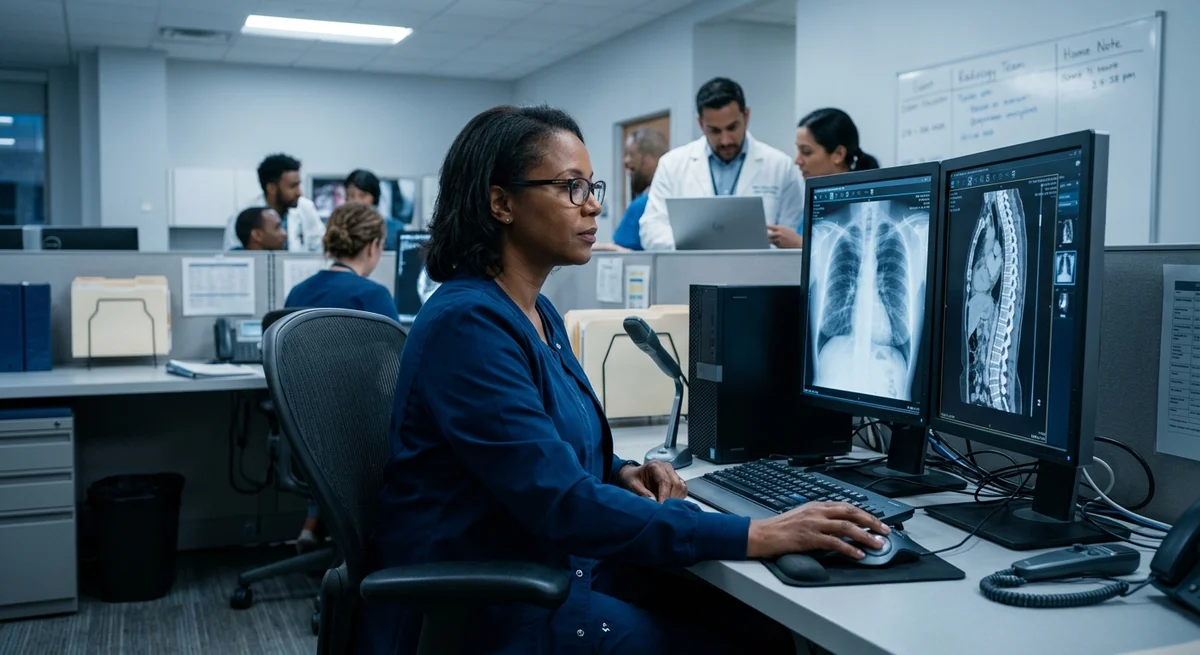
AWS presented a solution for optimizing workflows in radiology using AI agents. Instead of rigid rules, the system now accounts for multiple contextual factors that directly impact diagnostic quality and hospital economics.
Why Existing Systems Fail
Traditional worklist systems are built on simple rules: study urgency, arrival time, and equipment type. But they ignore what actually impacts productivity and diagnostic quality.
Consider a concrete example. A radiologist might be a narrow specialist in chest CT with twenty years of experience, but the system assigns him an MRI of the spine. Another physician is exhausted after eight hours of maximum workload, but the system doesn't see this. A complex case with rare pathology requires an experienced consultant, but the system picks the first available physician.
The result is predictable: radiologists redistribute the work themselves. They choose simpler studies (which are resolved quickly), avoid complex cases, and postpone urgent but labor-intensive images. This creates diagnostic delays for patients with truly serious diagnoses and increases hospital costs for rework and errors.
How AI Agents Solve the Problem
AWS AI agents analyze far more variables with each assignment:
- Specialization and competency of each radiologist — their certifications, average accuracy across different types of studies
- Physician's state — fatigue based on shift history, time since last break, risk of errors when overworked
- Case complexity — not just the diagnosis, but the rarity of the pathology, required skills, patient urgency
- Execution time statistics — how many minutes the physician typically spends on similar studies
- Workload balance — current and planned workload for each specialist
AI agents reconfigure the worklist in real time, assigning each study to the optimal physician at the optimal moment. The system learns from diagnostic outcomes and adjusts its decisions accordingly.
Results from Real Data
AWS analyzed the work of 62 hospitals and more than 2.2 million studies. Hospitals that implemented AI agents for work distribution reported a significant reduction in average diagnostic wait time — from when a study enters the system to when the report is issued. Workload was distributed more evenly among specialists, reducing burnout among radiologists. Diagnostic quality did not decline. On the contrary, physicians work with cases more suited to them and are in better form when called to handle complex cases. The economic effect is twofold: reducing time wasted on rework and reassignment, and decreasing errors related to misassigning complex cases to inexperienced physicians.
What This Means
AI agents in healthcare are transitioning from experiments to mass implementation. A system that understands the context of a physician's work as well as the physician does opens a new level of productivity. This is not a replacement for the physician — it's a tool that respects his time, his specialization, and his human nature. For hospitals, it means savings; for patients — faster diagnostics; for physicians — fair work distribution and recovery of work-life balance.
Want to stop reading about AI and start using it?
AI News is a curated feed of AI/tech news. Hamidun Academy teaches you to use AI systematically in your work.
The AI world, distilled — once a week
Seven stories that actually mattered, hand-picked. No noise, no reposts, no press releases.
Done! Check your inbox for a confirmation.