Lithuania becomes second EU country to approve Tesla's Full Self-Driving, with Greece and Belgium next in line
Tesla has won approval to launch Full Self-Driving (Supervised) in Lithuania. It is the second EU country to allow the system, just weeks after the Netherlands issued the first approval. Lithuania's transport safety authority accepted the Dutch RDW certification instead of running its own independent review, which sped up the process. Greece and Belgium are already in the queue for approval.
AI-processed from TNW; edited by Hamidun News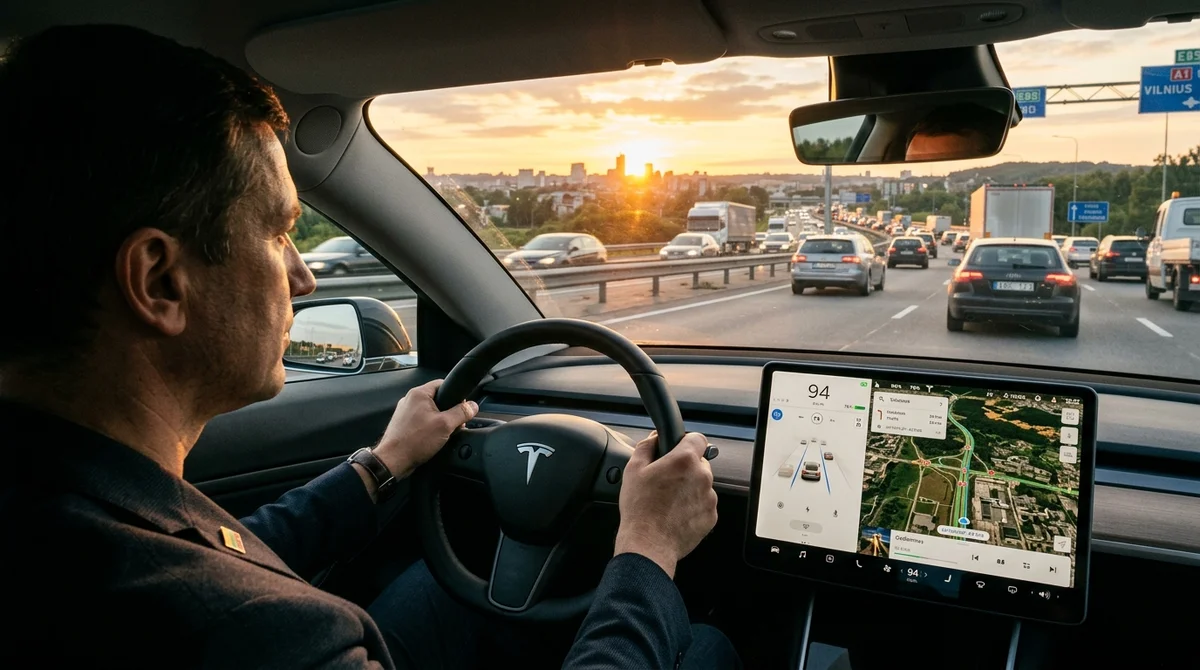
Tesla has secured approval for Full Self-Driving in Lithuania, making it the second European Union country where the technology has been cleared for mass use.
Lithuania joins the Netherlands
Lithuania's transport safety authority officially approved Full Self-Driving (Supervised) this week on Tuesday, the second link in Tesla's expansion chain across the European Union. It came just weeks after the Netherlands became the first EU country to permit Tesla's advanced autopilot.
The approval process in Lithuania moved noticeably faster because Lithuanian regulators formally accepted and recognized the certification of the Dutch agency RDW, rather than demanding and carrying out their own full, independent review. This approach, based on mutual recognition of certifications and harmonized requirements within the EU, saves considerable time and resources and lets other countries follow the Netherlands' example more quickly.
A wave of expansion across the EU
Lithuania is far from the end of the story. Greece is already actively preparing its own approval and is set to become the third EU country to permit Full Self-Driving. Belgium is in the queue behind Greece. This strategic sequence of approvals reveals Tesla's plan for the European market:
- Start with smaller regulatory environments that are more open to innovation
- Prove the technology's safety and reliability in practice
- Expand gradually into larger and more demanding markets
- Avoid complicated battles with France and Germany
- Create a precedent for other developers of autonomous systems
This approach lets the company advance strategically while it demonstrates successful deployment in less competitive territories. The quick approvals in the Netherlands and Lithuania show that European regulators are ready to accept Tesla FSD, provided the company proves its technology is safe. Mutual recognition of certifications between EU countries can significantly speed up regulatory procedures.
What Full Self-Driving (Supervised) can do
Full Self-Driving lets Tesla vehicles perform complex driving tasks in real traffic on public roads. The system can change lanes, avoid obstacles, handle turns and U-turns, and even park on its own, based on real-time analysis of the road situation.
However, the (Supervised) designation underlines a critical difference: the driver remains fully responsible for safety and must stay attentive at all times, ready to take control at any moment. Tesla positions FSD not as a fully autonomous mode but as an advanced driver-assistance system that requires active driver involvement. For Tesla owners in the Netherlands, and soon in Lithuania, this means access to one of the most advanced driver-assistance systems on the consumer market.
What this means
The expansion of Tesla Full Self-Driving across EU countries shows growing trust in autonomous technology within the European regulatory community. The quick approval in Lithuania suggests that regulatory hurdles in Europe are becoming less rigid when a company convincingly demonstrates the safety of its technology. This may open doors for other autonomous vehicle developers that previously met stiff resistance from European regulators.
The FSD expansion is not just a commercial move for Tesla, but an important signal for the entire autonomous driving industry.
- Nov 1, 2026Google's StreamVibe video agent beats other models by 10.7% on response timing and quality
- Nov 1, 2026New test catches hidden AI agent collusion by measuring how a partner reacts to a paraphrase
- Nov 1, 2026Illinois compiled 12 151 open problems and tested whether AI can solve them
- Oct 31, 2026AI engineer writes a single reward function for agent teams: win rate climbs from 51% to 90%
Key Questions Answered
What are the key details on Lithuania joins the Netherlands?
Lithuania's transport safety authority officially approved Full Self-Driving (Supervised) this week on Tuesday, the second link in Tesla's expansion chain across the European Union. It came just weeks after the Netherlands became the first EU country to permit Tesla's advanced autopilot. The approval process in Lithuania moved noticeably faster because Lithuanian regulators formally accepted and recognized the certification of the Dutch agency RDW, rather than demanding and carrying out their own full, independent review. This approach, based on mutual recognition of certif
What are the key details on A wave of expansion across the EU?
Lithuania is far from the end of the story. Greece is already actively preparing its own approval and is set to become the third EU country to permit Full Self-Driving. Belgium is in the queue behind Greece. This strategic sequence of approvals reveals Tesla's plan for the European market: Start with smaller regulatory environments that are more open to innovation Prove the technology's safety and reliability in practice Expand gradually into larger and more demanding markets Avoid complicated battles with France and Germany Create a precedent for other developers of autono
What Full Self-Driving (Supervised) can do?
Full Self-Driving lets Tesla vehicles perform complex driving tasks in real traffic on public roads. The system can change lanes, avoid obstacles, handle turns and U-turns, and even park on its own, based on real-time analysis of the road situation. However, the (Supervised) designation underlines a critical difference: the driver remains fully responsible for safety and must stay attentive at all times, ready to take control at any moment. Tesla positions FSD not as a fully autonomous mode but as an advanced driver-assistance system that requires active driver involvement.
Test Frontier LLMs & Autonomous Agents in One Workspace
Run Claude Opus 5.5, GPT-6, Gemini 3.1, and DeepSeek side-by-side in Nomad AI (nomadnet.ai) — unified model routing, deep research, and multimodal workflows under one subscription.
The AI world, distilled — once a week
Seven stories that actually mattered, hand-picked. No noise, no reposts, no press releases.
Done! Check your inbox for a confirmation.