OlmoEarth v1.1: Allen AI Releases Satellite Models 3 Times Cheaper
Allen AI has released OlmoEarth v1.1 — a new family of models for analyzing satellite data. The main achievement: computational costs have been reduced by 3 times while fully maintaining quality. The technical innovation lies in a redesign of the satellite imagery tokenization algorithm. The models are already working on real projects: tracking forest loss, monitoring mangrove forests, and identifying agricultural crop types worldwide.
AI-processed from Hugging Face Blog; edited by Hamidun News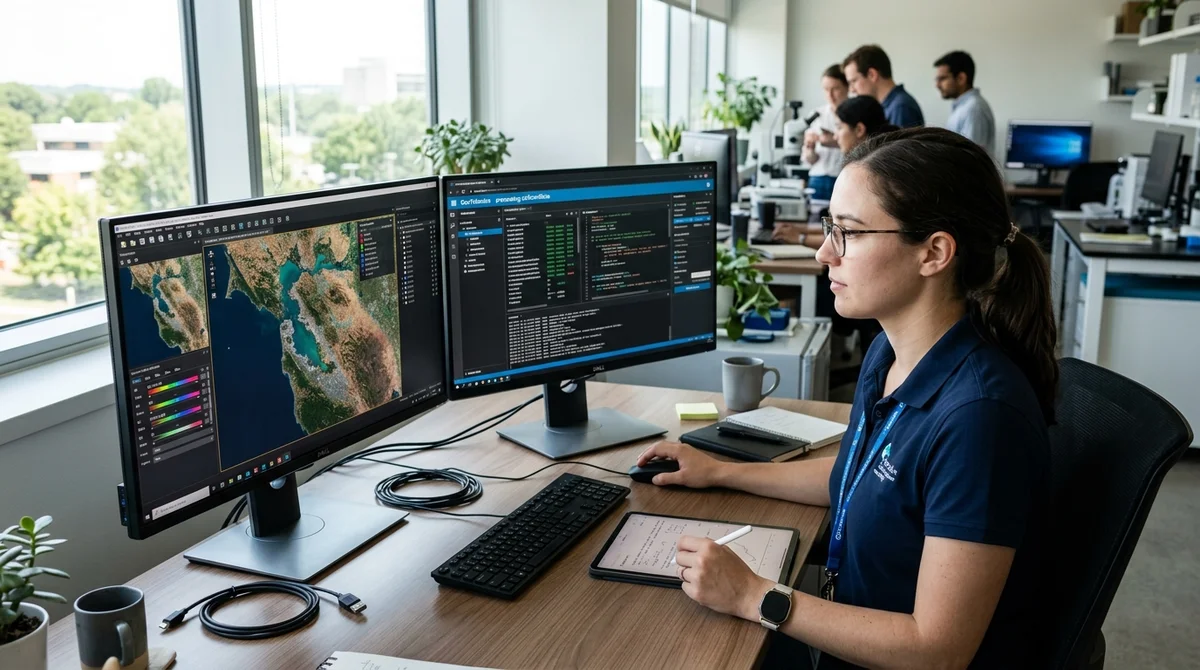
Allen AI presented OlmoEarth v1.1 — an updated family of transformer models for analyzing Sentinel-2 satellite imagery. The main result: computational costs have dropped by 3 times, while the quality of operation remains at the level of the previous version.
How Efficiency Changed
OlmoEarth v1 was released in November 2025 and immediately attracted the attention of researchers and developers. The model worked well: accurate classification of forest imagery, reliable determination of crop types, monitoring of mangrove forests. But there was a bottleneck — the computational cost of inference was a significant barrier to deployment in countries with limited budgets.
OlmoEarth v1.1 is available in three sizes: Base, Tiny, and Nano. Allen AI managed to maintain performance while significantly reducing computational costs. This will make the model more accessible to companies and research groups that want to frequently update satellite maps of the planet.
Technical Solution: Tokenization Redesign
The key to efficiency is how satellite data is encoded into tokens for the transformer. In the original OlmoEarth v1, each satellite resolution (there were three: 10m, 20m, and 60m) was encoded separately.
Sentinel-2 data has dimensions [H, W, T, D=12], where H and W are spatial dimensions, T is the number of temporal steps, and D is the number of spectral bands. For each image patch and each moment in time, 3 separate tokens were generated.
Allen AI redesigned the approach radically: all resolutions are now merged into one token per patch per time step. This immediately reduced the token volume by 3 times. This is critical for transformers because their computational costs grow quadratically with sequence length — half as many tokens equals four times less memory and time.
But there was a risk. When the team first simply merged the tokens, quality dropped by 10 percentage points on the m-eurosat test (land type recognition). Raw merging of different spectral bands destroyed relevant relationships in the data.
Allen AI solved the problem by redesigning the pretraining methodology. The model now trains on a single token but preserves understanding of relationships between different spectral bands despite their merging.
What the Results Look Like in Practice
Inference on OlmoEarth v1.1 runs 70% cheaper and faster than on the original version. For developers, this means: less to pay cloud providers for GPU, faster map updates, cheaper experimentation with new datasets.
For researchers, the new version is valuable in a different way. This is a controlled experiment: only one thing changes — token design, everything else (datasets, training approach, core architecture) remains unchanged. Such experiments help understand which components are truly critical:
- Which aspects of transformer architecture impact results
- How pretraining dataset quality affects performance
- Which pretraining methods are most effective
- How to balance between model size and quality
What's Next
The models are already deployed in real projects around the world. Partner companies use OlmoEarth for tracking forest degradation in the tropics, monitoring mangrove forest changes, and identifying agricultural crop types. Each of these applications is critical for conservation and land use planning.
Allen AI has made publicly available not only the models but also the code for training the model. This allows researchers to reproduce the results, fully understand the details of the pretraining methodology, and develop their own architectural variations based on the published approach. Models are available in three sizes (Base, Tiny, Nano), which allows choosing the optimal compromise between quality and speed for a specific task.
What This Means
Satellite AI is transitioning from a narrow research area into a widely applicable tool. Cheaper equals more accessible equals faster deployment. For companies building services based on satellite data, this opens a new price category: millions of images can be processed more economically and global maps can be updated more frequently. For countries with developing economies, where environmental monitoring is critical but budgets are limited, this could be a decisive factor.
Key Questions Answered
How Efficiency Changed?
OlmoEarth v1 was released in November 2025 and immediately attracted the attention of researchers and developers. The model worked well: accurate classification of forest imagery, reliable determination of crop types, monitoring of mangrove forests. But there was a bottleneck — the computational cost of inference was a significant barrier to deployment in countries with limited budgets. OlmoEarth v1.1 is available in three sizes: Base, Tiny, and Nano. Allen AI managed to maintain performance while significantly reducing computational costs. This will make the model more acc
What are the key details on Technical Solution: Tokenization Redesign?
The key to efficiency is how satellite data is encoded into tokens for the transformer. In the original OlmoEarth v1, each satellite resolution (there were three: 10m, 20m, and 60m) was encoded separately. Sentinel-2 data has dimensions [H, W, T, D=12], where H and W are spatial dimensions, T is the number of temporal steps, and D is the number of spectral bands. For each image patch and each moment in time, 3 separate tokens were generated. Allen AI redesigned the approach radically: all resolutions are now merged into one token per patch per time step. This immediately re
What the Results Look Like in Practice?
Inference on OlmoEarth v1.1 runs 70% cheaper and faster than on the original version. For developers, this means: less to pay cloud providers for GPU, faster map updates, cheaper experimentation with new datasets. For researchers, the new version is valuable in a different way. This is a controlled experiment: only one thing changes — token design, everything else (datasets, training approach, core architecture) remains unchanged. Such experiments help understand which components are truly critical: Which aspects of transformer architecture impact results How pretraining da
Executive AI Consulting, Custom Agents & Team Workshops
Work directly with Zhemal Khamidun at hamidun.com — enterprise AI architecture, production RAG & multi-agent systems, and executive training.
The AI world, distilled — once a week
Seven stories that actually mattered, hand-picked. No noise, no reposts, no press releases.
Done! Check your inbox for a confirmation.