A Conductor Instead of an Assembly Line: How AI Is Rethinking the Classic Pipeline
The classic development pipeline breaks down when AI agents enter every stage, from product to DevOps. At each step, the AI disrupts the usual order in which results are handed off. The system has to either rebuild itself or collapse. The new model is not an assembly line but an orchestra.
AI-processed from Habr AI; edited by Hamidun News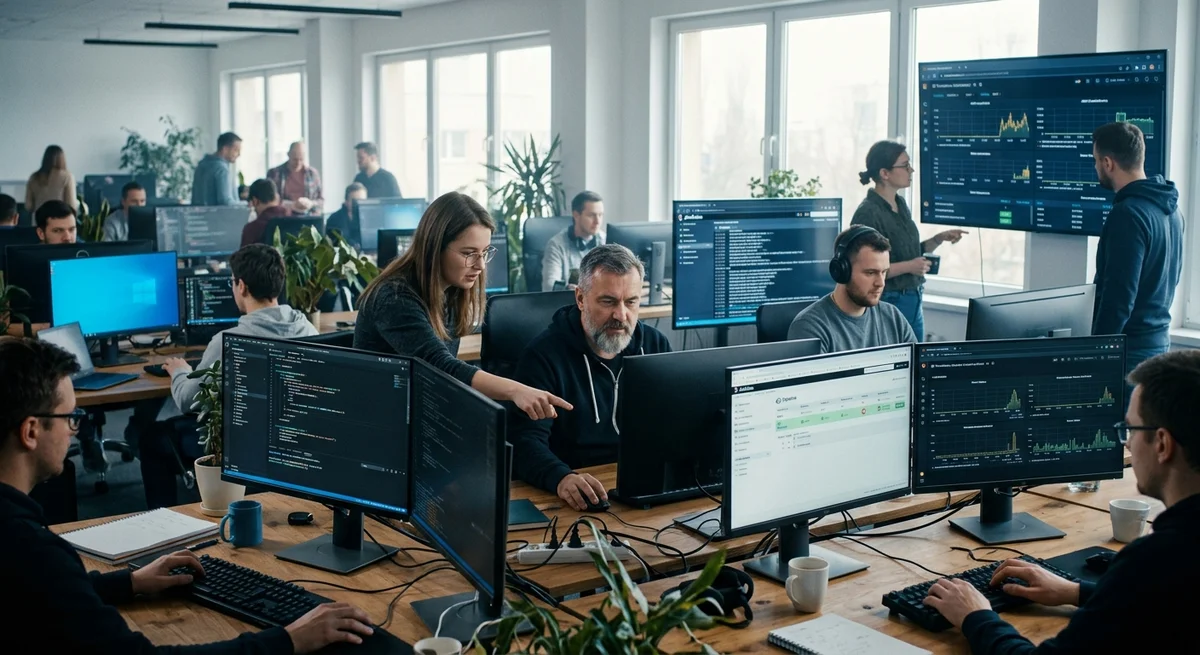
The classic development pipeline worked for 30 years. The product manager defines an idea and hands it to the analyst. The analyst writes requirements and hands them to the developer. The developer codes and hands the result to QA. QA tests and hands it to DevOps. DevOps rolls it out to production. Everyone knows their own segment, and everyone passes the result along. The belt carries the result to the user on its own.
How the pipeline worked
The system was convenient and easy to understand. Responsibility was clearly divided, so there was no confusion about who owned what. Knowledge was localized: the analyst didn't need to know the architecture, the developer didn't need to write specs, and QA didn't need to understand the business. The process as a whole was predictable: if the spec is right at the start, the code is right at the end.
But the pipeline demands two things. First, precise requirements at the start, otherwise rework hits every stage. Second, strict control at the boundaries between stages, otherwise errors slip through downstream. The system required hordes of synchronization, planning and meetings. And speed was capped by the slowest segment.
AI enters every stage
Then an AI agent arrived at every segment of the pipeline. At the product level, the agent helps formulate the idea, suggests alternative features, analyzes competitors and drafts requirements. At the analysis level, the agent studies the market, points out gaps in the requirements and argues with the product manager. At the development level, AI codes alongside the developer, suggests patterns, writes tests and catches architectural errors. At the QA level, the agent automates tests, finds edge cases and writes reports 10 times faster. At the DevOps level, AI prepares infrastructure, optimizes configuration and flags security problems.
The problem is not AI itself. The problem is that these agents know the context and the history. They see the whole document, all the code, the entire process. And they start talking to each other, bypassing the usual handoff channels. The QA agent sees the requirements and tells the developer about omissions. The developer agent argues with the analyst over interpretation. The pipeline starts to sputter because information flies everywhere instead of moving down the chain.
A conductor instead of a train driver
The old pipeline model says: do your part, hand over the result, don't ask your neighbor. The new model: AI coordinates the whole process in real time, shifts resources, takes on functions from different stages and makes decisions.
Not an assembly line. An orchestra, where the conductor (AI) directs the musicians. The conductor sees the whole process at once: spec, code, tests, deployment. If the product manager hasn't finished the spec, the conductor asks the analyst to clarify it before development starts. If the developer codes incorrectly, the conductor corrects it. If QA finds an edge case midway through development, the conductor redirects resources there.
We can't fix the pipeline, because AI has already taken the driver's seat.
What this means
The classic pipeline was efficient, but harsh. A single error in the specification meant redoing the entire chain. The new model is more flexible: AI coordinates in real time, and people focus on creative decisions and strategy rather than synchronization.
But this requires retraining. People must work alongside AI not as a subordinate with a boss, but as a musician with a conductor. It takes trust, synchronization and a new discipline. For the whole industry, this means giving up the old safety of the assembly line and embracing the new flexibility of the orchestra.
- Nov 1, 2026Local models lose to Opus and Codex: 0.21 on a MacBook versus 1.00 for Codex
- Nov 1, 2026Adobe's EditAgent judge picks a usable edit 81.3% of the time, versus 74.8% for EditScore
- Nov 1, 202616 models tested on 7 search tools: Exa averaged 10.5 out of 14, SearXNG about 3
- Nov 1, 2026Google's StreamVibe video agent beats other models by 10.7% on response timing and quality
Key Questions Answered
How the pipeline worked?
The system was convenient and easy to understand. Responsibility was clearly divided, so there was no confusion about who owned what. Knowledge was localized: the analyst didn't need to know the architecture, the developer didn't need to write specs, and QA didn't need to understand the business. The process as a whole was predictable: if the spec is right at the start, the code is right at the end. But the pipeline demands two things. First, precise requirements at the start, otherwise rework hits every stage. Second, strict control at the boundaries between stages, otherw
What are the key details on AI enters every stage?
Then an AI agent arrived at every segment of the pipeline. At the product level, the agent helps formulate the idea, suggests alternative features, analyzes competitors and drafts requirements. At the analysis level, the agent studies the market, points out gaps in the requirements and argues with the product manager. At the development level, AI codes alongside the developer, suggests patterns, writes tests and catches architectural errors. At the QA level, the agent automates tests, finds edge cases and writes reports 10 times faster. At the DevOps level, AI prepares infr
What are the key details on A conductor instead of a train driver?
The old pipeline model says: do your part, hand over the result, don't ask your neighbor. The new model: AI coordinates the whole process in real time, shifts resources, takes on functions from different stages and makes decisions. Not an assembly line. An orchestra, where the conductor (AI) directs the musicians. The conductor sees the whole process at once: spec, code, tests, deployment. If the product manager hasn't finished the spec, the conductor asks the analyst to clarify it before development starts. If the developer codes incorrectly, the conductor corrects it. If
Test Frontier LLMs & Autonomous Agents in One Workspace
Run Claude Opus 5.5, GPT-6, Gemini 3.1, and DeepSeek side-by-side in Nomad AI (nomadnet.ai) — unified model routing, deep research, and multimodal workflows under one subscription.
The AI world, distilled — once a week
Seven stories that actually mattered, hand-picked. No noise, no reposts, no press releases.
Done! Check your inbox for a confirmation.