Дефицит памяти стал главным узким местом в AI-инфраструктуре — Huang
На конференции Dell World в Лас-Вегасе CEO Nvidia Jensen Huang заявил, что дефицит высокоскоростной памяти (HBM) — самое критичное узкое место в цепи поставок д
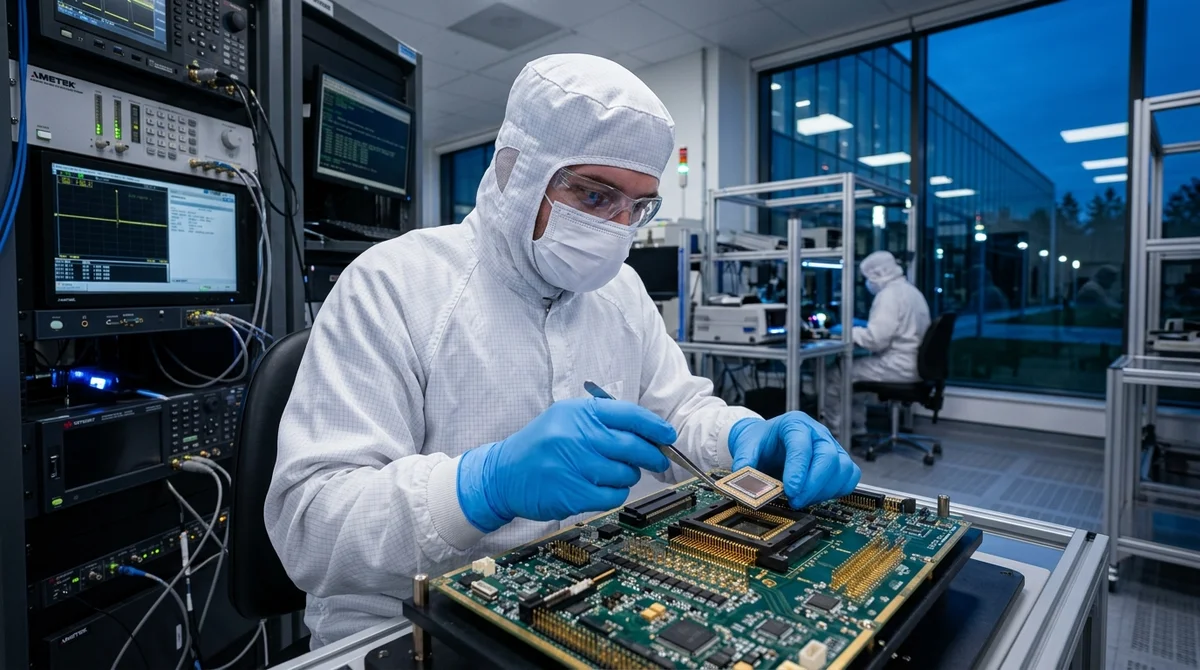
At the Dell World conference in Las Vegas, Nvidia CEO Jensen Huang raised a critical problem affecting the entire AI industry: a shortage of high-speed memory. In a conversation with Dell CEO Michael Dell and Bloomberg journalist Ed Ludlow, Huang directly stated that memory shortage has become more acute than chip manufacturing bottlenecks themselves. This is a candid acknowledgment that the pace of AI infrastructure deployment is slowing not due to a lack of GPUs themselves, but due to the inability to produce the required amount of memory.
Why Memory Became Scarce
High-speed memory HBM (High Bandwidth Memory) is a special type of memory embedded directly in the accelerator. It stores neural network parameters and intermediate computations, allowing the GPU to operate at full speed without latency from accessing slower system memory. Nvidia's H100 and H200 have between 80 and 141 gigabytes of such memory.
The problem is that demand for HBM is growing exponentially, while production isn't even keeping pace with linear growth. A year ago, major companies were ordering hundreds of GPUs; now it's about thousands; soon millions will be needed. Memory production is a multi-year technological cycle: new factories are built over five to seven years, technology becomes increasingly complex, and there are very few competitors in this segment.
Who Is Hardest Hit
The major memory producers — South Korean Samsung and SK Hynix, as well as American Micron — are struggling to keep up with demand growth. All three companies are investing tens of billions in new production capacity, but even that is not enough: the shortfall is already growing geometrically. This creates a cascade of problems throughout the supply chain:
- Prices are rising: GPUs with sufficient memory become 1.5–2 times more expensive on the secondary market
- Strategic uncertainty: companies don't know whether they will receive the required equipment in a timely manner
- Architectural compromises: forced to use narrower models, distribute computations across a larger number of GPUs
- Market stratification: those who secure memory supply contracts first will gain significant competitive advantage
Even Dell, one of the largest server integrators, is dependent on memory supplies. The company cannot sell more high-performance AI servers if there are no GPUs, and GPUs remain incomplete without sufficient memory capacity.
How the Industry Is Responding
Nvidia is actively working on new memory generations — HBM3e and HBM4 are already in development, with expected high bandwidth and performance. However, the timeline for development, qualification, and mass production of new memory standards is measured in years, not months. In parallel, the company and its partners are seeking software workarounds: software optimization, new neural network architectures that require less memory per unit of performance. But this too has strict limits — not all models can be trimmed without losing output quality.
Huang stated: this is not a short-term problem to be solved in months.
Memory shortage will remain a serious limiting factor for at least the next several years.
What This Means for the AI Industry
Memory shortage is becoming a new ceiling for the pace of AI infrastructure deployment. Not all companies will be able to deploy large language models at the necessary scale and timeframe. This creates clear market stratification: those who secure memory access first will develop faster, while those who fall behind will lag. For venture investors and startups, this means that obtaining the right equipment becomes a success factor as critical as the idea and team itself. It echoes the era of silicon shortages, when merely having chips provided competitive advantage.