Johns Hopkins builds an agentic AI system to coordinate teams of robots
Johns Hopkins Applied Physics Laboratory has unveiled an agentic AI architecture for robot teams. The LLM-based system lets different types of robots work together, coordinating on their own and adapting to tasks. The researchers have already demonstrated the architecture on real hardware, and they drew practical lessons for developing the technology further.
AI-processed from IEEE Spectrum AI; edited by Hamidun News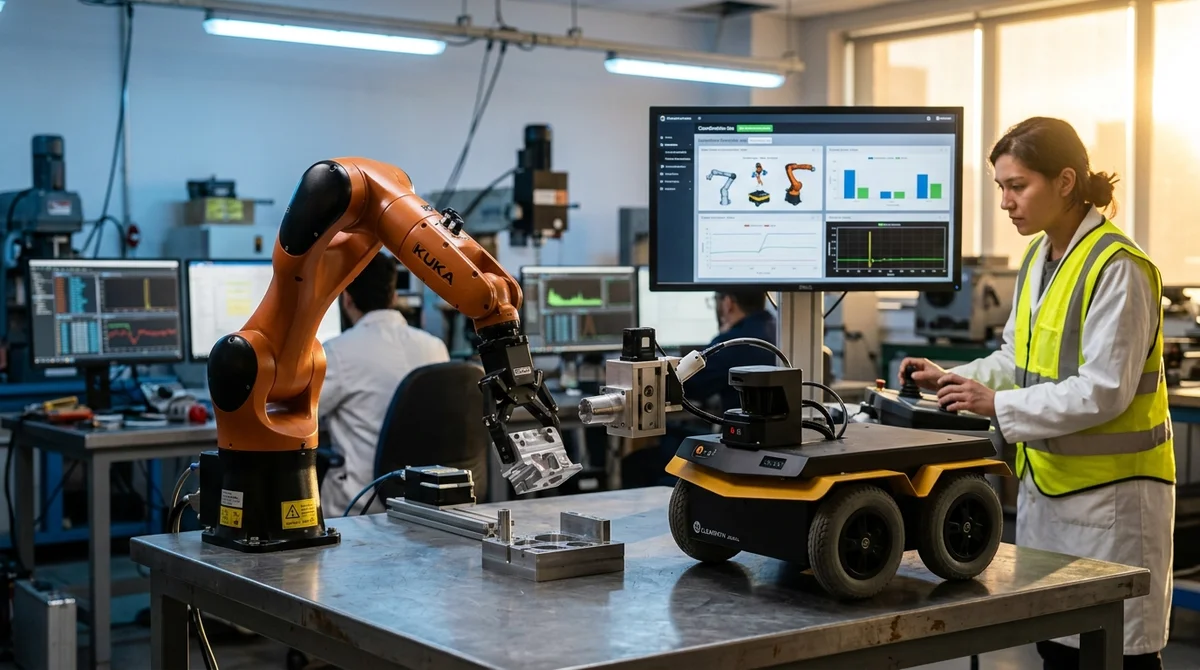
Johns Hopkins Applied Physics Laboratory (APL) has unveiled an agentic AI architecture designed specifically to coordinate teams of robots. The system is built on large language models and lets heterogeneous robots, which differ in type and capability, work together as a single organism, coordinating autonomously and adapting to unexpected situations in real time.
The problem with mixed robot teams
The difficulty is that robots in real teams are rarely identical. One is a manipulator with a gripper, another is a legged mobile platform with an array of sensors, and a third is a specialized module with a specific tool. How do you get them to act in sync when each one "speaks its own language"?
Johns Hopkins developed a scalable architecture that lets LLM agents control all of these systems as a whole. It is not just a collection of separate controllers but a genuine cognitive layer that understands the state of each robot and makes decisions for the team.
Three pillars of the system
The architecture tackles three key tasks at once.
Autonomy. Each robot gets enough "intelligence" to make decisions independently, without waiting for commands from a central node. This is critical for systems where even 100 milliseconds of network delay can cost the mission its success.
Coordination. Agents exchange information about their state, goals and obstacles in real time. When two robots need the same resource, the system mediates the conflict and picks the best path for the team as a whole.
Adaptability. When a piece of equipment fails or conditions change, the system reassigns tasks on the fly, rebuilds the plan and keeps working. It is not a rigid script but a live response to a changing world.
What an AI agent can do for a team
The researchers showed that an LLM agent in this architecture can:
- Plan for each robot individually — break the overall goal into subtasks, taking each robot's capabilities into account
- Resolve conflicts — when two robots claim the same resource, the agent chooses the optimal allocation
- Interpret sensor data — understand what exactly happened and why the plan needs adjusting
- Reassign tasks after failures — if a manipulator breaks, the agent reroutes the work to an alternative method
- Learn from mistakes — the system remembers what works and what doesn't, and adjusts its tactics
This is far from simple automation of a command sequence. It is coordination at the level of high-level decision-making. The robot does not just execute a fixed script; it reasons about context, weighs options and chooses the best path to its goal.
From theory to hardware
Johns Hopkins did not stop at simulations and theoretical models, as many academic labs do. The team actually ran its architecture on physical robots and demonstrated how the system performs in "combat conditions". This is a critically important step, because in labs AI often "works perfectly", and when theory meets reality, unexpected problems appear.
In their presentation, the researchers shared practical lessons they drew from this experience. These cover technical problems, such as network delays, asynchronous actions between components and errors in interpreting state, as well as more strategic questions about how to properly decompose a complex task for an agent.
What this means
This is a significant step toward semi-autonomous multi-robot systems that can work in real-world conditions with minimal human oversight. For now, of course, this is not about futuristic R2-D2s but about engineering teams of robots that can work on construction sites, in factories, in rescue operations, and in dangerous or inaccessible places.
If the architecture proves truly scalable (and Johns Hopkins signals confidence in the approach), we will likely see the first industrial prototypes and pilots based on it within the next two to three years.
- Nov 2, 2026DeepSeek open-sources Super-agent prototype: p95 task completion time of 15.7 minutes vs. 29.5
- Nov 2, 2026Bun creator uses Claude Code to port 750K lines from Zig to Rust in 11 days
- Nov 2, 2026Microsoft releases 4B model Mage-VL-Cowork, which solves 66.0% of OSWorld-Verified tasks
- Nov 2, 2026Meta's Muse assistant keeps dossiers on loved ones and gets root on Ubuntu by default
Key Questions Answered
What are the key details on The problem with mixed robot teams?
The difficulty is that robots in real teams are rarely identical. One is a manipulator with a gripper, another is a legged mobile platform with an array of sensors, and a third is a specialized module with a specific tool. How do you get them to act in sync when each one "speaks its own language"? Johns Hopkins developed a scalable architecture that lets LLM agents control all of these systems as a whole. It is not just a collection of separate controllers but a genuine cognitive layer that understands the state of each robot and makes decisions for the team.
What are the key details on Three pillars of the system?
The architecture tackles three key tasks at once. Autonomy. Each robot gets enough "intelligence" to make decisions independently, without waiting for commands from a central node. This is critical for systems where even 100 milliseconds of network delay can cost the mission its success. Coordination. Agents exchange information about their state, goals and obstacles in real time. When two robots need the same resource, the system mediates the conflict and picks the best path for the team as a whole. Adaptability. When a piece of equipment fails or conditions change, the sy
What an AI agent can do for a team?
The researchers showed that an LLM agent in this architecture can: Plan for each robot individually — break the overall goal into subtasks, taking each robot's capabilities into account Resolve conflicts — when two robots claim the same resource, the agent chooses the optimal allocation Interpret sensor data — understand what exactly happened and why the plan needs adjusting Reassign tasks after failures — if a manipulator breaks, the agent reroutes the work to an alternative method Learn from mistakes — the system remembers what works and what doesn't, and adjusts its tact
Test Frontier LLMs & Autonomous Agents in One Workspace
Run Claude Opus 5.5, GPT-6, Gemini 3.1, and DeepSeek side-by-side in Nomad AI (nomadnet.ai) — unified model routing, deep research, and multimodal workflows under one subscription.
The AI world, distilled — once a week
Seven stories that actually mattered, hand-picked. No noise, no reposts, no press releases.
Done! Check your inbox for a confirmation.